
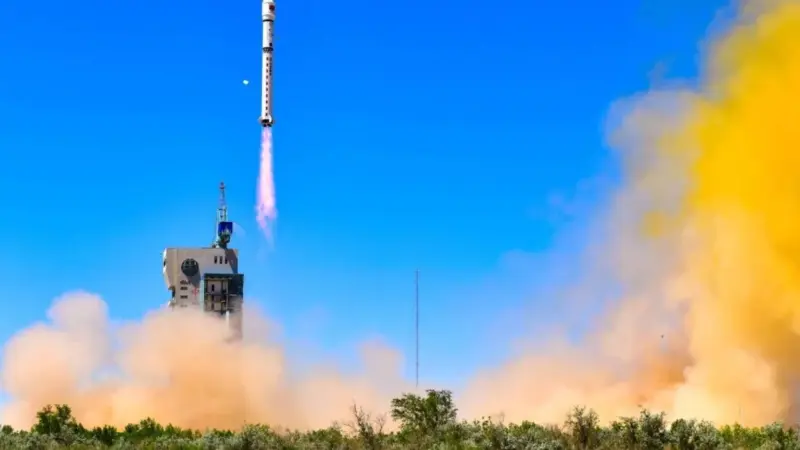

China has launched the first batch of satellites for its ambitious space computing constellation - a major technological leap that could rival the processing power of the world's most advanced ground-based supercomputers.
The Three-Body Computing Constellation by China
The satellite network, known as the Three-Body Computing Constellation, is a space-based infrastructure being developed by Zhejiang Lab, a research institute backed by the Zhejiang provincial government. Once fully operational, the constellation is projected to support real-time, in-orbit data processing at a staggering total capacity of 1,000 peta operations per second (POPS) - or one quintillion operations per second. For context, the El Capitan supercomputer at the Lawrence Livermore National Laboratory in California - named the world's most powerful supercomputer last year - achieves over 1.72 POPS."The First Substantial Flight Test"
Jonathan McDowell, a space historian and astronomer at Harvard University, described the space computing concept as part of a growing trend. "Orbital data centres can use solar power and radiate their heat to space, reducing the energy needs and carbon footprint," McDowell said. "Today's Chinese launch is the first substantial flight test of the networking part of this concept." McDowell added that in the future, "China, the United States and Europe could be expected to deploy such orbital data centres."China Addressing Earth-Based Limitations
The move comes amid rising global concerns over the sustainability of terrestrial data centres. According to the International Energy Agency, data centres worldwide could consume more than 1,000 terawatt hours of electricity annually by 2026 - an amount equivalent to Japan's entire electricity use. Cooling these Earth-based centres is another resource-intensive challenge. In 2022 alone, Google reportedly used 19.7 billion litres (5.2 billion gallons) of water to cool its data centres. Space-based computing offers a solution to these resource constraints. Traditionally, satellites collect data in space and transmit it back to Earth for processing - a method limited by bandwidth and ground station availability. Consequently, less than 10% of collected data typically reaches Earth, often after considerable delays.A Powerful Initial Network
Each of the 12 satellites launched on Wednesday can individually process up to 744 trillion operations per second. Linked by high-speed laser communication with data transfer rates up to 100 gigabits per second, the satellite network currently offers a combined computing power of 5 POPS and 30 terabytes of onboard storage. The satellites are also fitted with a space-based AI model comprising 8 billion parameters. This model is capable of directly processing raw satellite data in orbit - eliminating the traditional dependency on Earth-based data centres. These satellites will be used to demonstrate and test capabilities including cross-orbit laser communication and astronomical observations.Institutions Behind the Technology
Zhejiang Lab led the development of the onboard AI computers and space-based models powering the constellation's computing functions. Guoxing Aerospace, an AI satellite developer based in Chengdu, developed the intelligent satellite platforms and managed the satellite assembly. Additionally, HiStarlink, a start-up specialising in laser communications, designed and built the high-speed optical terminals that enable inter-satellite data transfer across the constellation. NASA's Super-Clean Space Labs Revealed 26 New Bacterial Species That Could Survive in Space