
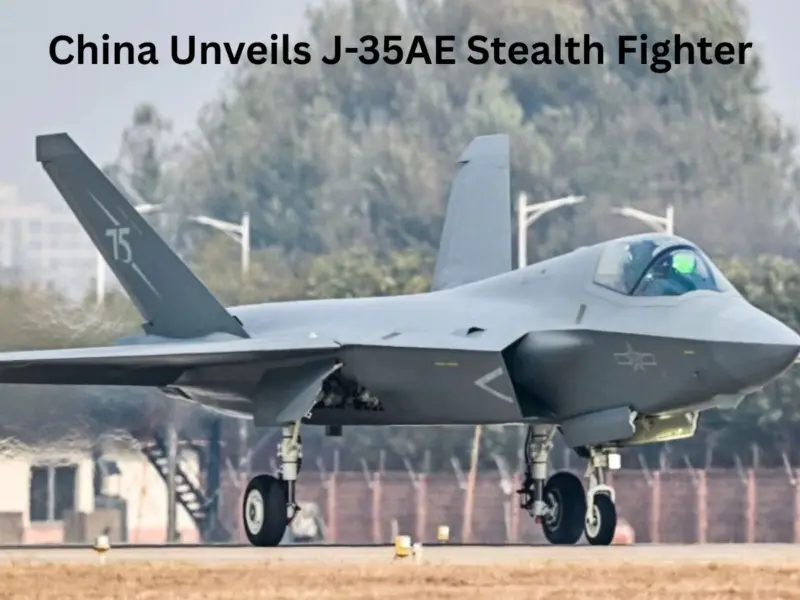

China has officially unveiled the J-35AE, the export-focused version of its latest fifth-generation stealth fighter, in a move that could significantly reshape the global arms market.
Positioned as a direct rival to the American-made Lockheed Martin F-35 Lightning II, the J-35AE signals Beijing's ambition to become a major supplier of advanced stealth combat aircraft worldwide. Developed by China's Shenyang Aircraft Corporation (SAC), the J-35 program originated from the FC-31 technology demonstrator and has gradually evolved into multiple operational variants. These include the J-35A, designed for the People's Liberation Army Air Force (PLAAF), and the carrier-capable J-35 naval variant built for aircraft carrier operations with reinforced landing gear and foldable wings.
From Prototype to Export Fighter
The newest addition to the lineup, the J-35AE, has been specifically configured for international customers. The "AE" designation was confirmed during a 2026 Chinese state media broadcast, where the aircraft carrying serial number 001 appeared with Aviation Industry Corporation of China (AVIC) branding instead of military insignia, highlighting its export-oriented role.
China is pitching the aircraft as a cost-effective alternative to Western stealth jets, especially for countries that either cannot afford or cannot access U.S. platforms due to political restrictions.
Advanced Stealth and Combat Capabilities
The J-35AE is designed to deliver near fifth-generation parity with Western aircraft while maintaining lower procurement and operational costs. The fighter is reportedly powered by twin afterburning turbofan engines, likely the WS-19, and is capable of reaching speeds up to Mach 1.8 with a combat radius between 1,200 and 1,350 kilometers.
Its stealth profile includes serrated engine nozzles, diverterless supersonic inlet (DSI) bumps, and an internal weapons bay designed to reduce radar cross-section. The aircraft also features an AESA radar and a teal-coated Electro-Optical Targeting System (EOTS), indicating improved sensor fusion and multi-spectrum target tracking capabilities.
The internal weapons bay can reportedly carry four to six missiles, including long-range PL-15 air-to-air missiles, while the total payload capacity is estimated at up to 8,000 kilograms.
Pakistan Emerges as Likely First Buyer
Pakistan is widely expected to become the launch customer for the J-35AE, further strengthening defense cooperation between Islamabad and Beijing. Reports suggest that the Pakistan Air Force (PAF) has already approved the acquisition of nearly 40 aircraft.
Pakistani pilots are also believed to have begun training in China since mid-2025, indicating that the induction process may already be underway behind the scenes.
Deliveries Could Begin by 2027
If timelines remain on track, deliveries of the stealth fighter could begin by late 2026 or early 2027. Analysts believe the induction of the J-35AE into the PAF would significantly enhance Pakistan's aerial combat capabilities and potentially alter the regional balance of air power in South Asia.
Beyond Pakistan, nations such as Egypt, Saudi Arabia, and the UAE are being viewed as potential future customers as they seek to diversify defense procurement and reduce dependence on Western military suppliers.
A Direct Challenge to the F-35 Export Market
The unveiling of the J-35AE marks a direct challenge to the dominance of the F-35 in the global stealth fighter export market. Unlike the United States, which limits F-35 sales through strict geopolitical and strategic conditions, China is attempting to market the J-35AE as a more accessible and "politics-free" option.
"The J-35 program marks China's second attempt at fielding a fifth-generation stealth fighter after the J-20, making China only the second country in the world to operate two distinct types of stealth aircraft."
By offering a medium-weight stealth fighter capable of operating from both land bases and aircraft carriers, China is positioning the J-35AE as a versatile platform that could influence military dynamics across the Indo-Pacific and the Middle East.
US-Iran War To End? What's In One-Page Memo At The Centre Of Big Update