
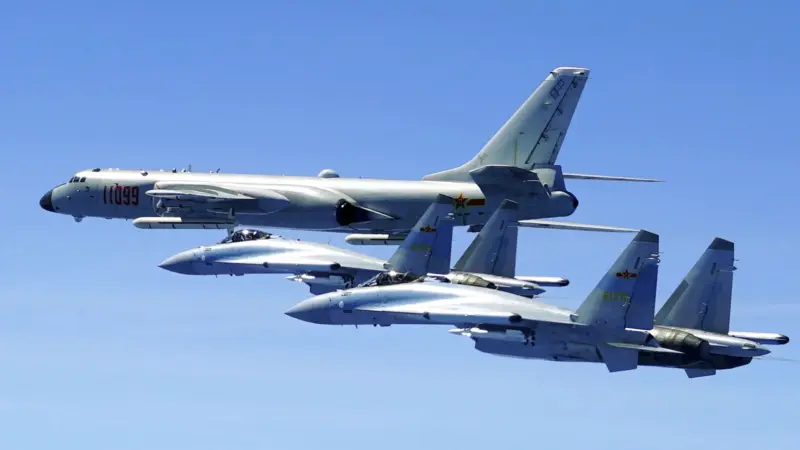

China has deployed two of its advanced H-6 long-range bombers to Woody Island in the South China Sea. This marks the first time these aircraft have landed on the island since 2020. Satellite imagery taken earlier this month confirms their presence in the Paracel Islands, a territory claimed by multiple countries.
Military Message or Strategic Posturing?
Analysts view the move as a calculated demonstration of Beijing's military capabilities. It comes at a time of rising tensions with the Philippines, increased operations near Taiwan, and just before the Shangri-La Dialogue, the region's largest defence forum. "China's long-range bombers don't need to be on the Paracels so it does appear to be omni-directional signalling by Beijing, against the Philippines and against the US and other things that are going on," said Collin Koh, a defence analyst at Singapore's S. Rajaratnam School of International Studies. The timing of the deployment is seen as significant. French President Emmanuel Macron is set to open the forum in Singapore with a speech. US Defence Secretary Pete Hegseth will follow with remarks outlining the Trump administration's strategy in the region. In another notable development, a British aircraft carrier is expected to sail through the South China Sea next month. Such deployments by the UK are rare and draw close attention from regional players. Two H-6 bombers were also spotted flying over the Scarborough Shoal in late March. This occurred just before Hegseth visited the Philippines and reaffirmed the United States' "ironclad commitment" to its treaty ally.Upgraded Aircraft with Expanded Reach
The H-6 bomber, originally based on a 1950s Soviet design, has been extensively modernized. It now features advanced flight systems and can carry anti-ship and land-attack cruise missiles. Some variants are also believed to be capable of launching nuclear-tipped ballistic missiles. These aircraft are viewed as a growing threat to US bases in the region. Last October, they participated in military exercises around Taiwan. In July, they flew close to the US mainland for the first time. However, analysts believe the bombers are not stationed on Woody Island permanently. "The ability to cycle forces through the bases, especially higher level assets like the H-6, provides the PLA with a force protection mechanism," said Ben Lewis, founder of PLATracker, an open-source defence monitoring platform. China's Southern Theatre Command, which oversees the South China Sea, operates two regiments of the H-6. Most of these bombers are typically housed at well-fortified bases on the Chinese mainland, which offer more protection in case of a conflict.An Intensifying Dispute Over Sovereignty
The South China Sea remains one of the most contested maritime zones in the world. China claims sovereignty over nearly the entire region, overlapping with claims by Brunei, Indonesia, Malaysia, the Philippines, Taiwan, and Vietnam. A 2016 ruling by an international tribunal rejected China's sweeping claims, stating they had no legal basis. Beijing has refused to accept the decision. Satellite images from Maxar Technologies show two H-6 bombers on the runway of Woody Island on May 19. Additional images from the same day show two Y-20 transport planes and a KJ-500 early warning aircraft. The KJ-500 is considered essential for coordinating air and sea operations. Analysts believe the aircraft may have arrived around May 17 and remained on the island until May 23. China's defence ministry has not commented on the deployment. The national security councils of the Philippines and Vietnam also did not immediately respond to requests for comment. Dmitry Medvedev Warns Donald Trump: 'Only One REALLY BAD Thing - WWIII' After Putin 'Playing with Fire' Comments