
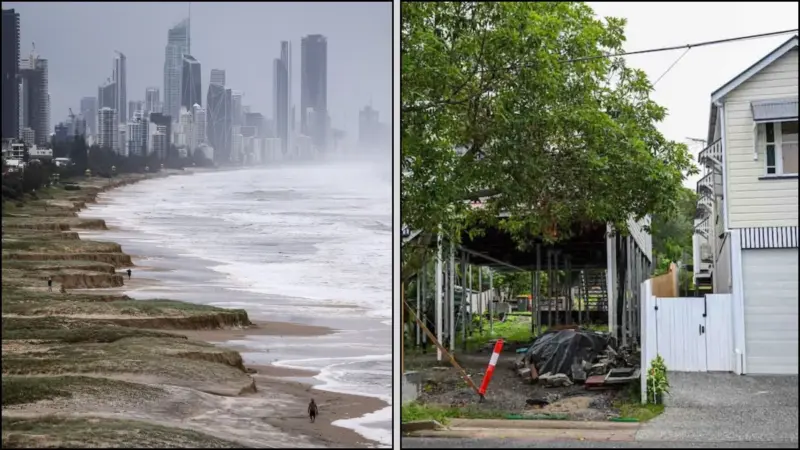

Cyclone Alfred latest updates: The tropical cyclone has reached the edge of North Stradbroke Island, off the coast of Brisbane, and is continuing to move towards the south-east Queensland coast, with rainfall, wind, and ocean impacts likely to persist Friday night and over the weekend, The Guardian reported, citing the latest update from the Bureau of Meteorology.
At 7.03 pm AEST, the forecast track map showed the center of the cyclone hitting the island in Moreton Bay, the report further said. Brisbane, Gold Coast, Sunshine Coast, Byron Bay and Ballina are among the areas in the warning zone that are likely to be impacted the most amid turbulent weather, the report said. Meanwhile, Cyclone Alfred left a widespread impact on the mobile phone and NBN networks, with at least 52 mobile sites reporting loss of connection due to power failures in affected regions. "At this stage, we don't know how long it will take to resolve services, but we are prioritising our resources to address impacted areas.
The safety and wellbeing of our customers and employees are of the utmost importance as we work as quickly as possible to restore services," Optus local general manager Nick Channell told the publication, adding that the telco was deploying fixed and mobile generators and had called in additional staff. People along Australia's eastern coast prepared for the arrival of the storm, which marks the most southerly tropical cyclone to threaten the area in over 50 years. According to Brisbane Times, the storm is predicted to have the strength of a category 1 Atlantic hurricane as it moves westward toward Brisbane, a city of 2.5 million residents, and surrounding coastal suburbs. Alfred is threatening a region where cyclones are not usually experienced, as they typically form much further north, over warmer waters in the tropics, a CNN report said.
Schools, public transport, major roads and airports were closed, with elective surgeries also put on hold, but emergency departments remain open, Brisbane Times reported. Reports suggest that the cyclone has already whipped up hazardous waves along the coast, including one measuring a record 12.3 meters on the Gold Coast, a popular tourist strip south of Brisbane. In northern New South Wales (NSW), around 4,000 homes were left without power on Thursday due to downed power lines. Heavy rain was reported in some areas, and riverine flooding was already threatening low-lying communities.
Authorities have warned millions of residents in the storm's path to prepare for destructive wind gusts, flash flooding and storm surges that may combine with high tides. Flood watches have been issued across the coast, where rainfall of 200 to 400 millimetres is expected, and isolated totals nearing 500 millimetres are possible. "There are waves, there is wind, there is rainfall, and there will be flooding, but none of those challenges are insurmountable, and I have every faith in the work that has been done to date," Queensland Premier David Crisafulli said, warning on late Thursday of the four key challenges.
The safety and wellbeing of our customers and employees are of the utmost importance as we work as quickly as possible to restore services," Optus local general manager Nick Channell told the publication, adding that the telco was deploying fixed and mobile generators and had called in additional staff. People along Australia's eastern coast prepared for the arrival of the storm, which marks the most southerly tropical cyclone to threaten the area in over 50 years. According to Brisbane Times, the storm is predicted to have the strength of a category 1 Atlantic hurricane as it moves westward toward Brisbane, a city of 2.5 million residents, and surrounding coastal suburbs. Alfred is threatening a region where cyclones are not usually experienced, as they typically form much further north, over warmer waters in the tropics, a CNN report said.
Schools, public transport, major roads and airports were closed, with elective surgeries also put on hold, but emergency departments remain open, Brisbane Times reported. Reports suggest that the cyclone has already whipped up hazardous waves along the coast, including one measuring a record 12.3 meters on the Gold Coast, a popular tourist strip south of Brisbane. In northern New South Wales (NSW), around 4,000 homes were left without power on Thursday due to downed power lines. Heavy rain was reported in some areas, and riverine flooding was already threatening low-lying communities.
Authorities have warned millions of residents in the storm's path to prepare for destructive wind gusts, flash flooding and storm surges that may combine with high tides. Flood watches have been issued across the coast, where rainfall of 200 to 400 millimetres is expected, and isolated totals nearing 500 millimetres are possible. "There are waves, there is wind, there is rainfall, and there will be flooding, but none of those challenges are insurmountable, and I have every faith in the work that has been done to date," Queensland Premier David Crisafulli said, warning on late Thursday of the four key challenges.