





Control over Bangladesh's "energy supply system," particularly natural gas supply, has effectively gone into the hands of two US companies.
On May 12 and 13, 2026, US Ambassador to Bangladesh Brent Christensen held meetings with Chevron President Javier La Rosa and Excelerate Energy President and CEO Steven Kobos.
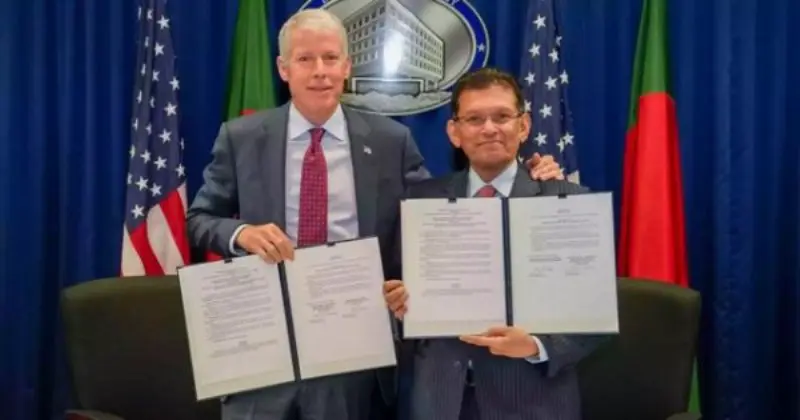
On May 14, Bangladesh's Foreign Minister Khalilur Rahman signed a "Strategic Energy Cooperation Memorandum of Understanding (MoU)" with US Energy Secretary Chris Wright at the US Department of Energy (DOE) in Washington, DC.
While officials from Bangladesh's Ministry of Energy and Petrobangla were reportedly not fully informed about this agreement. Khalilur Rahman is said to have hastily signed the MoU without vetting by the Ministries of Energy and Law.
On May 13, 2026, Christensen met La Rosa regarding ongoing cooperation in Bangladesh's energy sector. Chevron controls nearly 60 percent of Bangladesh's natural gas supply.
Through Production Sharing Contracts (PSCs) with Petrobangla, Chevron Bangladesh operates two of the country's major gas fields-Bibiyana (in Sylhet) and Shahbazpur (in Bhola).
On May 14, 2026, Christensen also spoke with Kobos. At present, Excelerate Energy is virtually the sole supplier of LNG in Bangladesh. After the meeting, the ambassador stated that Excelerate was working to meet Bangladesh's growing energy demand by utilising US innovation to expand energy infrastructure, including offshore LNG terminals and pipelines.
Last week, US Assistant Trade Representative Brendan Lynch held productive discussions with Bangladeshi government officials, the American business community, Bangladeshi companies, and labour organisations on strengthening trade and investment ties through the implementation of a US-Bangladesh reciprocal trade agreement.
It was stated that the agreement would facilitate market access in both countries, remove investment barriers, and expand commercial opportunities, thereby boosting economic growth.
Bangladesh's "multi-dimensional energy security system" has been dismantled over the past 21 months. Energy supply has been made one-sided-effectively US-oriented. The US has long sought to impose a long-term energy supply strategy on Bangladesh. Since the 1980s, US oil companies (IOCs) have tried to gain control over Bangladesh's oil and gas sector.
In the 1990s, companies like Scimitar, Occidental and Unocal made strong efforts to export gas from Bangladesh to India via pipeline. At that time, US President Bill Clinton even visited Bangladesh to lobby on behalf of these companies, but the then Bangladesh Prime Minister did not agree.
The May 14 agreement is being promoted as a "historic MoU with the United States to strengthen security and enhance strategic cooperation". It has been stated that, "amid current instability in the Middle East and a global energy crisis, this agreement is seen as a major relief for Bangladesh.
As a result of this deal, Bangladesh will be able to import American LNG, LPG, and other energy products at affordable prices. This will not only diversify energy sources but also ensure supply chain stability and help maintain the country's economic stability".
It is said that "under the agreement, both countries will exchange knowledge and expertise in sectors such as oil, gas, geothermal, and bioenergy.
This cooperation will create opportunities to modernise Bangladesh's energy sector through capacity building and advanced research." Wright described the agreement as a "historic advancement" in relations between the two countries.
However, reliable sources claim that the MoU has been signed as part of a strategic move to gain control over Bangladesh's maritime boundaries in the Bay of Bengal.
According to the agreement, Bangladesh will give priority to US companies for oil and gas exploration in the Bay of Bengal. US companies will work jointly with Petrobangla on seismic and geological surveys. It is worth noting that American oil companies operate under the US Department of Defense.
At the signing ceremony, Khalilur Rahman described the MoU as an important milestone in Bangladesh-US bilateral relations.
He thanked Bangladesh's Prime Minister Tarique Rahman and US President Donald Trump for their support of this initiative. Officials from the Bangladesh Embassy in Washington and senior officials from the US Department of Energy were also present at the event.