




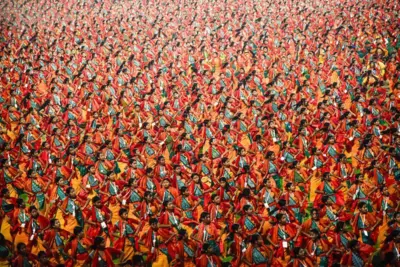

Guwahati: An aerial image showcasing thousands of Bagurumba dancers at Sarusajai Stadium in Guwahati has earned international recognition after being included by the BBC in its list of the nine most striking photographs of 2026 so far.
The photograph was captured during a Guinness World Record attempt organised on January 17 for the largest Bagurumba dance performance by the Bodo community.
Nearly 10,000 performers in colourful traditional attire participated in the event, turning the stadium into a spectacular cultural mosaic.
In its description of the image, the BBC highlighted the intricate arrangement of colours and formations created by the dancers when viewed from above.
The publication observed that the visual composition resembled the geometric abstraction associated with Dutch artist Piet Mondrian and drew parallels with his unfinished artwork, Victory Boogie Woogie.
The widely praised image was captured by Assam-based photojournalist Hafiz Ahmed.
Assam Cabinet Minister Bimal Borah welcomed the recognition and shared the development on X, describing the image as a proud cultural moment for the state. He said the photograph beautifully reflected the richness of Bodo traditions and Assam's diverse heritage.
A breathtaking moment of Assam that captivated the world!
This stunning scene of Bagurumba dancers at Sarusajai Stadium, Guwahati was chosen as one of @BBC's Photograph of the Year.
A tribute to the beauty of Bodo culture and Assam's rich cultural heritage. pic.twitter.com/GNNOVOFezk
- Bimal Borah (@BimalBorah119)
Bagurumba is a traditional folk dance of Assam's indigenous Bodo community, popularly known as the "Butterfly Dance" for its gentle and rhythmic movements inspired by butterflies and birds. Performed during the Bwisagu festival, the dance celebrates nature, the arrival of spring, seasonal change and the spirit of harvest.
Traditionally performed by Bodo women, the dance is accompanied by men playing indigenous musical instruments. The performers wear vibrant handwoven garments, including the dokhna (drape), jwmgra (scarf), and aronai (traditional muffler), and their graceful movements imitate butterflies and various elements of nature.
The performance relies on live, indigenous instruments, including the kham (cylindrical drum), sifung (bamboo flute), serja (bowed instrument), and gongwna .