
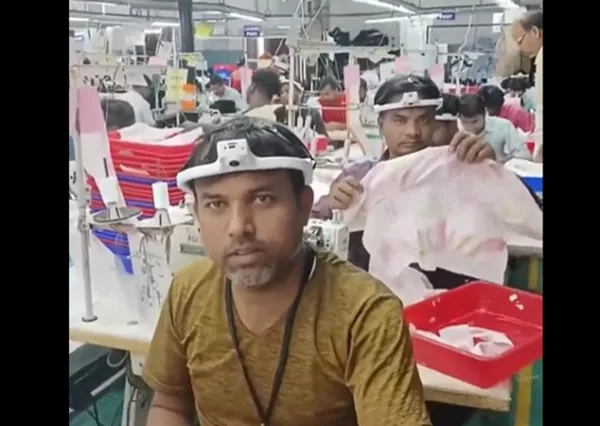

In April 2026, a widely circulated post by Mario Nawfal claimed that factory workers in India are being fitted with head-mounted cameras so that artificial intelligence systems can learn every nuance of human physical labour, effectively training their own replacements in real time.
Nawfal, a Lebanese - Australian entrepreneur known for hosting large-scale online discussions on emerging technologies and geopolitics, has built a substantial following by curating viral narratives around disruptive trends, though his posts often blend verified developments with speculative extrapolation.
The claim in question therefore merits careful scrutiny, separating documented technological practices from rhetorical amplification.
A close examination of available evidence suggests that while elements of the claim are grounded in reality, its framing is overstated and, in some respects, misleading.
The use of wearable cameras, motion sensors, and computer vision systems in industrial environments is not new, nor is it uniquely Indian.
Across advanced manufacturing ecosystems-from automotive assembly lines to logistics warehouses-companies have experimented with "human-in-the-loop" AI training methods.
These involve capturing human actions through video or sensor data to improve robotics, quality control systems, and workflow optimization.
In India, pilot deployments of such technologies have indeed been reported in sectors like automotive manufacturing, electronics assembly, and warehousing, particularly in industrial clusters around Tamil Nadu, Maharashtra, and parts of the National Capital Region.
However, these deployments are neither ubiquitous nor uniformly designed to "replace" workers in the immediate sense.
Instead, they are typically part of broader Industry 4.0 transitions, where firms aim to digitize operations, improve efficiency, and reduce error rates.
In some cases, wearable cameras are used for training new employees, safety monitoring, or ergonomic analysis rather than direct AI replication of labour.
That said, the underlying concern highlighted in the post-that workers may be contributing data that enables future automation of their own roles-is not entirely unfounded.
This is a well-recognized dynamic in the evolution of machine learning systems globally.
The deeper issue lies not in the presence of such technologies but in the asymmetry of power and information between employers and labour. In many Indian industrial settings, especially in informal or semi-formal sectors, workers have limited awareness of how their data is being used.
Consent mechanisms are often weak or implicit, and there is little transparency about whether collected data feeds into long-term automation strategies.
This creates a scenario where workers may unknowingly participate in processes that could diminish their future employment prospects.
From a labour economics perspective, the implications are complex and layered.
On one hand, technological augmentation can enhance productivity, potentially leading to higher wages, better safety conditions, and new categories of employment.
On the other hand, if automation accelerates without corresponding reskilling initiatives, it risks displacing large segments of low- and semi-skilled workers.
India's demographic profile-with its vast and youthful labour force-makes this tension particularly acute.
The country cannot afford a scenario where technological progress outpaces the absorptive capacity of its workforce.
Empirical studies on automation suggest that routine, repetitive tasks are the most vulnerable, while jobs requiring adaptability, problem-solving, and interpersonal skills are more resilient.
In the Indian context, many factory roles fall into the former category, especially in textiles, assembly, and basic manufacturing.
If AI systems trained on human data achieve sufficient accuracy, firms may gradually reduce dependence on manual labour in these areas.
The transition may not be abrupt, but it could be steady and cumulative, leading to what economists describe as "labour displacement through attrition" rather than mass layoffs.
Social implications must also be considered. Industrial employment in India often supports entire families and communities.
A decline in such employment without adequate social protection nets could exacerbate inequality, increase urban precarity, and strain rural-urban migration patterns.
Moreover, the psychological impact on workers-who may feel surveilled, deskilled, or rendered obsolete-should not be underestimated.
The introduction of head-mounted cameras, even for benign purposes, can create a sense of constant monitoring, affecting dignity and workplace morale.
At the same time, it is important to avoid technological determinism.
The trajectory of AI adoption is not preordained; it is shaped by policy choices, institutional frameworks, and societal values.
Countries that have managed automation transitions effectively have done so by investing heavily in human capital and embedding worker protections into technological deployment.
For India, this means recognizing that the question is not whether such technologies will be used, but how they will be governed.
Global best practices offer several instructive models. In Germany, the concept of "co-determination" ensures that worker representatives have a say in technological changes within firms.
This includes discussions on data usage, workplace surveillance, and automation strategies.
In Scandinavian countries, strong social safety nets and active labour market policies facilitate reskilling and redeployment of workers affected by technological shifts.
Singapore, meanwhile, has implemented targeted upskilling programmes aligned with industry needs, ensuring that workers can transition into higher-value roles as automation advances.
Translating these practices to the Indian context requires adaptation rather than replication. India's labour market is more fragmented, and unionization levels vary widely across sectors. Nevertheless, certain principles are universally applicable.
First, transparency in data collection and usage must be institutionalized.
Workers should be informed about the purpose of wearable technologies and how the data will be utilized.
Second, consent should be meaningful, not merely procedural. Third, there must be clear boundaries on surveillance to protect worker dignity and privacy.
Equally critical is the need for large-scale reskilling initiatives.
If workers are indeed contributing to the training of AI systems, they should also be beneficiaries of the technological transition.
This could take the form of employer-funded training programmes, public-private partnerships, and government-led skill development missions focused on emerging sectors such as robotics maintenance, data annotation, and AI system supervision.
The objective should be to move workers up the value chain rather than allowing them to be displaced by it.
Regulatory frameworks will also play a decisive role. India currently lacks comprehensive legislation governing workplace data and AI deployment.
Developing such frameworks-drawing from global standards but tailored to domestic realities-can help balance innovation with protection.
This includes defining ownership of worker-generated data, establishing accountability for misuse, and ensuring that automation does not lead to exploitative labour practices.
Corporate responsibility is another key dimension.
Firms adopting advanced technologies must recognize that long-term sustainability depends not only on efficiency gains but also on social legitimacy.
Ethical deployment of AI, fair treatment of workers, and investment in human capital are not merely moral imperatives; they are strategic necessities in an increasingly scrutinized global economy.
Returning to the original claim, it becomes evident that while the imagery of workers "training their own replacements" captures a certain truth about the logic of machine learning, it oversimplifies a far more nuanced reality.
The presence of head-mounted cameras in some industrial settings does not, by itself, signify an imminent wave of job displacement.
Rather, it is a symptom of a broader technological transition whose outcomes remain contingent on policy choices and institutional responses.
The real challenge, therefore, is not to resist technological change but to shape it in a manner that aligns with India's developmental priorities.
This requires a coordinated approach involving government, industry, and civil society. It demands foresight, investment, and a commitment to inclusive growth.
Above all, it calls for recognizing that workers are not merely inputs into production systems but stakeholders in the future of the economy.
If India can navigate this transition thoughtfully, it has the potential to harness AI not as a force of displacement but as a catalyst for empowerment.
If it fails to do so, the concerns articulated in viral social media posts may gradually move from the realm of speculation to that of lived reality.