
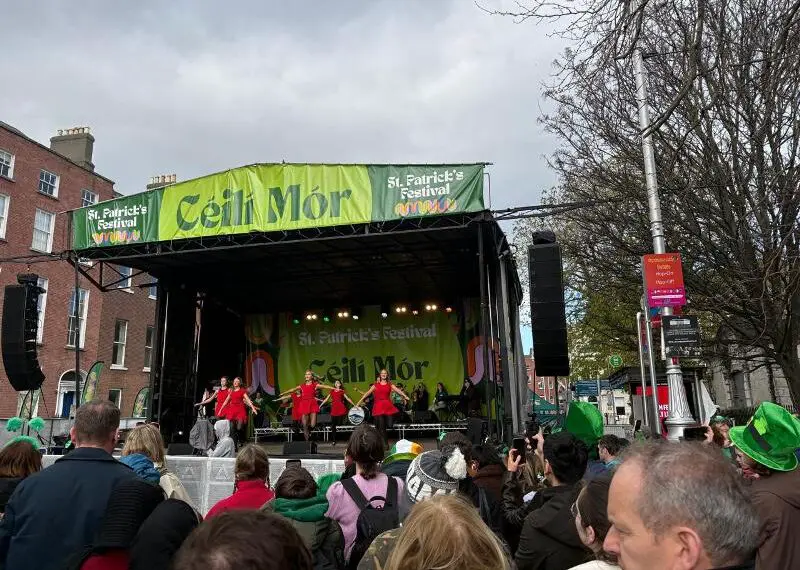

I arrived in Dublin on a cool March morning, the kind where the air carries a faint chill but also an unmistakable promise of festivity.
The city, even at first glance, seemed to be preparing itself for something larger than an ordinary celebration.
Shop windows shimmered in shades of green, streets were lined with fluttering flags, and strangers exchanged smiles that felt warmer than the weather.
Having planned my visit to Ireland for a fortnight, I had deliberately ensured that I would be in Dublin on the 16th and 17th of March 2026, coinciding with the grand culmination of the St. Patrick's Festival, which that year spanned from Saturday, March 14th, to Tuesday, March 17th.
What unfolded before me over those two days was not merely a festival, but a living, breathing embodiment of history, identity, and global cultural exchange.
Walking through the streets of Dublin on the eve of St. Patrick's Day, I quickly realised that this was no ordinary national holiday. The celebration had transcended its origins and evolved into something far more expansive-a global festival of Irish identity.
Historically, St. Patrick's Day marks the feast of St. Patrick, the 5th-century missionary credited with spreading Christianity across Ireland. In its earliest form, the day was a quiet religious observance, centred on church services, modest processions, and family gatherings.
The tone was reflective rather than exuberant, and even the colour associated with the saint was not green but blue, rooted in older ecclesiastical traditions.
Yet, as I wandered past vibrant street performances and listened to bursts of music spilling out of pubs, it was clear that centuries had transformed the day into a spectacle of collective joy. This transformation began in earnest during the 18th and 19th centuries, when Irish nationalism began to intertwine with the symbolism of St. Patrick's Day.
The colour green, now omnipresent, became a political emblem during resistance movements against British rule, particularly during the 1798 rebellion. What was once a religious feast gradually became a statement of identity, a subtle yet powerful assertion of Irish pride.
On the morning of March 17th, Dublin awoke with an electric energy. Crowds began gathering early, lining the parade routes with eager anticipation. Families, tourists, students, and elderly couples-all dressed in varying shades of green-waited together as if united by an invisible thread.
When the parade finally began, it was nothing short of mesmerising. Elaborate floats, traditional Irish dancers, marching bands from across the world, and theatrical performers moved through the city in a dazzling procession. The spectacle was both deeply local and strikingly global, reflecting how St. Patrick's Day has been shaped by the Irish diaspora over centuries.
It is fascinating to note that many of the features now considered quintessential to the celebration-grand parades, public revelry, and large-scale spectacle-did not originate in Ireland itself. They were developed by Irish emigrants, particularly in North America, where communities in cities like Boston and New York transformed the day into a vibrant display of ethnic pride.
These diaspora celebrations eventually influenced Ireland, creating a cultural feedback loop in which Irish identity was both exported and re-imported in new forms. Watching the Dublin parade, one could sense this layered history-an interplay of tradition and reinvention.
Beyond the parade, the city itself became a stage. Street musicians played traditional tunes on fiddles and tin whistles, their melodies weaving through the hum of the crowd. In areas like Temple Bar, the celebration took on a more exuberant tone, with pubs overflowing with laughter, music, and conversation.
Yet, despite the festive indulgence often associated with St. Patrick's Day, there was also a noticeable effort to present a broader cultural narrative. Art installations, theatre performances, and storytelling sessions were integrated into the festival, reflecting a modern Ireland eager to showcase its creative diversity.
The shamrock, visible everywhere-from lapel pins to painted faces-served as a subtle reminder of the festival's deeper roots. According to tradition, St. Patrick used the three-leaved plant to explain the concept of the Holy Trinity, though historians debate the authenticity of this account.
Over time, the shamrock evolved into a powerful symbol of Irish identity, blending religious, folkloric, and nationalist meanings. As I noticed children clutching shamrock balloons and elderly men wearing sprigs pinned to their coats, it struck me how a simple plant had come to embody centuries of cultural evolution.
What makes St. Patrick's Day particularly remarkable is its global reach. It is no longer confined to Ireland; rather, it is celebrated across continents, from the United States to Japan, from Australia to the Caribbean.
Cities dye rivers green, landmarks are illuminated in emerald hues, and millions of people-many with no Irish ancestry-participate in the festivities. This globalisation reflects the profound influence of the Irish diaspora, which has carried the traditions of the homeland across the world.
At the same time, it raises questions about authenticity and commodification. Is the festival still a meaningful expression of Irish culture, or has it become a commercialised caricature?
In Dublin, however, the balance between authenticity and celebration seemed carefully maintained. While the commercial elements were undeniably present-souvenir shops brimming with green merchandise and themed products-the festival also retained a sense of cultural depth. The emphasis on arts, heritage, and community participation ensured that the celebration did not lose its connection to its historical roots.
As evening descended on March 17th, the city took on a different kind of magic. Buildings were illuminated in green light, creating a surreal, almost dreamlike atmosphere. The River Liffey reflected these shimmering hues, turning the entire city into a canvas of emerald brilliance.
Standing by the river, surrounded by people from different parts of the world, I felt a sense of shared humanity that transcended cultural boundaries. It was as if Dublin had become, for a moment, the heart of a global community united by celebration.
Reflecting on my experience, I realised that St. Patrick's Day is not just about remembering a saint or celebrating a nation. It is about the evolution of tradition itself-how rituals adapt, expand, and acquire new meanings over time.
From a modest religious feast in early Ireland to a global festival of identity and expression, the journey of St. Patrick's Day mirrors the broader story of Ireland and its people.
: Trading the Sky: How Transferable Development Rights can finance India's urban future
My arrival in Dublin had been marked by curiosity, but my departure was shaped by a deeper appreciation. I had witnessed not just a festival, but a phenomenon-one that encapsulates history, diaspora, nationalism, and globalisation in a single, vibrant celebration.
As the echoes of music faded and the crowds slowly dispersed, the spirit of the festival lingered, reminding me that some traditions, no matter how transformed, continue to carry the essence of their origins while embracing the possibilities of the present.