
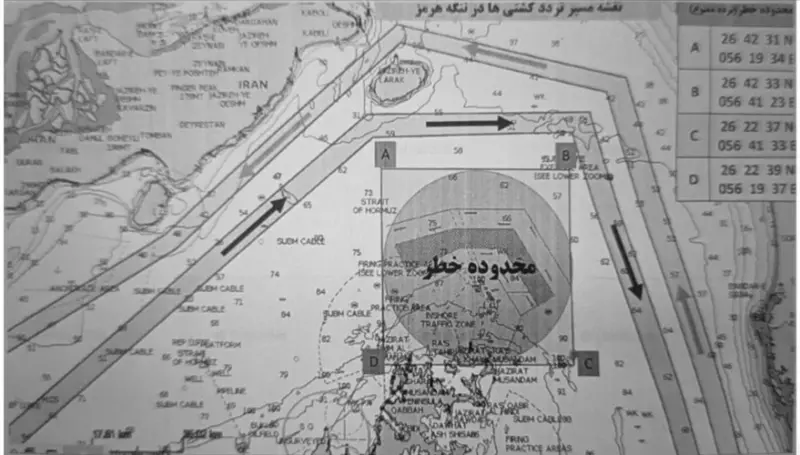

Iran's state-linked media on Thursday released a map indicating that naval mines may have been deployed in the Strait of Hormuz during the recent conflict, in what analysts see as a signal aimed at increasing pressure on the United States amid a fragile ceasefire.
The graphic, circulated by semiofficial outlets including ISNA and Tasnim, highlighted a "danger zone" along key shipping lanes in the narrow waterway, a critical global energy route through which a significant share of the world's oil and gas supplies passes.
The marked area appeared to overlap with the Traffic Separation Scheme used by commercial vessels, suggesting potential risks to maritime movement.
The development comes as a two-week ceasefire involving Iran, the United States and Israel continues to hold tenuously, with all sides offering conflicting interpretations of its terms.
While Tehran has maintained that it retains control over the Strait of Hormuz and can regulate passage, Washington has insisted the agreement ensures the waterway remains open and secure.
Tensions have also been fuelled by Israel's continued military operations against Hezbollah in Lebanon, which Iran claims violate the truce.
Israel, however, maintains that its actions in Lebanon fall outside the scope of the ceasefire.
Iranian Deputy Foreign Minister Saeed Khatibzadeh said Tehran would allow shipping through the strait in line with international law, provided what it describes as US "aggression" in the region ends and Israeli strikes in Lebanon cease.
He also indicated that Iran had temporarily restricted access to the route following alleged violations of the ceasefire.
Global markets reacted cautiously to the uncertainty, with oil prices climbing back above $97 per barrel after briefly dipping below $92 following the truce announcement.
Shipping activity in the Strait of Hormuz appeared limited, with tracking data showing only a handful of vessels transiting the passage on the first day of the ceasefire, excluding ships operating without active tracking systems.
US President Donald Trump signalled a hardline stance, stating that American military deployments around Iran would remain until the agreement is fully implemented.
He warned of severe consequences if the terms are not upheld, while reiterating that Iran would not be allowed to develop nuclear weapons and that the Strait of Hormuz would remain open.
Despite both Washington and Tehran claiming gains from the ceasefire, renewed violence has raised concerns about its durability.
Israeli airstrikes in Lebanon intensified, with reports of heavy casualties in Beirut and southern regions, further complicating diplomatic efforts.
Iran has questioned the viability of upcoming negotiations, arguing that the US has already breached key conditions.
Disagreements also persist over whether the ceasefire extends to Lebanon, with conflicting statements from Iranian, Israeli and US leadership, even as mediators in Pakistan suggested the agreement was meant to apply broadly across the region.
With talks expected to resume in Islamabad, observers warn the ceasefire remains highly unstable, with continued hostilities risking a broader escalation in the region.