
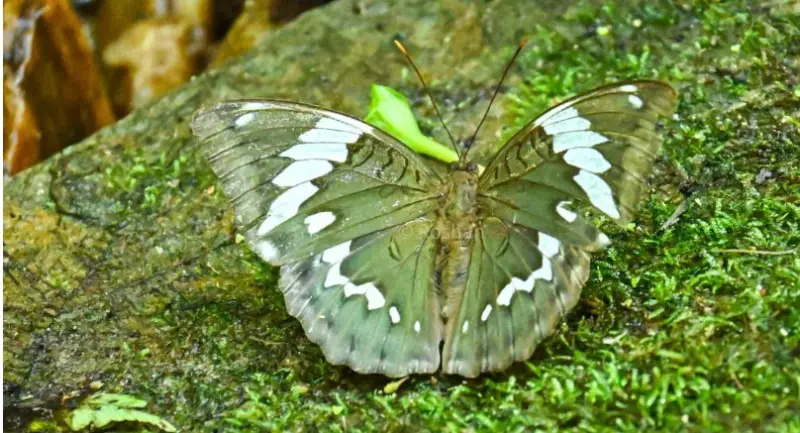

Itanagar: A new species of butterfly has been discovered in Arunachal Pradesh's Lepa Rada district and named after Assamese cultural icon Zubeen Garg.
The researchers-Roshan Upadhaya, a scholar at RIMT University in Punjab, and Kalesh Sadasivan of the Travancore Natural History Society-have proposed "Basar Duke" as the common name for the species, scientifically identified as Euthalia (Limbusa) zubeengargi.
The butterfly was recorded during field surveys carried out in 2025.
Notably, a newly discovered plant species was also recently named in honour of Zubeen Garg, whose death on September 19, 2025, in Singapore sparked widespread reactions and debate.
The butterfly is characterised by olive-brown wings marked with white patches and a turquoise-green underside. It inhabits humid forest environments.
So far, researchers have documented only two individuals of the species, making it an extremely rare discovery.
The findings, based on observations in semi-evergreen forests at elevations between 600 and 750 metres, have been published in the latest issue of Entomon, a quarterly journal brought out by the Association for Advancement of Entomology.
Despite several months of monitoring, the researchers recorded only two male butterflies-one collected as a specimen and another photographed in the wild-suggesting that the species may either be rare or confined to a very limited area.
Detailed examination confirmed that the butterfly differs from all known related species, based on its distinctive wing patterns and unique male anatomical characteristics.
Upadhaya, popularly known as the "Butterfly Man of Arunachal Pradesh", said the species belongs to the genus Euthalia, a group widely distributed across South and Southeast Asia. Members of this genus are usually found in forest habitats and are recognised for their earthy brown wings with pale markings.
In a social media post, he described the naming as "a tribute to the legendary icon Zubeen da."
Field observations also indicated that Euthalia zubeengargi prefers cool and shaded interiors of forests. The butterfly was seen resting on low vegetation, feeding on tree sap, and occasionally gathering minerals from damp surfaces near streams.
"The butterfly appears to be active mainly from late morning to early afternoon, making short, slow flights between nearby plants," the researchers noted.
The discovery further underscores the rich biodiversity of Northeast India and highlights the region as a hotspot of largely unexplored natural diversity.