
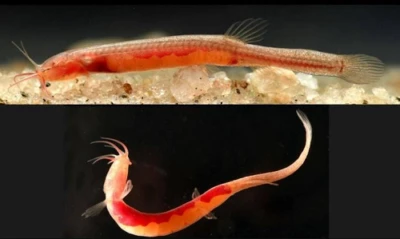

Researchers have discovered a tiny, blind, blood-red fish inhabiting underground aquifers in Assam's Goalpara district, marking a rare and significant scientific finding.
The newly identified species, named Gitchak Nakana, is the first groundwater-dwelling fish ever recorded in Northeast India.
It was found inside a concrete-ringed dug-out well in a village near the foothills of the Shillong Plateau in Goalpara.
Reacting to the discovery, Assam Chief Minister Himanta Biswa Sarma on Monday described it as an important reflection of the state's largely unexplored biodiversity.
In a post on X, he wrote, "Fascinating discovery from Assam! A rare fish species has been found in deep underground water in Goalpara, showcasing our rich and unexplored biodiversity."
He also congratulated the team of scientists and researchers involved in the study for their contribution to biodiversity research in the region.
"Kudos to researchers from Senckenberg, Assam Don Bosco University, Dhanamanjuri University and others for this remarkable work," he added.
Fascinating discovery from Assam! A rare fish species has been found in deep underground water in Goalpara, showcasing our rich and unexplored biodiversity.
Kudos to researchers from Senckenberg, Assam Don Bosco University, Dhanamanjuri University and others for this remarkable… pic.twitter.com/PrzuQtjqQX
- Himanta Biswa Sarma (@himantabiswa)
Also Read: Northeast's first fish canning facility launched in Mizoram's Zawlnuam
The fish measures only about 20 millimetres, placing it among miniature species. It has a distinctive appearance, lacking both eyes and pigmentation. Its translucent body exposes blood vessels and internal organs, giving it a striking red coloration.
Scientists consider the discovery important because subterranean aquatic ecosystems remain among the least explored habitats in India. Organisms living in such isolated and dark habitats often develop unusual biological traits due to long-term isolation, darkness and limited food availability.
Researchers say the finding not only sheds light on hidden ecosystems but also underscores the importance of conserving these fragile and largely unknown habitats.