
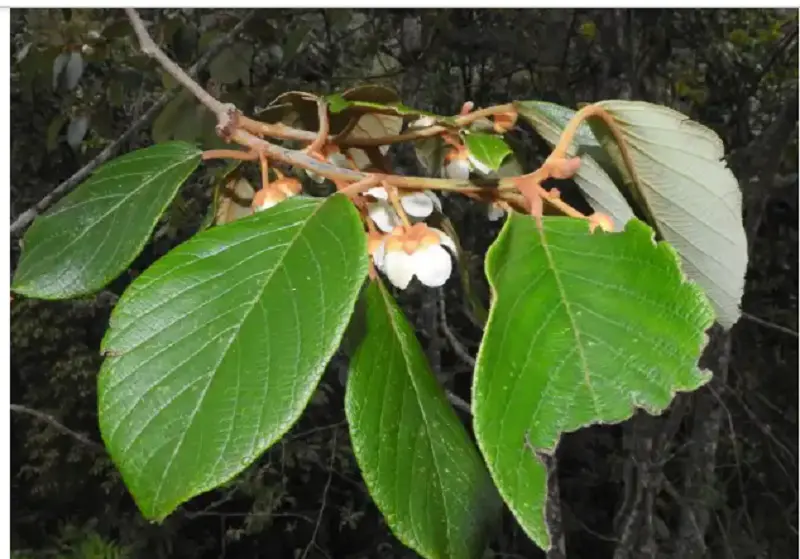

Itanagar: In a major scientific breakthrough, researchers have discovered a new species of wild kiwi in Arunachal Pradesh, further highlighting the Eastern Himalaya's status as one of the world's richest biodiversity hotspots.
The species, named Actinidia indica, has been described by researchers Rohan Maity and Umeshkumar L. Tiwari of the Botanical Survey of India's Central National Herbarium, along with Sudhansu Sekhar Dash of the organisation's headquarters in Kolkata.
"The discovery of a new wild kiwi species, Actinidia indica, from the landscapes of our State is a testament to the incredible biodiversity of the Eastern Himalaya," Deputy Chief Minister Chowna Mein said.
The discovery of a new wild kiwi species, Actinidia indica, from the landscapes of our State is a testament to the incredible biodiversity of the Eastern Himalaya.
This finding highlights how much of our natural heritage still remains to be explored and understood. My heartiest… pic.twitter.com/KPvbtzMAol
- Chowna Mein (@ChownaMeinBJP)
"This finding highlights how much of our natural heritage still remains to be explored and understood. My heartiest congratulations to the dedicated team of scientists for this significant achievement," he added.
Mein said their work not only adds to India's floral diversity but also underscores the vital role of conservation and scientific research in protecting the country's ecological wealth.
The discovery was made during fieldwork conducted in 2022 in the Lower Subansiri district, where researchers came across a unique population of wild kiwi growing along forested slopes. Detailed morphological analysis and comparisons with known species later confirmed that the plant had not been documented earlier.
: Arunachal Pradesh: Namsai tops NITI Aayog rankings in financial inclusion and skill development
According to the researchers, Actinidia indica is distinguished by its large, showy flowers measuring 4-6 cm across, rounded and slightly hairy fruits, and a uniquely patterned surface marked by linear, spindle-shaped lenticels arranged in a net-like formation. These features set it apart from closely related species such as Actinidia fulvicoma.
The species has so far been documented at an elevation of around 1,726 metres in Lower Subansiri district, where it grows along forest edges amid rich subtropical vegetation.