
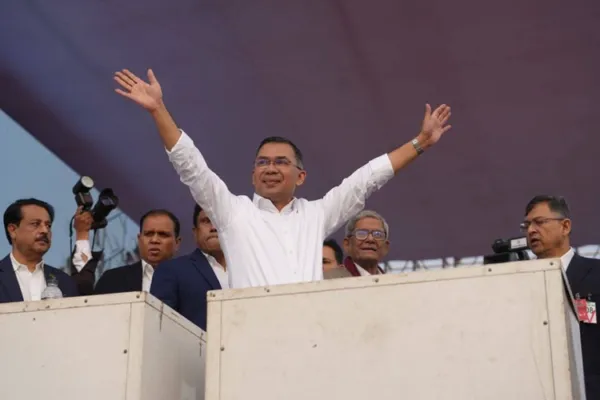

By Enayet Kabir
Zubaida Rahman, the wife of Bangladesh's Prime Minister, Tarique Rahman-who is accused by the FBI-has gone on a "proxy" visit to the United States.
Invited by US First Lady Melania Trump to attend an event, Zubaida's visit is considered significant in the context of Bangladesh.
Although Tarique Rahman has been relieved of sentences in various cases by Bangladeshi courts, he is still listed as accused in FBI records.
In 2008, an FBI official named Debra LaPrevotte testified before Bangladesh's Anti-Corruption Commission regarding money laundering allegations against him.
It is worth noting that Tarique, who was accused in US investigations, had spent the last 17 years in self-imposed exile in London and had not travelled to any other country before returning to Bangladesh on December 25, 2025.
Since assuming office as Prime Minister, there has been no announcement of any foreign visits in the past five weeks. Therefore, Zubaida's visit is being seen as a "proxy" trip.
Since the start of the Iran war, the US has been pushing Bangladesh for the signing of GSOMIA and the ACSA agreements.
The US believes that due to geopolitical complexities, establishing a military base in Bangladesh may be a prolonged process.
However, GSOMIA and ACSA would allow unrestricted US military presence in Bangladesh.
For the past 18 months, the Ramu Cantonment in Bangladesh has effectively been under unofficial US control.
Due to the Rohingya issue, there has already been a presence of UN and foreign agency representatives in Cox's Bazar and Ukhia, many of whom are US citizens.
On the morning of March 25, 2026, US Ambassador Brent Christensen met with Bangladesh Army Chief Waker-uz-Zaman.
Earlier that same day, the Principal Staff Officer of the Armed Forces Division, Lieutenant General Mir Mushfiqur Rahman, briefed the Army Chief on the latest initiatives regarding GSOMIA and ACSA.
The previous day, August 24, 2026, the Army Chief had invited Brigadier (Retd.) Shamsul Islam, security advisor to Tarique Rahman, to his office to learn about the government's stance on these two proposals.
Meanwhile, the arrests of influential military officers from the 2007-2008 "1/11" caretaker government period-retired Lieutenant General Masud Uddin Chowdhury and Major General (Retd.) Sheikh Khaled Mamun-are being viewed as acts of revenge and retaliation.
There are allegations that during that time, current Prime Minister Tarique was tortured in intelligence custody over corruption, murder, and other serious charges.
Following these arrests, rumours are circulating that the government may also arrest former Army Chiefs General (Retd.)
Hasan Mashhud Chowdhury and General Abdul Mubin.
The process of arresting retired military officials has created discomfort for the current Army Chief, as some of those detained are known to have close ties with the United States.
However, political analysts believe that the newly elected government of Bangladesh is under US influence and surveillance.
Khalilur Rahman, who served as National Security Advisor under the Muhammad Yunus government, is now the Foreign Minister in the ruling government led by Tarique Rahman.
He has been accused of allowing unrestricted US military activities in Ramu Cantonment without informing Bangladesh's military authorities.
Additionally, Khalil is accused of assisting nine mercenaries in infiltrating Myanmar through Bangladesh's hill tracts via India.
Since then, military authorities have effectively declared him unwelcome at the headquarters in Dhaka.
Khalilur Rahman, seen as backed by the United States, is now actively campaigning at home and abroad to become President of the UN General Assembly.
He has already secured support from the US and the United Kingdom.
It is believed that if Khalil becomes President, it will be easier for the United Nations to take control of Ramu Cantonment under the Rohingya issue.
The US aims to shape Bangladesh into an anti-China proxy and satellite state in South Asia. "FBI-controlled" Tarique Rahman is considered a trump card for them.
Zubaida Rahman's "proxy" visit is not expected to loosen that control.
(The writer is a political and economic analyst)