
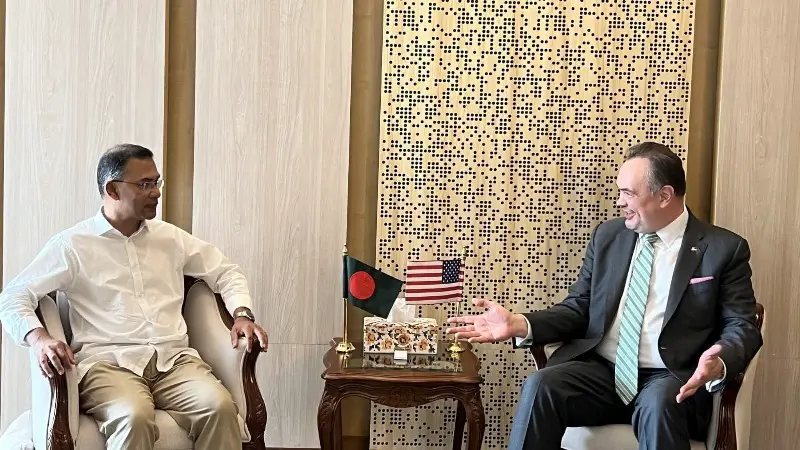

After taking over as the US Ambassador to Bangladesh on January 10 this year, Brent Christensen began his stint on a sedate note. He did exactly what a new ambassador - moved to Dhaka to replace the Chargé d'Affaires Tracey Ann Jacobson who officiated following the departure of Peter Haas on July 23, 2024 - was expected to do.
He began meeting a wide spectrum of political leaders.
But over the last two months or so, Christensen visited the secretariat on several occasions, meeting Prime Minister Tarique Rahman and about two dozen ministers and advisers.
He practically enters ministerial offices at will. He regularly meets Army Chief General Waker-uz-Zaman, Navy Chief Admiral Mohammad Nazmul Hassan and Air Chief Marshal Hasan Mahmood Khan.
The US is attempting to dismantle Bangladesh's strong, locally grounded economy and impose a debt-dependent one. It has already drawn Bangladesh into the trap of a Reciprocal Trade Agreement (RTA). This agreement is binding and requires US approval for Bangladesh's foreign trade.
On February 9, 2026, this agreement was signed by Muhammad Yunus's unelected and unconstitutional government. The BNP's "political" government then enforced it through a "mandatory" Boeing purchase agreement on April 30.
On March 3, 2026, Christensen met Civil Aviation and Tourism Minister Afroza Khanam Rita and secured the purchase of 14 Boeing aircraft.
Rita is a leading figure of the Munno Group. Immediately after the meeting, Biman Bangladesh Airlines moved rapidly to finalise a deal worth BDT 37,000 crore, officially signed on April 30 at the InterContinental Hotel in Dhaka.
The ambassador had earlier stated that Bangladesh's aviation sector is poised for growth, with Boeing and other US tech companies as ideal partners. A week before the deal, businessman Rumi Hossain of Rangs Group was appointed chairman of Biman.
The RTA agreement includes a clause allowing cancellation within 60 days, but the text claims it lacks legal basis since US tariff laws under Trump were struck down by the Supreme Court.
Anticipating this, Muhammad Yunus and Khalilur Rahman allegedly rushed the agreement so it would remain valid even if later invalidated. The BNP government, instead of cancelling RTA, implemented it through the Boeing deal.
On April 12, 2026, Christensen met Environment Minister Abdul Awal Mintoo to advance the US-Bangladesh partnership. He stated that companies like Chevron and Excelerate Energy are ready to expand gas production. Mintoo's Multimode Group holds shares in both companies. Former US Ambassador Peter Haas, linked to the 2024 regime change, leads Excelerate Bangladesh.
The Yunus government signed long-term LNG deals with Excelerate at high cost. Offshore exploration contracts are also pending.
Mintoo previously collaborated with Occidental and Unocal and played a role in energy agreements in the Sylhet Basin. US efforts to export Bangladeshi gas to India were once resisted by Sheikh Hasina. Later, Unocal transferred operations to Chevron and attempts to sell to a Chinese firm were blocked by India.
On April 27, 2026, Christensen met BNP Secretary General Mirza Fakhrul Islam Alamgir, urging adoption of US expertise in rural infrastructure, agriculture, and cooperatives. He urged Fakhrul to take up new projects by utilising American "expertise" in smart rural infrastructure, agricultural innovation, and cooperative development.
The US has long been trying to introduce "corporate agriculture" by dismantling the strong local foundation of Bangladesh's economy, which is based on the collective investment of small farmers. Sheikh Hasina's Awami League government had been reluctant to withdraw support and incentives for small farmers.
The US, the IMF and the World Bank have long been pressuring for the removal of farmers' subsidies. By undermining local production, the US has been making determined efforts to gain control over the large consumer market for agricultural and food products.
It was reported that the US sought to replace Bangladesh's smallholder farming with corporate agriculture. International institutions like the IMF and World Bank have long pressured Bangladesh to remove subsidies.
On March 3, Christensen also met Agriculture Minister Mohammad Aminur Rashid, stating US agricultural exports support Bangladesh's livestock and food sectors. Amin leads the Lalmai Group, active in imports and exports. Under the RTA, Bangladesh must import $3.5 billion in US agricultural goods annually.
On March 11, Christensen met his old friend and now Finance Minister Amir Khasru Mahmud Chowdhury and discussed opportunities to expand cooperation on shared economic priorities.
He stated that "to advance the goal of mutual prosperity, the US Treasury's Office of Technical Assistance is working with the Ministry of Finance." Finance Minister Khasru is the founder of the Chittagong Stock Exchange.
In addition, Christensen held meetings with Home Minister Salahuddin Ahmed, Foreign Minister Khalilur Rahman, Commerce Minister Khandaker Abdul Muktadir, Health Minister Sardar Sakhawat Hossain Bokul, Minister for Children, Women and Social Welfare A Z Zahid Hossain, Law Minister Asaduzzaman, Posts and Telecommunications Minister Fakir Mahbub Anam, Education Minister Ehsanul Haq Milon, Information Minister Zahiruddin Swapan, Road Transport Minister Robiul Alam, Labour Minister Ariful Haque Chowdhury, State Minister for Food Abdul Bari, among others.
Accompanied by US Special Envoy Charles Harder, Christensen also held meetings on "security strategy" with Energy Minister Iqbal Hasan Mahmud Tuku, Foreign Affairs Adviser Humayun Kabir, and Security Adviser Brigadier (retd) Shamsul Islam.
On April 5, 2026, Christensen met Prime Minister Tarique Rahman at the Secretariat and stated that the meeting was "productive."
It remains to be seen how productive Christensen's meetings with the BNP ministers turn out to be even as Bangladeshis are trying to make sense of the Boeing deal.
The RTA has pushed Bangladesh into a tight corner and there is little it can do to free itself from an 'agreement' that it was compelled to sign. While the Tarique Rahman-led BNP government appears to be unperturbed by the overwhelming 'presence' of the US, it may have hoisted by its own petard.