





Reported by Roopak Goswami
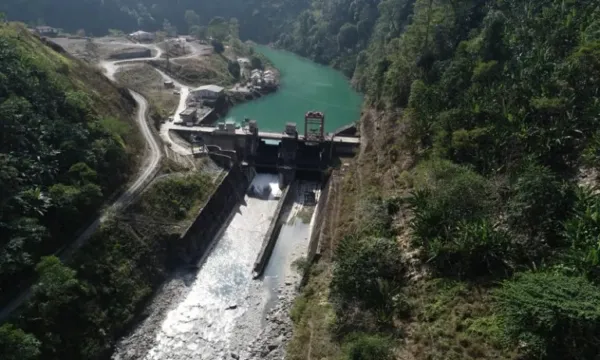
Guwahati: Two proposed hydropower projects in Arunachal Pradesh are set to have a significant environmental footprint, with official records indicating that more than 80,000 trees could be cut and over 1,100 hectares of forest land diverted for their development.
The projects - the 1,200 MW Kalai-II Hydroelectric Project in Anjaw district and the 680 MW Attunli Hydroelectric Project in Dibang Valley district have been recommended for Stage-I, or "in-principle", forest clearance by the Forest Advisory Committee (FAC) under the Union Ministry of Environment, Forest and Climate Change. The recommendations are subject to compliance with several environmental safeguards and wildlife protection measures.
According to FAC documents, the Kalai-II project, proposed by THDC India Limited on the Lohit river basin, would require the diversion of 869.35 hectares of forest land spread across the Namsai and Anjaw forest divisions. The project is expected to result in the removal of 33,338 trees.
A major portion of the diverted forest area around 638 hectares would be submerged under the reservoir created by the project. The remaining land would be utilized for project infrastructure such as underground facilities, access roads, quarry sites, muck disposal zones and other construction-related activities.
The committee noted that the project site forms part of a biologically rich forest landscape that supports several wildlife species, including hoolock gibbons, capped langurs, Assamese macaques, leopard cats, serows and takins. It also flagged the presence of the critically endangered White-bellied Heron and directed that the project's Wildlife Management Plan be reviewed by the Wildlife Institute of India, with special focus on protecting the bird's habitat.
The Attunli Hydroelectric Project, proposed by SJVN Limited in Dibang Valley district, would involve the diversion of 261.53 hectares of unclassed forest land within the Talo (Tangon) river basin. FAC records indicate that 47,243 trees would be felled for the project.
The committee observed that the proposed project area falls within a dense forest zone categorised under Eco Class-I. It also forms part of the Dibang sub-basin, where cumulative environmental impact and carrying capacity assessments have previously been conducted.
Given the fragile mountainous terrain of the region, the FAC raised concerns regarding quarrying operations and disposal of excavated material. It directed the state government to commission detailed geological investigations and slope stability assessments through expert institutions, while ensuring that appropriate mitigation measures are implemented.
For the Attunli project, approximately 120.57 hectares of forest land proposed for temporary use, including dumping areas, would be restored after project completion and returned to the forest department.
The two projects are among a series of hydropower developments planned in Arunachal Pradesh, a state known for its extensive forests and rich biodiversity. While hydropower expansion is seen as a key component of energy generation in the Northeast, conservationists have repeatedly raised concerns about forest fragmentation, impacts on wildlife habitats and the cumulative ecological pressures on river systems within the Brahmaputra basin.