
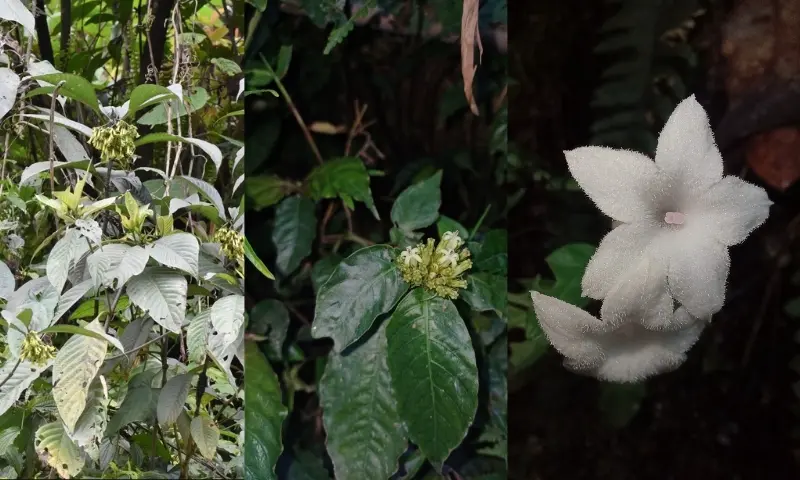

Guwahati: Deep inside the mist-laden forests of Arunachal Pradesh's Shi-Yomi district, where clouds cling to ridgelines and streams carve through mossy ravines, scientists have uncovered something remarkable: three plant species new to science, each rooted in one of the richest yet least explored landscapes of the Eastern Himalaya.
In a significant scientific breakthrough, researchers from the G.B. Pant National Institute of Himalayan Environment, North-East Regional Centre, Itanagar, in collaboration with the Department of Botany, Sikkim University, Gangtok; Kaliabor College, Assam; FRLH Herbarium, The University of Trans-Disciplinary Health Sciences and Technology (TDU), Bengaluru; and Central National Herbarium, Botanical Survey of India, Kolkata, have reported the discovery of three plant species new to science from the remote forests of Arunachal Pradesh. The findings have been documented in two separate research papers published in the international botanical journal Taiwania.
The discoveries were made during recent botanical explorations in Shi-Yomi district, a biodiversity-rich yet understudied region of the Eastern Himalaya.
The research was carried out through two parallel studies led by PhD scholar Madhusudhan Khanal. The first study, describing Mycetia arunachalensis, was conducted by Madhusudhan Khanal along with Dipankar Borah, Devendra Kumar, Ashutosh Sharma, and Shuvadip Sarkar.
The second study, which reported Ophiorrhiza himadrica and Ophiorrhiza bharat, was led by Madhusudhan Khanal along with Nirjala Khanal, Shuvadip Sarkar, Devendra Kumar, and Santosh Kumar Rai.
A shrub hiding in plain sight
In one study, Mycetia arunachalensis, a member of the coffee family (Rubiaceae), was discovered along the edges of tropical evergreen forests.
Despite growing up to 2.5 metres tall, the plant had long escaped recognition and was even misidentified in earlier collections. Detailed morphological analysis revealed its distinct identity, marked by larger bracts, tightly clustered inflorescences, and a smooth (glabrous) outer corolla.
The species name arunachalensis directly refers to Arunachal Pradesh, highlighting its geographic uniqueness and endemism.
What makes this discovery particularly striking is its rarity: only about 12 mature individuals have been recorded so far-suggesting either extreme scarcity or how little of the region has been thoroughly explored.
Two new herbs from the forest floor
In a parallel study, the researchers described two new species of Ophiorrhiza, a genus known for its ecological sensitivity and diversity.
Ophiorrhiza himadrica grows in high-altitude temperate forests near Mechuka, thriving along shaded stream banks and moss-covered ravines at elevations between 1,900 and 2,200 metres.
Ophiorrhiza bharat occurs in lower-elevation subtropical evergreen forests near Hone village, forming dense, clustered inflorescences in humid understory environments.
Although closely related, the two species show notable differences. O. himadrica exhibits heterostyly, while O. bharat is homostylous, reflecting evolutionary divergence shaped by microhabitats.
Ophiorrhiza bharat is named in dedication to the country, while Ophiorrhiza himadrica is named after the Himalaya, reflecting the significance of the Himalayan region. Both names symbolize biogeographic identity and national recognition of rich Eastern Himalayan biodiversity. The two species exhibit distinct reproductive strategies, reflecting adaptation to different microhabitats.
A biodiversity hotspot still full of surprises
These discoveries highlight how little is still known about the Eastern Himalaya.
All three species share highly restricted distributions, small population sizes, and strong habitat specificity.
Between discovery and uncertainty
All three species, Mycetia arunachalensis, Ophiorrhiza himadrica, and Ophiorrhiza bharat, are currently treated as Data Deficient, with limited information available on their distribution, population size, and ecology, highlighting the need for further field investigations.
A quiet warning from the forest
These plants are not just additions to science, they are indicators of both ecological richness and risk. Their restricted distributions and dependence on specific microhabitats make them especially vulnerable to environmental change. Subtle shifts in climate, habitat disturbance, or land-use patterns could have disproportionate impacts on their survival. In this sense, these newly discovered species serve as early signals, reminding us that even as we uncover biodiversity, we may also be witnessing ecosystems under increasing pressure.
The bigger picture
The Eastern Himalaya remains a frontier of discovery, where every expedition can reshape what we know about life on Earth.
"These discoveries are a reminder that large parts of the Eastern Himalaya are still botanically unexplored. Each new species we find is not just an addition to science, but a signal of how much remains hidden, and how urgent it is to document and conserve these fragile ecosystems," said PhD scholar Madhusudhan Khanal.
"These discoveries reveal not just new species, but the intricate ecological processes that sustain life in the Eastern Himalaya. Such species are often tightly linked to specific microhabitats and environmental conditions, making them highly sensitive indicators of ecosystem health. Their presence reflects complex evolutionary histories and finely balanced ecological interactions that remain largely undocumented. As environmental pressures intensify, understanding and conserving these systems becomes critical, not only to protect individual species, but to safeguard the integrity and resilience of entire Himalayan ecosystems," said Devendra Kumar, Scientist "E" at the G.B. Pant National Institute of Himalayan Environment, North-East Regional Centre, and corresponding author of both studies.