
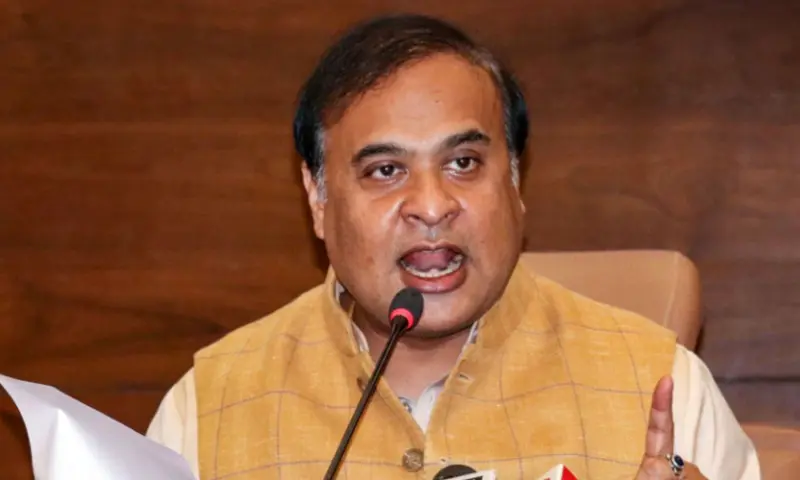

Guwahati: Assam Chief Minister Himanta Biswa Sarma on Friday announced that the state's high school history curriculum will be revised, days after his remarks on Muslim communities sparked political debate.
Sarma said he has directed the Education Department to initiate changes in school textbooks, though he did not spell out detailed reasons for the revision. He raised questions over the portrayal of historical figures in existing lessons, particularly the reference to Ahom-era warrior Bagh Hazarika.
Speaking in the presence of Union Home Minister Amit Shah, the chief minister said Education Minister Ranoj Pegu has been informed about the decision to update the curriculum. He later claimed that Bagh Hazarika did not take part in the Battle of Saraighat alongside Ahom commander Lachit Barphukan.
Addressing the concluding session of the 10th Mising Youth Festival organised by Takam Mising Porin Kebang at Kareng Chapori, Sarma stated that the resistance against the Mughal forces in Kamrup was led by Mising leader Miri Handique, not Bagh Hazarika.
Several historians note that Bagh Hazarika, also known as Ismail Siddique, was a 17th-century warrior who took part in the Ahom campaign against the Mughals at Saraighat. He is believed to have come from a Muslim family in what is now Sivasagar district.
The announcement comes amid an ongoing political row triggered by Sarma's repeated remarks on Muslim communities in the state.
The chief minister and the ruling BJP have frequently drawn a line between indigenous Muslim communities and Bengali-speaking Muslims, often referred to as "Miya."
Earlier this week, Sarma had courted controversy by urging people to inconvenience members of the "Miya" community, suggesting that sustained difficulties would force them to leave the state. He has also linked the issue to alleged infiltration and land encroachment.
During his address, Sarma credited the Mising community with safeguarding Upper Assam, claiming that their presence had limited the expansion of Bengali-speaking Muslim settlements in the region. He praised the community's work ethic and role in preserving Assamese culture.
The term "Miya," traditionally used in a derogatory sense for Bengali-speaking Muslims, often viewed by non-Bengali groups as migrants from Bangladesh, has in recent years been reclaimed by sections of the community as a marker of identity.
At the event, the chief minister also announced financial support of Rs 100 crore for the Mising Youth Festival and an additional Rs 10 crore for initiatives linked to the Donyi-Polo society.