
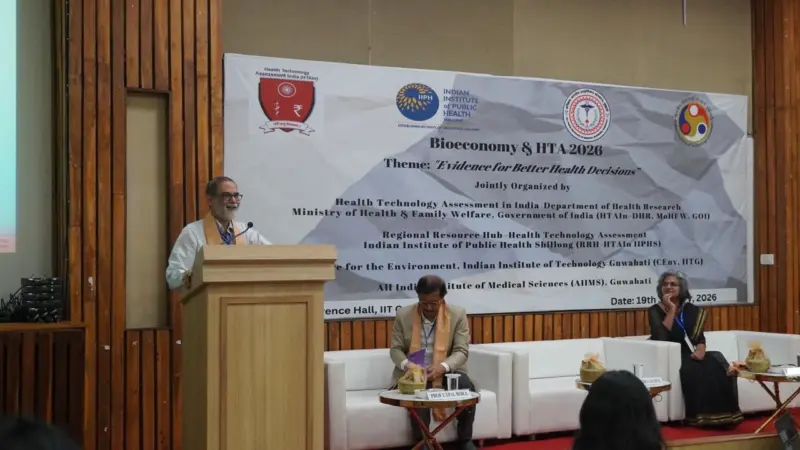

Guwahati: An international conference on "Bioeconomy and Health Technology Assessment (HTA): Evidence for Better Health Decisions" was held at IIT Guwahati on January 19. The event was jointly organised by the Indian Institute of Public Health Shillong (IIPHS), IIT Guwahati and AIIMS Guwahati, in collaboration with Health Technology Assessment in India under the Department of Health Research, Ministry of Health and Family Welfare, Government of India.
The conference brought together policymakers, researchers, clinicians, students and public health professionals to deliberate on the role of evidence-based approaches in strengthening health systems in India.
The event aimed to build awareness and understanding of Health Technology Assessment, particularly among students, early-career researchers and professionals from non-economics backgrounds, to promote a multidisciplinary approach to health and service delivery. HTA is a systematic process used to evaluate the clinical effectiveness, costs and broader impact of health technologies, including medicines, diagnostics, devices and public health interventions. It plays a critical role in guiding health policy and resource allocation by integrating engineering and drug or device development with clinical, public health and economic research methodologies.
The conference opened with an inaugural session chaired by Prof. Utpal Bora, Head of Biosciences and Bioengineering at IIT Guwahati, and Prof. Sandra Albert, Director of IIPH Shillong. The event was formally inaugurated by Prof. Devendra Jalihal, Director of IIT Guwahati. This was followed by an overview of HTA activities in India by Kavitha Rajsekar, Scientist-F at the Indian Council of Medical Research-Department of Health Research.
The technical sessions focused on key components of HTA. Gaurav Jyani of PGIMER Chandigarh spoke on the valuation of health outcomes and its relevance for economic evaluation. Beena Joshi of ICMR-NIRRH, Mumbai, discussed the use of HTA evidence in policymaking and the challenges of translating research into decision-making. Somen Saha of IIPH Gandhinagar delivered a session on costing methodologies, outlining approaches to measuring costs for HTA studies.
A highlight of the conference was the oral paper presentation session, moderated by Phulen Sarma of AIIMS Guwahati. Seven presentations showcased ongoing HTA research from institutions across the country. Topics included cost-effectiveness analysis of AI-assisted chest X-ray tools for tuberculosis detection, economic evaluation of HPV DNA diagnostics for cervical cancer, assessment of newborn screening technologies, maternal nutrition interventions and tools for improving HTA modelling. The session underscored the wide application of HTA methods across clinical and public health domains.
A poster session followed, providing participants an opportunity to engage in discussions, share research ideas and explore potential collaborations. The posters reflected strong interest among young researchers in applying HTA methods to address health system challenges.
The afternoon session featured a presentation by Bhaskar Borgohain of NEIGRIHMS, Shillong, on the evaluation of a lightweight prosthesis, highlighting the role of HTA in medical innovation. This was followed by a talk by Biju Soman of SCTIMST, Thiruvananthapuram, on the use of free and open-source software in HTA. An international perspective was provided by Saudamini V. Dabak of HITAP, Thailand, who discussed topic prioritisation in HTA based on the Thai experience.
The conference concluded with an interactive session involving policymakers, speakers and participants, focusing on challenges in conducting HTA in India, capacity-building needs and opportunities for collaboration. The event highlighted the growing importance of HTA in strengthening evidence-based health decision-making and building a skilled workforce for India's health ecosystem.