
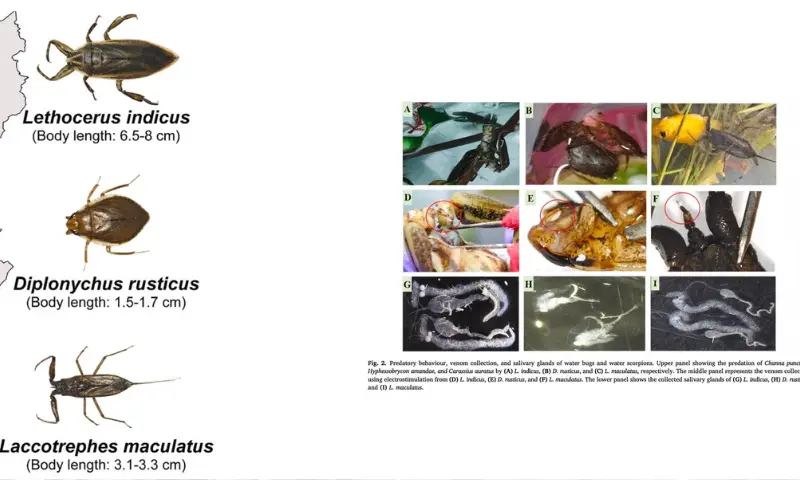

Doomdooma: A common aquatic insect, often ignored or even consumed by locals, has emerged as a potential hidden threat after a series of bite cases reported in upper Assam, a medical expert has revealed.
Surajit Giri, an anaesthesiologist, working on snakebite awareness and associated with the ICMR's "Zero Snakebite Death" project at Demow Rural Hospital, highlighted an alarming yet largely overlooked health risk posed by a small water-dwelling insect found across ponds and wetlands in the region.
The warning follows a recent case involving a 30-year-old trailer driver from Darikapar area in Sivasagar district, who experienced severe swelling and pain in his leg after stepping into shallow water near a hilly route close to the Indo-Myanmar border.
"The patient did not realise he had been bitten. By the time he reached us on the third day, his condition had worsened significantly," Giri said.
The victim was treated using a temporary antivenom protocol and discharged after five days, though he later developed a deep wound at the bite site. He has since recovered.
Describing the insect as resembling a small aquatic creature about eight centimetres long, Giri noted that it is commonly found in ponds and paddy fields and is even eaten by people in some parts of Northeast India.
"We never imagined such a common insect could turn harmful under certain circumstances," he admitted.
Hospital records from 2018 to date show that around 100 such bite cases have been treated at Demow Rural Hospital, with only one fatality reported.
"Nearly 28 patients developed serious wounds requiring prolonged care, while about 70 percent experienced only mild symptoms," he added.
Explaining the science behind such incidents, Giri said venom from insects or snakes causes harm only when it enters the bloodstream.
He noted that the toxins produced by snakes and similar organisms are classified as venom, which is generally not harmful if ingested. "For venom to be dangerous, it must be injected into the bloodstream," he said, adding that mere contact with the skin or ingestion usually does not cause harm.
In contrast, substances such as phenyl are categorised as poisons, which can damage the body even without entering the bloodstream.
He explained that this is why consuming certain toxic organisms found in water bodies may not necessarily result in harm.
Referring to snakebites, Giri said the severity of injury depends on the quantity of venom delivered. A lethal dose can be fatal if untreated, while a sub-lethal amount may lead to pain, swelling or localised wounds but is unlikely to cause death.