
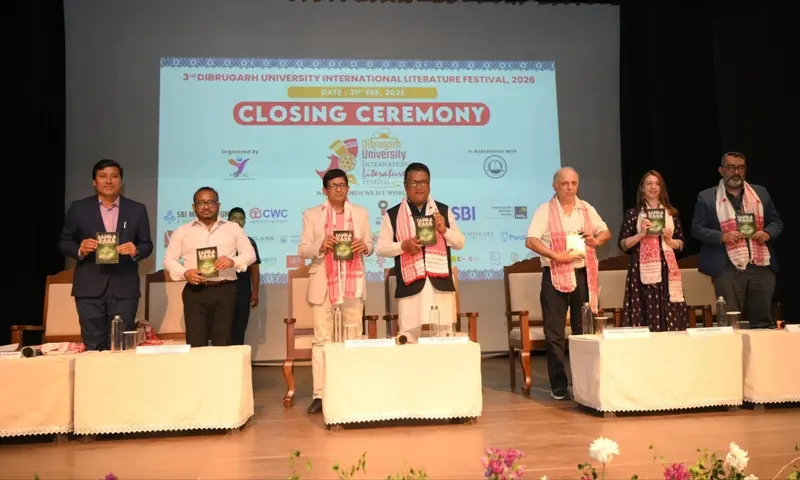

In December 2024, my friend of many years, Pankaj Dixit, spoke to me about the Dibrugarh University International Literature Festival (DUILF).
He invited me to attend, assuming that my husband, a writer, might also be interested in participating. The proposal did not come to fruition. However, early this year, Pankaj renewed his invitation based on his experience of DUILF in 2025. I started feeling a little more inclined. The organizers were planning to include Hindi writers for the first time, which made the invitation even more special. Although my husband initially accepted the invite from the curator, he later had to decline due to professional commitments. Now, I had to decide whether to attend.
I felt somewhat hesitant. I wondered if I would truly enjoy the experience, especially since I had not been actively reading for years. Pankaj encouraged me, saying that the festival, held on the Dibrugarh University campus with students as the primary attendees, would be a wonderful experience. With a mixture of excitement and nervousness, I finally decided to go.
When I arrived at the Dibrugarh Airport, I immediately sensed an atmosphere of festivity. The organisers and the university protocol team were there to receive us. Many of my fellow passengers turned out to be authors travelling for the festival, and meeting them filled me with an unexpected sense of joy and anticipation.
I was truly delighted and pleasantly surprised by the way the Foundation for Arts, Culture and Literature, the principal organiser, and the protocol team, represented by university professors and students, managed everything for the visiting authors and guests. From guiding us to our hotels and guest rooms to ensuring our comfort at every step, their arrangements were seamless. It was evident that a great deal of dedication and preparation had gone into organizing the event so smoothly, right up until the departure of the guests.
As I entered the Dibrugarh University campus for the first time, I was amazed by its vastness. Colourful banners displaying the names and photographs of authors lined the pathways, instantly catching my attention. Students moved around busily with visible enthusiasm as they prepared for the upcoming festival. ing them, I almost felt like a student again, it felt like returning to a familiar and welcoming home.
The festival began with tremendous excitement and energy. It opened with a vibrant cultural programme that beautifully reflected the spirit of the region. The performances celebrated the essence of the Northeast and involved both students and faculty members. Nothing had been outsourced, everything was created and performed by the university community itself, and that authenticity made all the difference.
I also realised that each year the festival chooses a "Focus Region." This year, it was the Middle East and North Africa.
The first session I attended featured author Sopan Joshi, whose mesmerizing account of mangoes and their deep connection with our culture and happiness transported me to orchards and bustling markets filled with fragrance and joy, something I had experienced as a child growing up in Bihar. Later, during the first of the four official dinners, I shared a table with him. Amid the pleasant music and warm ambience, our conversation continued to revolve around the fascinating world of mangoes.
On other occasions, I also met General Bipin Bakshi, Rear Admiral S. K. Gupta, and Air Vice Marshal Arjun Subramaniam, who shared their thoughts about the festival. Despite their distinguished careers and remarkable achievements, they appeared relaxed and thoroughly enjoyed the atmosphere of freedom and camaraderie that surrounded the event.
It was not only Indian authors who contributed to this vibrant environment, writers from different parts of the world, especially those from the Middle East and North Africa, also participated. I heard a variety of accents and languages, which made the festival feel like a truly global gathering. I noticed that most authors were approachable, friendly, and happy to talk with anyone interested in their work. Their openness created a welcoming environment. I made an effort to speak with many of them, and several expressed deep affection for the festival, describing it as something they felt personally connected to. I was pleasantly surprised to learn how many of them returned year after year and eagerly welcomed new writers into this literary community.
More than 150 writers, poets, and speakers from numerous countries participated in the festival, sharing diverse perspectives through panel discussions and conversations. In one session, authors from India, Egypt, and South Korea came together to discuss their ideas. They spoke freely and warmly, creating an atmosphere of friendship and mutual respect. It was inspiring to see how literature can bridge cultures and connect people through shared human experiences. The moderators encouraged lively exchanges that made everyone feel included.
In another memorable session, Sumana Ramanan, the author of The Secret Master, engaged in a thoughtful conversation with Trisha Dey Niyogi, a publisher. They explored the themes of her book and the inspirations behind it. What made the session unique was how Sumana complemented her discussion with music. She played musical notes that reflected the mood of the narrative and even sang a few lines to help the audience feel the emotions behind the words. It was a beautiful experience that demonstrated how music can express feelings that language sometimes cannot. Together, they created a deeply engaging atmosphere that left us with thoughtful reflections and a renewed appreciation for both literature and music.
One of my favourite sessions was a book reading accompanied by a presentation. It shared stories of struggle, conflict, and resilience connected to the history of Bangladesh's liberation. What made it especially meaningful was the presence of two defence personnel engaging in discussion with an author from a civilian background on a subject that touched everyone's heart. There were no barriers regarding who could speak or contribute. This openness created a sense of unity among us. It reminded me that literature has the unique power to connect people through stories, memories, and shared history. Once again, I felt that the spirit of free expression defined the entire festival.
Since this was the first time the festival hosted sessions in Hindi, I made sure to attend them. They turned out to be extremely popular, featuring poetry readings, book discussions, and lively exchanges of ideas. I sensed a strong feeling of belonging among the audience. Many participants asked thoughtful questions and later interacted with the authors in detail. It made me feel that Hindi literature has a promising future here, and I would certainly suggest that it be given even more space in future editions of the festival.
One of the festival's greatest strengths was its location: the university campus. It attracted not only students from Dibrugarh University but also young participants from nearby states. I particularly enjoyed having meals in the campus canteen, where I had the chance to interact with students and faculty members. They were full of curiosity, energy, and fresh ideas, which became evident during the engaging question-and-answer sessions. Sitting with them over tea and delicious meals prepared in the canteen-food that seemed never to run out, I once again felt like a student. We exchanged opinions and contact details, creating connections that I believe will last long after the festival.
The coordination between the organisers was remarkable. Everywhere I looked, volunteers-students as well as faculty members, were working tirelessly to ensure that every session ran smoothly. Their enthusiasm and dedication made each day of the festival a success. The only thing I wished for was a greater presence of the local public audience, something which signals that the festival is now being owned by all.
Like all good things, the festival eventually came to an end after four remarkable days on February 21. Yet the experience left me enriched in many ways. It felt as if I had stepped into a vast living library filled with stories from around the world. It was not only about books-it was about people who write, think, and share ideas.
For someone attending a literature festival for the first time, it was an unforgettable experience: a chance to meet real writers, to understand how stories come to life, and to witness how literature connects cultures across the world.
Now that I am back home, I carry with me a deep sense of happiness and inspiration from this beautiful world of books, art, and culture. I am already reading a book after almost 12 years.