




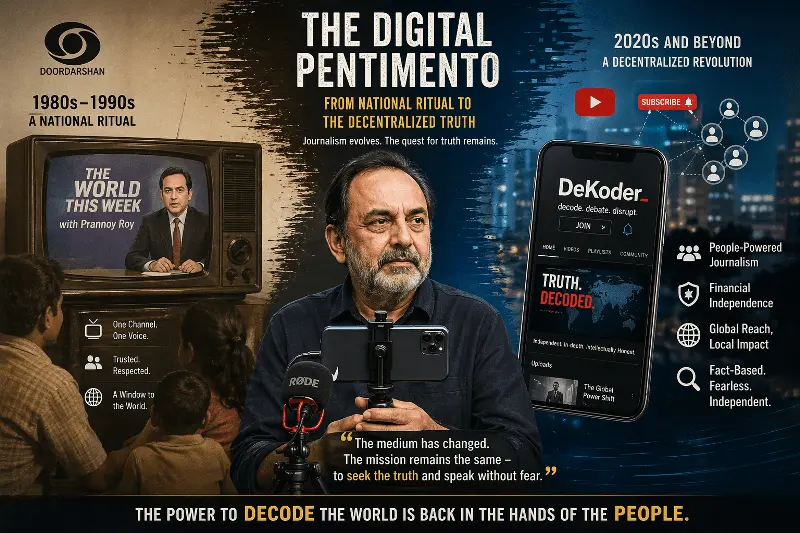

In the late 1980s and early 1990s, the Indian living room underwent a weekly transformation. Before the cacophony of five hundred satellite channels and the relentless ping of smartphone notifications, there was a singular, quiet ritual.
On Friday nights, households across the subcontinent tuned into the national broadcaster to watch The World This Week. For a generation growing up in a pre-liberalized India, this was more than just a news program. It was an intellectual window.
As the distinctive, rhythmic pulse of the tabla theme music began, Prannoy Roy would appear-not as a shouting head, but as a sober guide. In forty-five minutes, he would distill the complexities of global governance and international shifts into a coherent narrative. For many, this was the crucible of their "global citizenship," the moment they realized that happenings in a distant capital had a direct, systemic link to their own lives.
Today, in 2026, we find ourselves at another pivotal junction, one that feels like a "digital pentimento"-a concept in art where the original lines of a painting, once covered by layers of newer pigment, begin to reappear. The original intent of those early days-fact-based, intellectually driven journalism-is resurfacing, but it is doing so by breaking through the very institutions that once claimed to protect it.
The Rise and Fall of the Media Monolith
The trajectory of Indian media over the last thirty years is a study in the paradox of scale. The transition from the state-controlled monolith of Doordarshan to the private "media revolution" of the early 2000s was initially hailed as a victory for democracy. The founding of NDTV (New Delhi Television) represented the gold standard of this era: unbiased, professional, and fiercely independent.
However, as the media ecosystem became more commercialized, the "unit of trust" began to erode. The high capital costs of running a national satellite network-satellite link-ups, massive studio overheads, and sprawling bureaucratic structures-created a dangerous dependency. To survive, these institutions required massive infusions of corporate capital or government advertising.
This dependency eventually led to what can be described as "institutional capture." We watched as premier channels were transformed into "corporate cucumbers," silenced or redirected by hostile takeovers and political pressure. The very infrastructure designed to broadcast the truth became the cage that contained it.
The documentary While We ed, focusing on the struggles of veteran journalist Ravish Kumar, serves as a poignant eulogy for this era of institutionalized journalism, highlighting the immense psychological and professional toll on those who refused to surrender the "voice of reason."
The Decentralized Revolution: The iPhone and the Subscription
Fast forward to the present, and the wheel has turned full circle. There is a profound poetic justice in seeing the pioneers of that first revolution return to the front lines. Seeing Prannoy Roy today-not in a multi-million-dollar studio, but standing with an iPhone camera and a simple microphone to launch DeKoder-marks the beginning of a new epoch.
This is the era of low-capital, high-trust journalism. By moving to subscription-based, digital-first platforms like YouTube, the financial "choke points" of the past are being bypassed.
- Revenue as Autonomy: When the "boss" is a collective of five hundred thousand individual subscribers rather than a single corporate conglomerate or a state department, the journalist is insulated from external censorship.
- The Democratization of Access: The barriers to entry have collapsed. A journalist with a smartphone and a reputation for integrity can now compete for the "mindshare" of an audience increasingly weary of the absurdity and vulgarity of mainstream cable networks.
- Global Resilience: This is not just an Indian phenomenon; it is a global recalibration. From independent newsletters to subscriber-funded investigative units, we are seeing the emergence of a decentralized media ecosystem that is significantly harder to control or co-opt.
The Indomitable Human Drive for Fact
Underlying this structural shift is a fundamental truth about human nature. As individuals, we possess an inherent, almost biological drive to "think beyond." Throughout history, power centers have attempted to consolidate the message and curate the narrative to serve their own ends. They often succeed in the short term, utilizing propaganda to influence the consumer. Yet, there is a limit to how much the human imagination can be curbed.
We are, at our core, an inquisitive species. Our place at the top of the food chain is a result of our ability to decipher complex signals, to look for the alternative, and to distinguish fact from fabrication. When the institutional narrative diverges too far from the lived reality of the individual, the human drive for fact-based information becomes an unstoppable force.
The migration of audiences away from legacy media and toward independent, subscription-funded platforms is the ultimate evidence of this indomitable nature. It is a collective refusal to settle for a half-truth.
The New Age of Governance and Information
We are witnessing the heralding of a new age. While the loss of legacy institutions like the original NDTV felt like a defeat for the "voice of reason," it was actually the catalyst for a more resilient form of journalism.
The ritual has changed-from waiting for a Friday night broadcast to clicking a notification on a smartphone-but the underlying hunger for quality news remains constant. As long as the human spirit retains its need to explore and understand, no amount of institutional capture can permanently hide the facts.
We are moving toward a more representative, open, and decentralized form of information governance, where the power to "decode" the world is finally back in the hands of the people.