
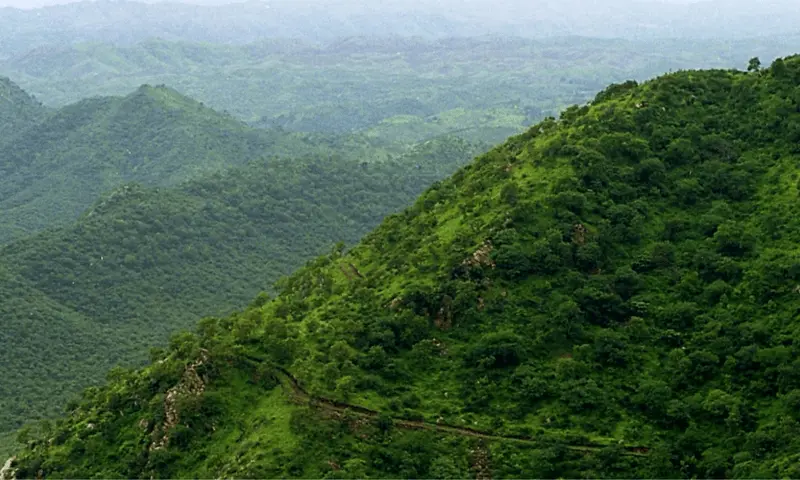

Guwahati: The Ministry of Environment, Forest and Climate Change has informed the Supreme Court of India that it has no objection to the constitution of a 10-member high-powered expert committee proposed by the Central Empowered Committee to come up with a uniform definition for the Aravalli hills and ranges.
In an affidavit submitted to the apex court, the Ministry endorsed the names suggested for the proposed panel, which includes serving and retired bureaucrats linked to the Forest Survey of India, Geological Survey of India and Survey of India, along with several academicians and subject experts.
"The MoEFCC respectfully submits that it has no objection if this court accepts the suggested names for the constitution of the proposed High Powered Committee. It is further submitted that the Ministry does not have any additional names to propose at this stage for inclusion in the said committee," the affidavit said.
The Ministry also noted that issues related to the Aravalli hills and ranges require a comprehensive and analytical examination by domain experts, including consultations with relevant stakeholders.
According to the CEC's report to the court, the proposed committee would be headed by Devi, a 1991-batch Indian Forest Service officer from the Madhya Pradesh cadre, who has more than three decades of experience in forestry education and research, wildlife management and forest policy.
Other members suggested for the panel include Subhash Ashutosh, former Director General of the Forest Survey of India, Rajendra Kumar Sharma, former Director of the Geological Survey of India, climate and energy policy expert Tejal Kanitkar, life sciences researcher and academician Jaya Parkash Yadav, senior geographer Tejbir Singh Rana, former Additional Surveyor General of India S.V. Singh, former Gujarat Principal Chief Conservator of Forests C.N. Pandey, and former Nagaland PCCF Dharmendra Prakash.
The CEC has also recommended the inclusion of R.N. Mishra, a noted author, and Vijay Dhasmana, an ecological restoration practitioner and conservationist.
On February 26, the Supreme Court had directed the Environment Ministry and other stakeholders to suggest the names of domain experts for the committee, which will work on defining the Aravalli hills and ranges. The court also observed that only lawful mining activities would be permitted in the region.
Earlier, on December 29, the court had taken note of concerns raised over a new definition of the Aravallis and kept in abeyance its November 20 directions that had accepted a uniform definition of the hill range. It had also ordered a halt to all mining activities in the region.
The court observed that several "critical ambiguities" needed to be addressed, including whether the proposed criteria - such as a minimum elevation of 100 metres and a 500-metre gap between hill formations, could exclude significant portions of the Aravalli range from environmental protection.