





Written by: Prisha Khanna, Moitrayee Das
Staying in one job for five years was a sign of job stability. For a lot of young professionals today, it is called stagnation.
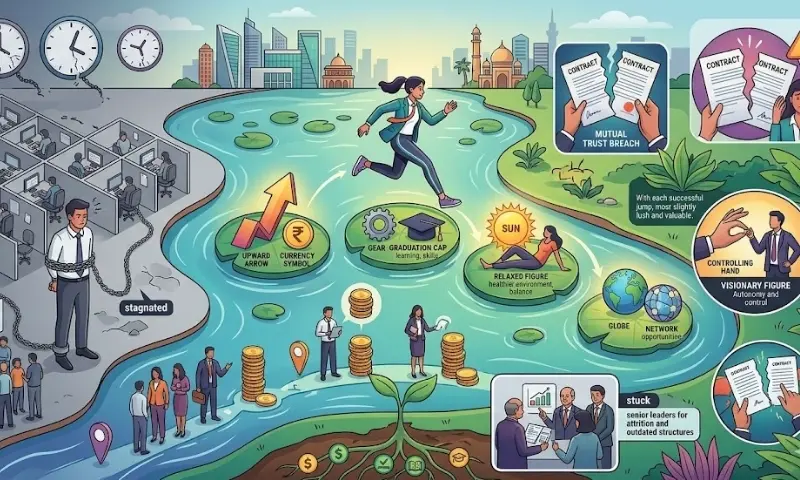
While we may pass it off as Gen Z impatience or restlessness, it is in fact the opposite. This is not a random shift out of boredom but a strategic move from one role to another in search of better pay, faster learnings or even a healthier work environment. There's a name for this phenomenon already- Lilypadding. Team leaders often see it as the lack of commitment. However, that notion misses the point.
Atleast 7 out of 10 Gen Z professionals in India are willing to switch jobs in about 6 months. This is largely a result of dissatisfaction with pay and growth incentives (Ajinkya Kawale, 2025). A broad 72% of the professionals are actively seeking new work opportunities (Banerjee, 2026) .
This isn't instability or impulsiveness. Rather, it is adaptation to changing work setups. Lillypadding is a reflection of a psychological shift in how work, job security and job loyalty are perceived in a market where none of these remain guaranteed.
Behind the Scenes of Lillypadding
Lilypadding is rooted in the silent, unwritten expectations between employees and employers. So far, this contract of mutual understanding has assured stability, gradual growth and job security in return for loyalty towards the organization. However, frequent layoff cycles, contract based hiring and burnout causing work cultures have weakened that perspective. Research has shown that when employees recognize this breach of trust, they re-evaluate their relationship with work (Sok et al., 2013). This is visible in the shift from long term to short term commitments. In such a context, lilypadding appears less of a rejection to loyalty and more like a response to the ongoing erosion.
There is a stronger emphasis on autonomy. As per the Self Determination Theory, autonomy refers to the innate need to feel in control of one's choices (Hagger & Star, 2026) . Gen Z is entering a workforce driven by digital access, interconnected global opportunities and visible career opportunities. Such an environment only amplifies the need for this autonomy. When they find themselves in restrictive, monotonous, misaligned roles, exit becomes a rational decision for them instead of the last resort.
The Indian job market is already showing signs of this phenomenon. Reports have shown that platforms like LinkedIn and Naukri consistently show increased job mobility amongst younger employees (Deloitte, 2025). This is often linked to better pay, advanced skill acquisition and job role upgrade. In systems where external changes yield notably higher returns than internal growth, staying in one place for longer may seem like a psychological and financial risk. This makes lillypadding not an aimless movement. Rather, it is a tactful strategy born out of unfulfilled expectations and the growing need for control in the unpredictable job market.
Why does it Matter?
What makes lilypadding so prominently visible in India is not just psychological repercussions but also incentives. Early- career professionals have realized that staying put in one place costs them economically. Externally switching jobs in sectors like marketing and technology can yield 15-40% salary hikes (Mukherjee, 2024). This is far greater than annual appraisal limits. Employees with 0-3 years of work experience often show the greatest attrition rates. This is largely driven by a mismatch between compensation and job roles. Similar insights also highlight that Gen Z professionals tend to prioritise skill development and career growth over a long term tenure (Deloitte, 2025).
From a psychological standpoint, this phenomenon closely aligns with how individuals respond to reinforcement. When each job switch yields a better income, learning opportunity or work environment, overtime becomes a rational, reinforced strategy instead of risky choices. With time stability may feel like a loss of better opportunities elsewhere rather than a virtue.
It is important to consider the identity component as well. Early career paths are no longer about "settling down" but more about exploring varied roles, industries and even versions of one's professional selves. In fast moving urban hubs, high exposure to startups, side gigs and global work cultures normalises being on the go constantly. What older generations call inconsistency, is expanded learning opportunities for the Gen Z.
Lillypadding is thus not just a retaliation to unfulfilled expectations. It is rather backed by a system that rewards mobility than just loyalty alone.
What Needs to Change
This phenomenon, increasingly labelled as impatience by organizations is infact a failure to pace with how the perception of work itself has changed with the younger workforce. Most companies still rely on outdated organizational structures. Slow promotion cycles, opacity in career paths and rigid hierarchical boundaries remain constant while expecting employees to remain invested under the name of loyalty. As per Aon India's Salary Increase Survey, annual increments are stagnant at an average of 9% (Aon, 2026). However, external job switches yield notably higher returns. This creates a system where growth is more accessible to employees externally than within their current organization.
If organizations want to reduce this constant churn, the solution does not lie in demanding unquestioned loyalty but to evolve themselves for it. This requires building transparent growth pathways, easing the process of internal mobility in the form of role rotations and bringing compensation closer to existing market realities. Companies need to form their own internal 'lilypads' where employees can freely move, evolve and grow without feeling stagnated.
Organizations need to see the reality for what it is. Gen Z is not leaving at the first opportunity they get. Rather, they are leaving when they find the next opportunity to be meaningfully better. Until this gap does not close, lilypadding will remain as a predictable response of young professionals, not as a lack of commitment but the sheer refusal to settle for stagnation.
References
Ajinkya Kawale. (2025, June 25). 7 of 10 GenZs plan on switching jobs in 6 months for better pay: Survey. @Bsindia; Business Standard. https://www.business-standard.com/industry/news/gen-z-india-job-switching-intent-salary-dissatisfaction-deel-survey-125062501095_1.html
Aon. (2026). Aon Survey Projects Slight Uptick in Salaries in India From 8.9 Percent in 2025 to 9.1 Percent in 2026. Aon.com. https://www.aon.com/apac/in-the-press/asia-newsroom/2026/aon-survey-projects-slight-uptick-in-salaries-in-india-2026?searchtext=salary+increment&utm_
Banerjee, D. (2026, January 8). 72% of Indians seek a job change, but only 16% feel prepared: LinkedIn Report. The Indian Express. https://indianexpress.com/article/education/india-job-market-2026-27-gen-z-boomer-worker-unprepared-ai-takeover-workforce-linkedin-report-data-10461008__trashed-10461034/lite/
Deloitte. (2025). 2025 Gen Z and Millennial Survey. Deloitte. https://www.deloitte.com/global/en/issues/work/genz-millennial-survey.html
Hagger, M. S., & Star, K. M. (2026). Self?Determination Theory and Workplace Outcomes: A Meta?Analysis. Stress and Health, 42(1), e70151-e70151. https://doi.org/10.1002/smi.70151
Mukherjee, R. (2024, April 11). Shifting jobs may give you 15-40% salary hike: Survey. The Times of India; Times Of India. https://timesofindia.indiatimes.com/business/india-business/shifting-jobs-may-give-you-15-40-salary-hike-survey/articleshow/109209042.cms?
Sok, J., Blomme, R., & Tromp, D. (2013). The use of the psychological contract to explain self-perceived employability. International Journal of Hospitality Management, 34, 274-284. https://doi.org/10.1016/j.ijhm.2013.03.008
Prisha Khanna is an undergraduate psychology student at FLAME University, Pune, and Moitrayee Das is an assistant professor of psychology at FLAME University, Pune.