
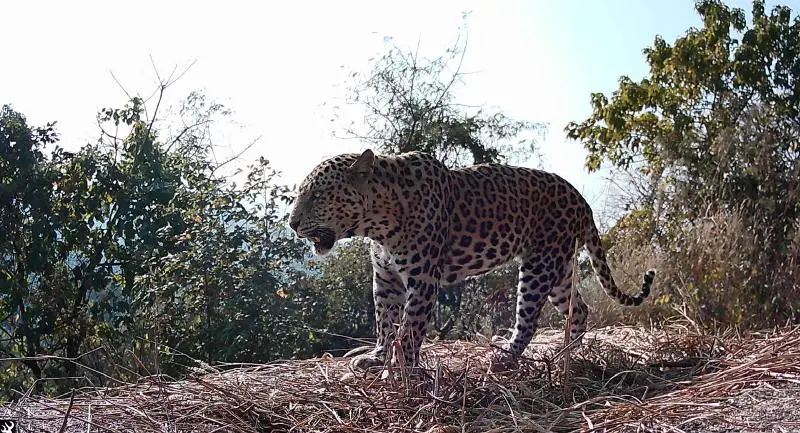

Guwahati: At least 34 leopards are living in Guwahati, a new camera-trap study by the Assam Forest Department has found, highlighting the city as a key habitat for big cats.
The study, conducted under the Assam Project on Forest and Biodiversity Conservation (Phase II), was funded under the leadership of Project Director Anurag Singh, IFS, and implemented by Sunnydeo Choudhary, IFS, Conservator of Forests, Central Assam Circle, Guwahati. Wildlife biologist Kamal Azad played a key role in the research.
But researchers say this is only part of the picture.
Using statistical modelling, the team estimates that Guwahati could be home to around 55 leopards, indicating that many animals remain undetected within the city's fragmented green spaces.
A City Shared with Big Cats
The study reveals that leopards are not confined to isolated forests but are actively using a network of habitats-including hill forests, reserve forests, wetlands, and even tea gardens.
Areas surrounding Amchang Wildlife Sanctuary and adjoining hill systems have emerged as critical refuges, enabling the species to persist within one of Northeast India's fastest-growing urban centres.
Masters of the Night
Despite their proximity to people, leopards remain largely invisible.
Camera trap data shows that the animals are predominantly nocturnal, with peak activity recorded between 10 pm and 2 am-a behavioural adaptation likely aimed at avoiding human contact.
They navigate forest corridors, rest along rocky hill slopes, and even access water sources used by nearby communities.
Adapting to Urban Survival
One of the most striking observations is their growing adaptation to urban environments.
In a telling instance, a leopard was captured carrying a street dog, suggesting a shift towards urban prey.
While this adaptability aids survival, it also raises concerns about increasing human-wildlife interactions.
A Rich Yet Fragile Ecosystem
Beyond leopards, the survey recorded over 25 wildlife species, including elephants, clouded leopards, pangolins, and several primates-highlighting the biodiversity still surviving within Guwahati's shrinking natural landscapes.
Warning Signs Emerge
The study flags growing threats from rapid urbanisation, including encroachment, hill cutting, and habitat fragmentation, which are steadily pushing wildlife closer to human settlements.
Notably, researchers reported no leopard detections in areas like Garbhanga and Rani, raising concerns about habitat degradation in these zones.
A Delicate Balance
The findings underscore a stark reality: Guwahati is not just a human city-it is also a leopard landscape.
As urban expansion continues, the challenge ahead will be maintaining a fragile coexistence between people and one of India's most adaptable big cats.