





Written by:A. N. Mohammed
The Subansiri Lower Hydroelectric Project (SLHEP) represents one of the most significant hydropower developments in India's Northeast and offers an important example of how modern hydropower infrastructure can evolve beyond conventional electricity generation.
Located at Gerukamukh on the Assam-Arunachal Pradesh border, the 2,000 MW run-of-the-river project has been designed not only to provide peaking power support to the national grid but also to contribute meaningfully to downstream flood moderation during the monsoon season.
In recent years, debates surrounding large dams in Himalayan river systems have often focused on environmental concerns, displacement, sedimentation, and downstream impacts. While these concerns remain valid and deserve continued scrutiny, it is equally important to examine how contemporary reservoir operation strategies are increasingly attempting to balance multiple objectives simultaneously. SLHEP, in many ways, reflects this transition.
Based on more than five decades of hydrological data, the operational philosophy of the project demonstrates how regulated reservoir management can enable reliable peaking generation even during dry periods, while deliberate seasonal drawdown can create substantial flood-cushioning capacity. The project therefore provides an important case study in balancing energy generation, environmental flow compliance, sediment management, and flood-risk reduction within the fragile Himalayan river basin context.
Rethinking Role of Large Hydropower Projects
Large hydropower projects in Himalayan river systems have always faced complex operational challenges arising from extreme seasonal variability, high sediment loads, and recurrent downstream flooding. Traditionally, most hydropower projects were designed primarily as energy-generation assets. However, changing climatic conditions and increasing flood vulnerability are forcing a shift toward multi-objective reservoir management systems.
The Subansiri Lower Hydroelectric Project exemplifies this emerging approach. Designed as a peaking power station with an online reservoir, SLHEP integrates grid support, environmental flow compliance, and flood attenuation within a single operational framework. In that sense, the project represents not merely an engineering structure, but an evolving model of integrated water management.
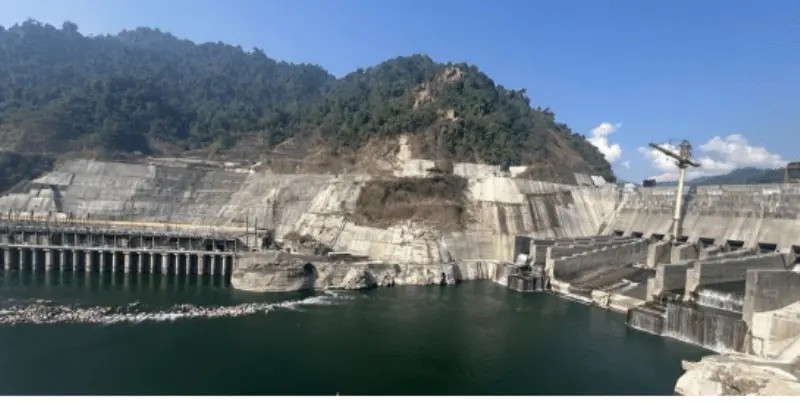
View of Subansiri Lower Hydroelectric Project dam and powerhouse
Project Design and Engineering Considerations
SLHEP is located on the Subansiri River, one of the major tributaries of the Brahmaputra. The project has an installed capacity of 2,000 MW and consists of eight surface-mounted Francis turbine units of 250 MW each.
Schematically Layout represents the project components, including: 116 m high concrete gravity dam, 8 nos 7.3mx9.5m Power intake and 8 nos 9.5m dia Headrace Tunnels, 8 nos 9.5m dia Surge Tunnels, Surface powerhouse with 8 units of 250 MW, 35mx206m Tailrace channel.The selection of vertical-axis Francis turbines followed comprehensive techno-economic evaluation and was intended to match the site-specific head and discharge conditions. Importantly, unit sizing also accounted for operational flexibility, maintainability, and the practical challenges of transporting heavy equipment into remote mountainous terrain.
Phased commissioning of the project began in December 2025, with four units totalling 1,000 MW achieving commercial operation by May 2026. Full commissioning is expected during 2026-27.
Understanding the Hydropower Equation
Power generation at SLHEP follows the standard hydropower relationship:
P = \rho gQH\eta
where ( \rho ) represents water density, ( g ) is gravitational acceleration, ( Q ) denotes turbine discharge, ( H ) refers to net head, and ( \eta ) represents overall efficiency.
Each 250 MW unit requires a design discharge of 322.4 m³/s at an operating gross head of 91 m. This results in a total discharge requirement of 2,579.2 m³/s for continuous full-capacity operation of all eight units.
These figures are important because they underline a key operational reality of Himalayan hydropower systems: installed capacity and actual generation capability often differ sharply across seasons due to fluctuating river flows.
Hydrological Reality of the Subansiri Basin
The Subansiri River has an average annual flow volume of 44 billion m³, corresponding to a mean discharge of 1,396 m³/s. Approximately 85% of the runoff is rainfall-driven, while the remaining 15% is contributed by snowmelt.
This seasonal imbalance defines the operational character of the entire project.
Lean-season flows between October and May average only 400 m³/s, while monsoon flows rise dramatically to nearly 4,000 m³/s. Historical records spanning more than five decades indicate a dependable minimum discharge of 188 m³/s even during the driest years. Flooding tendencies in downstream regions generally begin when flows exceed 7,000 m³/s.
Another important aspect often overlooked in public debates is sediment behaviour. The annual sediment load at the Subansiri Lower dam is estimated at 20 MCM, with nearly 85% entering during the flood season. By maintaining a low spillway crest elevation (El. 145 m) and keeping reservoir levels relatively lower through much of the monsoon, the project is designed to increase sediment transport and reduce large-scale sediment settlement.
According to experts, once the project becomes fully operational, it is expected to restore a relatively stable sediment regime closer to natural river conditions.
The average seasonal flow pattern of the Subansiri River. Lean-season flows during December-February remain in the range of 300-400 m³/s, whereas monsoon flows between June and August rise to nearly 4,000-4,500 m³/s. At times, flows can increase to 12,000 m³/s for short durations during intense monsoon periods. Flood conditions downstream typically begin when flows exceed 7,000 m³/s.Reservoir Dynamics and Operational Flexibility
View of the SLHEP reservoir. At FRL, the reservoir extends approximately 59.5 km in length and between 400 m and 1 km in width, covering an area of 33.5 km².The 116 m high dam creates an elongated reservoir with substantial storage flexibility. The reservoir's elevation-storage relationship forms the basis of its operational planning strategy.
Table 1. Hydrological Data of the Subansiri Lower Hydroelectric Project
| Features | Values |
|---|---|
| Design flood (m³/s) | 37,500 |
| Average annual runoff (BCM) | 44 |
| 1 in 100-year flood (m³/s) | 19,600 |
| 1 in 25-year flood (m³/s) | 14,500 |
| 1 in 10-year flood (m³/s) | 12,400 |
| River bed level, elevation (m) | 94 |
| Maximum Water Level, MWL (m) | 208.25 |
| Full Reservoir Level, FRL (m) | 205 |
| Minimum Drawdown Level, MDDL (m) | 181 |
| Minimum reservoir level (m) | 190 |
| Storage capacity at MWL (MCM) | 1,485 |
| Gross storage capacity at FRL (MCM) | 1,365 |
| Storage capacity at MDDL (MCM) | 720 |
| Live storage (MCM) | 645 |
| Storage capacity at minimum reservoir level (MCM) | 923 |
| Maximum observed flood (2011) (m³/s) | 13,800 |
| Minimum observed flow (February 1979) (m³/s) | 188 |
| Annual sediment load (MCM) | 20 |
Hydrological data of Subansiri Lower Hydroelectric Project
The storage-elevation relationship used for reservoir operations. One of the most significant operational decisions involves maintaining reservoir levels around 190 m during the monsoon period. This strategy preserves flood-cushioning capacity while retaining adequate hydraulic head for post-monsoon power generation.Lean-Season Generation and Environmental Flow Obligations
One of the practical limitations of run-of-the-river projects with limited live storage becomes evident during the lean season.
Between December and February, river inflows reduce to only 300-400 m³/s. Under these conditions, SLHEP operations remain constrained to:
- Continuous operation of one unit to maintain the mandated environmental flow of 240 m³/s
- Short-duration peaking operation of additional units for roughly 3-4 hours daily, depending on reservoir availability
This operational reality illustrates the trade-off between environmental obligations and power generation capacity.
With the arrival of pre-monsoon rainfall during March and April, inflows gradually rise to between 1,000 and 2,000 m³/s, enabling 6-12 hours of daily generation consistent with the project's design expectations.
Peaking Power and Grid Support
SLHEP has been designed primarily as a peaking station, intended to supply electricity during periods of maximum grid demand.
The load factor is defined as:
LF = \frac{E_{annualP_{installed} \times 8760}
where:
- ( E_{annual} ) is the annual energy generated
- ( P_{installed} ) is the installed capacity of the plant
- ( P_{installed} \times 8760 ) represents the theoretical maximum annual generation if the plant operated continuously throughout the year
The plant is expected to operate at an average load factor of approximately 45%, which is typical for peaking hydropower projects.
In a 90% dependable hydrological year, total annual energy generation is estimated at 7,421 MU.
Table 2. Seasonal Energy Generation
| Season | Energy (MU) |
|---|---|
| Lean season (Oct-May) | 2,965 |
| Monsoon (Jun-Sep) | 4,456 |
| Total | 7,421 |
Seasonal energy generation
Flood Moderation: The Most Significant Public Benefit?
Perhaps the most important public-policy argument in favour of SLHEP lies in its flood moderation potential.
Although primarily conceived as a power-generation project, the reservoir incorporates explicit flood attenuation measures. During peak monsoon conditions, reservoir levels are intentionally maintained at around 190 m, creating a flood cushion of:
V_f = 1365 - 923 \approx 442\ \text{MCM}
This operational strategy enables:
- Full attenuation of a 10-year flood of 12,400 m³/s for a duration of 24 hours
- A 30-40% reduction in medium-magnitude flood peaks associated with 10-100 year return periods
The dam has also been engineered to safely pass the Probable Maximum Flood (PMF) of 37,500 m³/s through its spillway system.
The PMF hydrograph has been routed through the reservoir at Full Reservoir Level (FRL) EL 205 m, resulting in a calculated Maximum Water Level (MWL) of EL 208.25 m. This provides an additional flood cushion of nearly 120 million cubic metres.
However, flood moderation does not come without economic cost.
At full operational optimisation, the powerhouse could theoretically generate 7,909.41 GWh in a 90% dependable year. Yet, because reservoir operations must preserve flood-cushioning capacity, annual generation is deliberately reduced to 7,421.59 GWh. In effect, nearly 487.82 GWh of energy generation is sacrificed annually for regional flood moderation requirements.
To preserve flood cushion during the monsoon, generation is restricted to approximately 1,800 MW instead of the full 2,000 MW capacity. This translates into a revenue impact estimated at nearly ?250 crore annually.
Yet, when viewed against the recurring human and economic costs of downstream flooding in the Brahmaputra basin, this trade-off may well be justified.
Conclusion
The Subansiri Lower Hydroelectric Project demonstrates that large hydropower infrastructure can no longer be viewed solely as a power-generation asset. Increasingly, such projects must function as integrated reservoir and water-management systems capable of balancing multiple and often competing objectives.
The operational strategy adopted at SLHEP shows how strategic seasonal reservoir drawdown can modestly reduce annual energy generation while significantly enhancing downstream flood-risk mitigation and basin-level resilience.
Equally important is the possibility of coordinated operation with future upstream hydropower developments. Such integrated cascade management could contribute to cumulative flood attenuation across the wider Subansiri-Brahmaputra river system.
Ultimately, the SLHEP model suggests that data-driven reservoir regulation can simultaneously support grid-oriented peaking power generation, environmental flow compliance, sediment management, and flood moderation.
In a region increasingly vulnerable to climatic uncertainty, hydrological variability, and extreme flood events, the lessons emerging from SLHEP may become increasingly relevant for the future of sustainable hydropower development across the Himalayan river basins.
A. N. Mohammed is a Consultant at Hydropower Development, India,