

Creating 3D assets has traditionally been a time-consuming and technically demanding process. Artists often spend hours building geometry, refining topology, and preparing assets for rendering or animation.
For many creators, traditional 3D design tools require a steep learning curve and significant manual work.
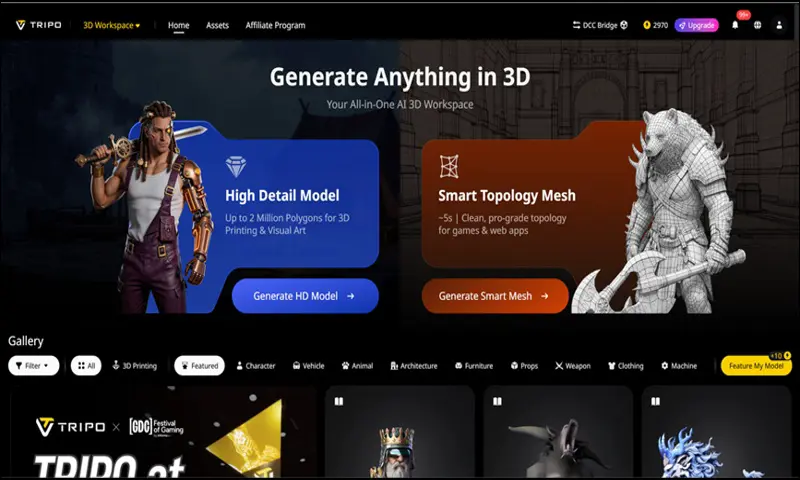
Today, AI is beginning to change that workflow. Tripo Studio is an advanced AI 3D model generator that allows users to create high-quality 3D assets directly from prompts or images. Instead of modeling objects manually, creators can generate models within seconds and then refine them inside a unified workspace. By combining generation, optimization, and editing tools, Tripo provides a faster and more accessible approach to AI 3D modeling.
As demand for 3D content continues to grow across gaming, digital media, and immersive technologies, platforms like Tripo Studio are emerging as powerful solutions for modern creators.
What Is Tripo?
Tripo is an AI-powered platform designed to simplify the creation of 3D assets. Built around a powerful AI 3D model generator, the platform enables creators to transform ideas, text descriptions, or images into detailed 3D models with minimal effort.
Through Tripo Studio, users can generate models, refine mesh structures, apply textures, and prepare assets for animation. This integrated workflow makes it possible to move from concept to production-ready assets much faster than with traditional pipelines.
At its core, Tripo functions as a comprehensive 3D AI generator, combining multiple AI technologies into a single platform. Instead of relying on separate tools for modeling, retopology, and texturing, creators can complete most tasks within one system.
The result is a workflow that significantly reduces technical barriers while maintaining high-quality output.
Core Features of Tripo
The strength of Tripo lies not only in its generation speed but also in its ability to support the full workflow of AI 3D modeling. The platform integrates multiple features that allow creators to generate, refine, and prepare assets efficiently.
Text to 3D Model Generation
One of the most powerful capabilities of Tripo is its text to 3D model generation system. With this feature, users can simply type a description of an object, character, or environment. The AI interprets the prompt and converts it into a fully structured 3D model. For example, prompts like "a futuristic drone," "a stylized medieval sword," or "a cartoon robot character" can quickly produce usable assets.
This capability allows creators to explore ideas rapidly. Instead of spending hours modeling from scratch, designers can experiment with multiple concepts and variations in minutes. As a result, the AI 3D model generator dramatically accelerates the early stages of creative development.
Image to 3D Model Generation
In addition to text prompts, Tripo also supports image to 3D model generation. Users can upload a reference image or concept sketch, and the system reconstructs it into a three-dimensional asset. This is particularly useful for artists who already have visual references or concept art but need to convert them into usable 3D assets.
By analyzing shape, depth, and visual features, the AI 3D model generator creates structured geometry that reflects the original image. This process allows designers to bridge the gap between 2D artwork and interactive 3D content. For creators working in concept art, game design, or digital illustration, the image to 3D model workflow can significantly streamline production.
Intelligent Segmentation
Working with complex assets often requires separating models into individual parts. In traditional 3D design, this step typically involves manual mesh editing and can take considerable time. Tripo's Intelligent Segmentation feature automates this process. The AI analyzes the generated model and splits it into logical components that can be edited independently.
This allows creators to adjust different sections of a model, experiment with variations, or modify details without affecting the entire structure. By automating these tasks, it provides a more flexible and efficient editing workflow.
Smart Retopology
Topology plays a critical role in the usability of 3D assets. Poor mesh structures can cause problems in animation, simulation, or real-time rendering environments. Tripo addresses this challenge with its Smart Retopology system. After a model is generated, the platform automatically rebuilds an optimized mesh structure while preserving important visual details. This step ensures that the output of the AI 3D model generator can be integrated into production pipelines more easily. Clean topology also makes models easier to edit, animate, and export to other software. For developers working with game engines or interactive media, optimized topology is essential for performance and compatibility.
AI Texturing and Materials
Beyond geometry creation, Tripo also supports automated texture generation. With its AI texturing tools, creators can quickly apply realistic materials to models. The platform generates high-quality PBR textures that respond accurately to lighting conditions. This allows models produced by Tripo to appear much closer to production quality without requiring extensive manual texture work. Creators can also refine textures using built-in editing tools, enabling quick adjustments to colors, materials, and surface details.
Automatic Rigging
Preparing models for animation is another step that often requires technical expertise. Building skeleton structures and assigning weights can take significant time in traditional workflows. Tripo simplifies this process with automatic rigging. The platform can generate skeleton rigs for compatible models, allowing them to be animated immediately or exported to other animation software. This feature reduces the complexity of preparing characters or articulated objects for animation. For many creators, this capability transforms the AI 3D model generator into a complete pipeline rather than just a generation tool.
Applications Across Industries
The flexibility of Tripo allows it to support a wide range of creative fields.
Gaming
Tripo accelerates the creation of game assets, from character models and environmental props to entire level designs. Its AI-driven generation cuts down on manual modeling time, enabling developers to iterate faster and build more immersive, visually rich gaming worlds without sacrificing detail.
3D Printing
By streamlining the process of generating print-ready 3D models, Tripo bridges the gap between digital design and physical production. It helps designers refine geometries, optimize structures, and ensure models are compatible with various 3D printing technologies, reducing material waste and production cycles.
Animation & Film
For animators and filmmakers, Tripo serves as a powerful pre-visualization and asset creation tool. It can generate character models, set pieces, and props in minutes, allowing teams to test concepts, storyboard scenes, and build out production pipelines more efficiently, even with tight deadlines.
Product Design
Product designers use Tripo to rapidly prototype concepts, explore different form factors, and visualize products in context. The tool's ability to generate high-fidelity 3D models from simple inputs helps teams iterate on designs, validate ideas with stakeholders, and bring products to market faster.
AR & VR
In augmented and virtual reality, Tripo enables the creation of immersive, interactive 3D content. It generates optimized models that load quickly and render smoothly in AR/VR environments, supporting everything from virtual training simulations to consumer-facing experiences.
Architecture & Interior
Architects and interior designers leverage Tripo to visualize spaces with precision. It generates detailed 3D models of buildings, rooms, and furniture, allowing teams to explore layouts, test materials, and present photorealistic renderings to clients, streamlining the design and approval process.
The Future of AI 3D Modeling
As generative AI continues to evolve, the role of tools like Tripo Studio will only grow. Recent updates from Tripo clearly demonstrate this direction.
For example, the HD Model mode is designed to produce highly detailed geometry with sharper edges, richer textures, and more precise structures, enabling creators to generate assets with significantly higher fidelity suitable for professional pipelines. Meanwhile, the newly introduced Smart Mesh system generates clean, optimized meshes with structured topology that can be used directly in real-time environments such as games or web-based 3D applications.
Together, these updates highlight an important trend in the evolution of AI 3D model generators. The goal is no longer just faster generation. Tools like Tripo are pushing toward a balance between speed, structure, and production-ready quality, making AI-generated assets increasingly usable in real creative workflows.
Tripo represents a major step toward this future. For designers, developers, and artists looking to explore the next generation of 3D design, Tripo offers a powerful and accessible starting point.