
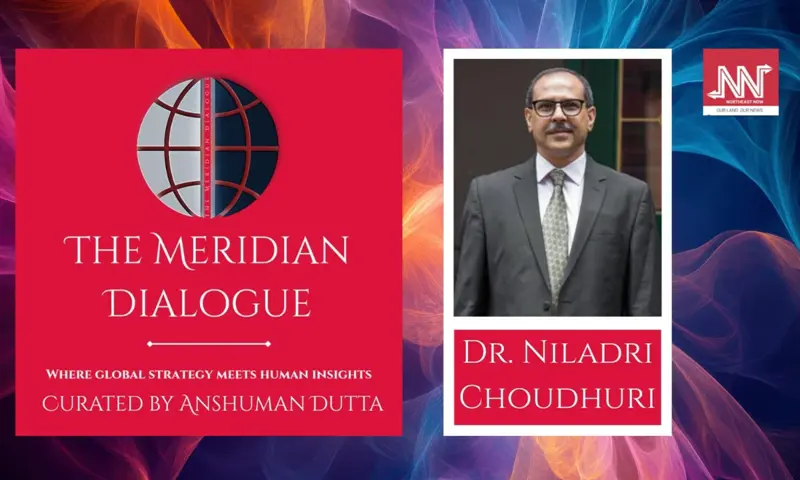

In an era when digital transformation often advances faster than our understanding of its long-term consequences, leaders like Dr. Niladri Choudhuri are asking a deeper question: What does responsible technological progress look like?
With more than three decades of experience spanning enterprise delivery, DevOps transformation, consulting, and global training, Choudhuri has worked across continents guiding organizations through complex technological change.
As President of Green Computing Foundation and CEO of Xellentro Consulting Services LLP and an active voice in the global DevSecOps ecosystem, he has increasingly turned his focus toward Sustainable IT and Sustainable AI. His work also intersects with initiatives like Green Computing Foundation, advocating for a future where innovation does not come at the expense of planetary stability. In this conversation with The Meridian Dialogue, Dr. Choudhuri reflects on leadership at the intersection of technology, sustainability, and systems thinking where the real challenge is not merely building faster systems but building wiser ones.
Technology and Responsibility
Digital transformation has long been framed as an economic imperative. At what point does technological progress also become a moral responsibility for leaders and organizations?
The moral dimension of technology is not a future consideration - it is already overdue. I believe every organization crossed that threshold the moment its technology decisions began affecting communities, environments, and livelihoods beyond its own balance sheet. At Green Computing Foundation, we operate from a foundational conviction: Sustainability is not a constraint on progress; it is the very definition of responsible progress.
We are living through a period of concurrent crises - climate disruption, geopolitical conflict, and economic fragility - that are no longer theoretical. The wars unfolding in Ukraine, the Middle East, and flashpoints across the globe are not isolated tragedies. They are fracturing global supply chains, redirecting energy investments, inflating commodity prices, and creating a long economic shadow that will endure for decades. In this context, an organization that treats technological resource consumption as unlimited, or as someone else's problem, is not just being irresponsible - it is being strategically reckless. At GCF and Xellentro, we advise clients that optimizing resource usage in IT is not altruism; it is sound business. The organizations that embed Sustainability into their DNA today will be the ones with the resilience to survive tomorrow's shocks.
Technology leaders must internalize that their servers, cloud workloads, and AI pipelines are not neutral. They consume energy, they emit carbon, and they depend on global systems now under severe strain. Moral responsibility begins the moment a leader realizes this and continues to act as though it does not matter.
The DevOps Philosophy Beyond Engineering
DevOps is often described as a methodology for speed and efficiency. Do you see it more fundamentally as a philosophy of organizational collaboration and trust?
Absolutely, and I would go further. DevSecOps at its deepest is not a toolchain - it is a philosophy of shared ownership, collective accountability, and continuous learning. Speed and efficiency are welcome outcomes, but they are byproducts of something more fundamental: the elimination of silos and the cultivation of psychological safety. When cross-functional teams trust one another enough to surface failures early and collaborate openly, the organization becomes more adaptive, resilient and more Sustainable.
I also connect DevSecOps philosophy directly to Sustainable IT. The same lean thinking that eliminates wasteful software release cycles can be applied to eliminate wasteful compute cycles. The same feedback loops that accelerate deployment pipelines can be used to monitor and reduce energy consumption. At Xellentro, we help organizations see that the DevSecOps mindset - measure, improve, iterate - is equally applicable to their carbon and resource footprint. Collaboration and trust, as a cultural foundation, make this holistic view possible. Without them, sustainability initiatives remain siloed from engineering, and both suffer.
The Sustainability Paradox of AI
As AI accelerates innovation, its energy consumption and environmental footprint are growing concerns. How should technology leaders reconcile the tension between computational progress and ecological responsibility?
This is what I call the Sustainable AI Imperative, and it is not paradoxical if you reframe the question correctly. The tension exists only when we treat AI capability and ecological responsibility as opposing forces. At Green Computing Foundation, we argue they are, in fact, aligned - because optimizing AI for resource efficiency is also optimizing it for performance and cost. A model that consumes 40% less energy to deliver the same outcome is not a compromised model; it is a better-engineered one.
The current geopolitical landscape makes this urgent. Wars are disrupting energy grids, driving up electricity costs, and destabilizing the rare earth mineral supply chains that power our GPU clusters. Data centres running large language models are not isolated from these realities. When an organization trains a massive AI model without considering its carbon footprint or compute cost, it is building on an assumption of abundance that the world can no longer sustain. Sustainable AI practices - model compression, distillation, quantization, contextualization, efficient inference, right-sizing compute, using small models, green data centre selection, and responsible AI governance - are not optional ethics checkboxes. They are operational necessities in an increasingly resource-constrained world.
Leaders must ask: does every AI deployment justify its energy cost? Is this the right model size for this task? Could a smaller, locally deployed model deliver 90% of the value at 10% of the footprint? These are the questions of Sustainable AI, and they also happen to be the questions of financial prudence. Though the first question is - Do we need AI for this work?
Leadership in Complex Systems
Modern digital ecosystems are deeply interconnected supply chains, cloud infrastructure, data platforms. What leadership mindset is required to navigate such systemic complexity?
The required leadership mindset is what I describe as systemic humility combined with decisive adaptability. Systemic humility means acknowledging that no single leader, team, or organization can fully control or predict behavior in a deeply interconnected digital ecosystem. Supply chains span continents; cloud platforms cross jurisdictions; data pipelines stitch together dozens of vendors. Any node in this web can introduce cascading failure - as we saw during the pandemic, and as we are seeing again now as war-driven sanctions and energy crises reshape the global technology supply chain. There is a need for a well-organized and smoothly operating eco-system.
Leaders navigating this complexity must invest in observability - not just of their technical systems but of their environmental and geopolitical dependencies. Sustainability plays a critical role here. Organizations that have diversified their energy sources, minimized wasteful infrastructure, and built lean digital estates are far more resilient when external shocks hit. The Sustainable enterprise is also the Resilient enterprise. At GCF and Xellentro, we coach clients to treat their IT architecture not as a fixed asset but as a living system - one that must be continuously monitored, pruned, and adapted. We are in a probabilistic environment and not a deterministic environment.
The Democratization of Technology
You've spoken about decentralized and context-aware AI architectures. Do you believe the future of technology will be defined more by distributed intelligence than centralized hyperscale platforms?
I do believe the future belongs to distributed intelligence, and the convergence of sustainability and geopolitics is accelerating this shift. Centralized hyperscale platforms made sense when compute was a scarce, specialized resource. But we are entering an era of edge computing, smaller purpose-built AI models, and sovereign data requirements - all of which favor decentralization. War and trade fragmentation are reinforcing this: nations are increasingly reluctant to entrust critical workloads to platforms domiciled in adversarial or uncertain jurisdictions. At GCF and Xellentro, we talk about network of Green Micro Data Centres as opposed to large DCs.
From a Sustainable IT perspective, distributed intelligence is also more efficient. Running inference at the edge, closer to the data source, eliminates the latency and energy cost of roundtripping to a centralized cloud. Context-aware AI - models that are small, specialized, and optimized for their domain - will outperform general-purpose giants on both energy efficiency and practical utility. At Green Computing Foundation, we actively promote architectures that favor local intelligence over cloud dependency, precisely because they are greener, faster, and more resilient in a world of unstable networks and contested infrastructure.
DevOps and Organizational Culture
Many digital transformations fail not because of technology but because of culture. What cultural shifts must organizations undertake to truly embrace agile and DevOps thinking?
The failure is almost always cultural, and it is almost always rooted in the same dysfunctions: fear of failure, blame culture, hierarchical gatekeeping, and short-termism. Truly embracing DevSecOps and Agile requires organizations to make several non-negotiable shifts. First, from output-thinking to outcome-thinking - measuring what matters to customers and the planet, not just lines of code shipped or tickets closed. Second, from blame to blameless post-mortems - where failure becomes a source of learning rather than punishment. Third, from silos to shared responsibility - where development, operations, security, and sustainability teams are genuinely integrated, not merely adjacent.
I would add a fourth shift that is increasingly relevant: from indifference to sustainability awareness. Teams that understand the real-world cost - environmental, economic, geopolitical - of the systems they build make better decisions. When an engineer understands that an inefficient query costs not just milliseconds but kilowatt-hours, and that kilowatt-hours in a war-strained energy market carry an amplified cost, they think differently about their code. Culture is ultimately about what people believe matters. Leaders must make sustainability matter, loudly and consistently, and reward the behaviors that reflect it.
The Ethics of Automation
As automation increasingly makes decisions once reserved for humans, where should leaders draw the boundary between algorithmic efficiency and human accountability?
The boundary lies at consequence. The greater the potential human consequence of a decision - to a person's livelihood, health, freedom, or dignity - the more firmly human accountability must be preserved. Automation is powerful and often more consistent than human judgment in narrow, well-defined tasks. But it is also opaque, brittle, and prone to amplifying the biases embedded in the data it was trained on. When an algorithm decides who receives a loan, who is flagged as a security risk, or who is denied healthcare, or decide to authorize the kill in a war, the stakes are too high to abdicate human responsibility.
From a Sustainable IT lens, ethical automation also means avoiding automation for its own sake. Organizations often automate processes not because it is better, but because it signals modernity. Unnecessary automation consumes compute, adds complexity, and creates technical debt - all of which have sustainability costs. Leaders should ask: does this automation serve a genuine human need? Is the model explainable and auditable? Is there a human in the loop for consequential decisions? Can we operate this sustainably? These are not separate questions; they are dimensions of the same responsible leadership imperative. In a world where algorithmic decisions are already influencing conflict, propaganda, and economic policy, the ethical stakes of automation have never been higher. Machines cannot be accountable, accountability will have to remain with human, even for the action machine takes.
Designing the Future of Digital Infrastructure
If we imagine the digital world twenty years from now, what principles should guide the infrastructure we build today efficiency, decentralization, sustainability, or something deeper?
All the above - and something deeper, which I would call regenerative intent. Efficiency and decentralization are necessary conditions, not sufficient ones. Sustainability, as I practice and preach it, is not merely about doing less harm; it is about designing systems that actively restore and strengthen the broader ecosystems - environmental, social, and economic - in which they operate.
The geopolitical reality we inhabit today is our most urgent teacher. Wars are not just humanitarian disasters; they are economic catastrophes with decades-long tail effects. They destroy infrastructure, fracture trade, displace populations, and redirect public investment away from digital progress toward defence and recovery. Every conflict we fail to prevent represents a compound loss of human potential, environmental capital, and economic capacity. The digital infrastructure we build over the next two decades must therefore be designed with one principle above all others: do not make the world more fragile. Every architectural choice that locks in dependency, externalizes environmental cost, or concentrates power in ways that invite conflict is a design failure, regardless of how technically elegant it appears.
At Green Computing Foundation, we envision a future where every data centre runs on renewable energy, every AI workload is right sized for its task, and every organization measures its digital carbon footprint with the same rigor it applies to its financial accounts. At Xellentro, we work with organizations to make that vision operational - today, not twenty years from now. Because the infrastructure choices we make in the next five years will determine the trajectory of the next fifty. The question is not whether we can afford to build sustainably. The question is whether we can afford not to.
The conversation with Dr. Niladri Choudhuri covers nearly three decades of hard-won perspective on technology, sustainability, and the quiet courage required to lead complex systems responsibly. For those who prefer to carry the essence of that thinking forward, here are six insights that deserve to live beyond this interview.
Regenerative Intent in AI and Digital Infrastructure: Six Insights from The Meridian Dialogue
1. Sustainable AI Is an Operational Necessity Sustainable AI practices - model compression, quantization, efficient inference, and right-sized compute - are no longer ethical aspirations. In a world shaped by geopolitical instability and resource scarcity, every AI deployment must justify its energy cost. The first question a leader should ask is not how to build the model. It is whether the model is needed at all.
2. DevSecOps Is a Culture, Not a Toolchain At its deepest, DevSecOps eliminates silos and builds psychological safety. The same lean thinking that removes wasteful release cycles can - and must - be applied to reduce carbon footprints. Sustainability and engineering are not separate disciplines. In the most resilient organizations, they are the same discipline.
3. The Sustainable Enterprise Is the Resilient Enterprise Organizations that diversify energy sources, minimize wasteful infrastructure, and build lean digital estates absorb external shocks far better than those that do not. Sustainability is not a values statement. It is a strategic resilience investment - one that pays its largest dividends precisely when the world becomes most unstable.
4. Distributed Intelligence Will Define the Next Era of AI Centralized hyperscale platforms are giving way to edge computing, sovereign data architectures, and purpose-built models. Smaller, context-aware AI running closer to the data source delivers superior energy efficiency, lower latency, and greater resilience in a world of contested infrastructure and fragmented geopolitics.
5. Human Accountability Cannot Be Automated Away Where decisions carry real consequences - to livelihoods, health, freedom, or dignity - human oversight is non-negotiable. Algorithms can be consistent. They cannot be accountable. In an age where AI influences economic policy, conflict, and public life, that distinction is not philosophical. It is foundational.
6. Build With Regenerative Intent Efficiency and decentralization are necessary conditions, not sufficient ones. The deeper principle guiding the digital infrastructure of the next fifty years must be regenerative intent - designing systems that actively restore the environmental, social, and economic ecosystems they touch, rather than merely doing less harm. The infrastructure choices made in the next five years will determine the trajectory of the next five decades. The question is not whether we can afford to build sustainably. The question is whether we can afford not to.
Linksto previous articles:
Interview: The Meridian Dialogue in conversation with Rinita Datta, Marketing Director, Splunk
Interview: The Meridian Dialogue in conversation with Rinita Datta, Marketing Director, Splunk
Interview: The Meridian Dialogue with Krishma Narayanan, Insurance Business Unit Head, Cognizant
Interview: The Meridian Dialogue with Babak Hodjat, Chief AI Officer at Cognizant
Interview: Meridian Dialogue with Sheila Adams Sapper, founder Ridgeway Consulting
Interview: The Meridian Dialogue with Irene Sandler, Chief Marketing Officer at Mechanical Orchard