

The Brahmaputra valley has a distinctive natural environment that depends largely on wetlands. Innumerable freshwater lakes (locally called beels), ox-bow lakes, marshes, swamps, ponds and tanks serve as habitats offering critical breeding and feeding grounds for a vast range of species-from amphibians to migratory birds. Wetlands in the Brahmaputra floodplain host a multitude of waterfowl-ducks, geese, storks, ibises, pelicans, grebes, cormorants, herons, egrets, etc.
While Protected Areas like Kaziranga, Pobitora, Orang, Nameri, Manas, Dehing-Patkai, Dibru-Saikhowa and Deepar Beel offer key wintering habitats for migratory water birds, there are vast swathes of marshes in Neemati, Majuli, Bordoibam-Bilmukh and freshwater wetlands like the Maguri, and hundreds of other natural lakes/manmade tanks outside Protected Areas that have been under periodic use by migratory species.
Wetlands serve as vital stopover points, resting and foraging sites for long-distance winter migrants. Come November, flocks of waterfowl-Pintails, Mallards, Shovellers, Pochards, Gadwalls, Lesser Whistling Ducks, Spot-billed Ducks, Greylags, Ruddy Shelducks, Wigeons and Bar-headed Geese-arrive at their vital stopovers-beels, marshes, river banks and streams.
When it comes to wintering sites of water birds, the Kaziranga-Laokhowa-Burhachapori floodplain complex in the Brahmaputra valley serves as a critical wintering node for the Central Asian Flyway (CAF). CAF passes through 30 countries and is used by some 200 water bird species that include at least 30 threatened and near-threatened species. Situated on the floodplains of the Brahmaputra, the Kaziranga National Park and Tiger Reserve is well connected to the mighty river through a complex network of smaller rivers, streams and water bodies-each forming an ideal habitat for water birds.
The Seventh Kaziranga Water Bird Estimation conducted last winter recorded a total of 1,05,540 birds belonging to 107 species, indicating abundance and species diversity. Migratory geese-Bar-headed (19,133) and Greyleg (6,533)-accounted for over 25,000 birds, followed by Gadwalls (5,283), Green-winged Teal (5,220), Ferruginous Pochard (5,594), Lesser Whistling Duck (6,700) and Grey-headed Swamphen (6,286).
The survey documented 66 endangered greater adjutant storks (Leptoptilos dubius), a species of global conservation concern, and 61 Pallas's fish eagles (Haliaeetus leucoryphus), a vulnerable species. While the latest water bird count reaffirmed the importance of the Kaziranga-Laokhowa-Burhachapori floodplain within the Central Asian Flyway, the Panidehing Bird Sanctuary-the only officially recognized bird sanctuary in Assam-paints a very different picture.
Panidehing: Once a birder's paradise…
Since the 1980s, Panidehing, located in the Sivasagar district of Assam, has received attention from ornithologists and nature lovers as a crucial wintering ground for migratory birds. Nestled between the Disang and Demow rivers, it formed a rich wetland ecosystem. Water bodies and river channels like Boloma, Jarjaria, Tokia, Dighali, Singarajan, Kandhulijan and Sagunpora formed key birding sites that would host a significant number of avifauna, specifically winter visitors like mallards, shovellers, pochards, gadwalls, lesser whistling ducks, spot-billed ducks, ruddy shelducks, wigeons, greylags and bar-headed geese, adding to a list of other regular species like open-bills, adjutant storks, woolly-necked storks, fishing eagles, Himalayan griffon (Gyps himalayensis) and the Critically Endangered white-rumped vultures (Gyps bengalensis).
A key bird and biodiversity area bordering the Brahmaputra, Panidehing received protected area status when 33.93 sq km of wetland and grassland area was declared a bird sanctuary in 1996. "In 1999, after it was declared a bird sanctuary, we counted 365 species," said Ghanashyam Borgohain, who lives near the Sanctuary and is actively involved in local conservation efforts.
A 2008 survey recorded 27,000 water birds. Panidehing recorded sightings of species like the spoon-billed sandpiper. In the following years, although this important bird area would host over 20,000 water birds-a benchmark currently referenced in Ramsar Criterion 5 for identifying wetlands of international importance-by 2010, species numbers had reduced to 267 (including 70 migratory species).
"The number of migratory birds dropped drastically due to a number of factors. Poaching, grazing of cattle, and now they have legalized fishing inside the Sanctuary as the block-level administration carried out projects like Amrit Sarovar tanks. Can you imagine fisheries inside a Protected Area? People wonder whether Protected Areas cease to be protected, leaving them vulnerable to illegal poaching," questioned Ghanashyam Borgohain. "People involved in hunting and sale of migratory birds are not immigrants but locals," he added.
Protected Areas and laws like the Wildlife (Protection) Act, which award special protection for certain species in our country, seem inadequate to stop the decline in bird populations. There is a large network of sites that the birds depend on for migration, and loss of these sites makes the visitors vulnerable.
Assam's premier birding location beset by obstacles
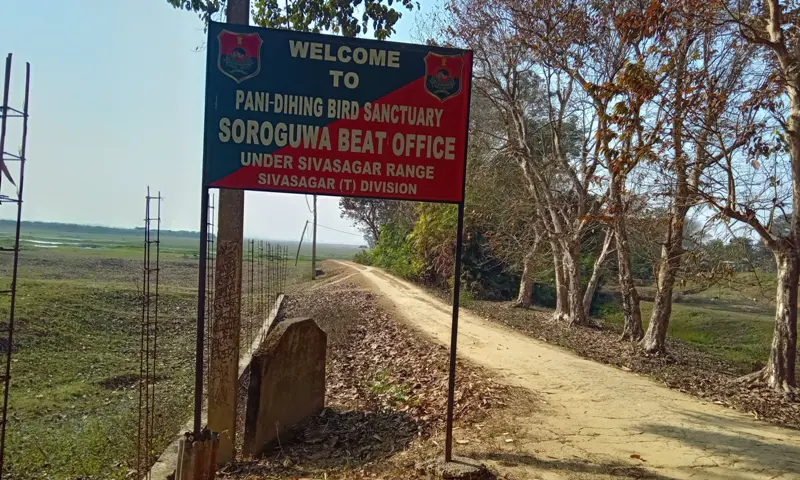
"In the 1980s or early 90s, before Panidehing got its protected area status, the beels here were leased out for fishing. The lessee would ensure that water bodies retained water during the drier months by removing sediments and ditching. It was necessary because both the grazing cattle from the surrounding villages and the wild elephant herds needed to drink from the nearby water bodies. This, however, stopped after Panidehing was declared a sanctuary. Earlier, paddling of wild ducks from the Dhaba beel was audible from the Soroguwa beat office. That water body almost dried up. So did the Bokolai and the Demow River. The beels and river channels would become dry even before the avian visitors would land here. Their numbers have continued to decline over the years," said Nilo Kalita, a local from the Soroguwa area surrounding Panidehing.
Wetlands in most parts of the Brahmaputra valley are found to be drying up within a couple of months after the monsoon retreats. Driven by climate change, high-intensity, short-duration rainfall results in rainwater flowing off rather than percolating underground. Moreover, an increase in temperature accelerates the rate of evaporation from open water bodies, leading to a significant drop in surface water levels and resulting in shrinking vegetation cover and aquatic life.
Drying and formation of wetlands are natural processes, but the rate at which wetlands are drying up is alarming. The gap has widened, forcing many wetland-dependent species to the edge. Large wetlands are imperiled by increased siltation from surface run-off. Large-scale fragmentation shows an increase in wetland numbers; however, these have turned out to be less favorable as wintering sites for migratory birds. A good number of avifauna reflects the health of the ecosystem. However, over the years, waterfowl populations have declined in Panidehing.
The reasons are hunting, disturbance in nesting and roosting areas, increased silt deposition in water bodies, reduced freshwater inflow, fragmentation and degradation of habitat, overfishing, environmental contaminants, land-use changes and changes in aquatic vegetation, among others, which have caused declines in populations of many water birds, both resident and migratory.
"Shrinkage in wetlands due to siltation has become a grave concern. Inside the Sanctuary, many natural wetlands have already dried up," said Gautam Hira, who leads a local NGO, Panidehing Nature Conservation Society. He further added, "The Demow River has been leased out and hunting of birds took place under the garb of fishing. This needs to stop because there are more birds than fish in the fishing nets. With only three forest guards to man vast swathes, protection has been compromised."
Pressures of encroachment and growth of settlements pose a grave threat to the Soroguwa side of Panidehing Bird Sanctuary. In addition, lack of resources, manpower and poor infrastructure have imperiled this important bird area. "Continuous apathy has shrunk this precious ecosystem. They are building resorts, but if the sanctuary is not alive, why would tourists come here?" questioned Manik Chandra Baruah, a local teacher.
There is a large network of sites that the birds depend on for migration, and loss of these sites makes them vulnerable. There are key links between migratory bird conservation and local community development. Connecting people at key migratory bird sites and reinforcing education and awareness about the need to protect migratory birds and their habitats have become key to balancing the needs of conservation against the needs of local communities.
At the same time, restoring ecosystems and ensuring that agriculture, forestry and fisheries are managed sustainably could help put shrinking bird populations on a path to recovery. "We would request the forest department to take help from the community, the local youths, who are always ready to volunteer in protecting one of Assam's best birding locations," Gautam Hira said.