
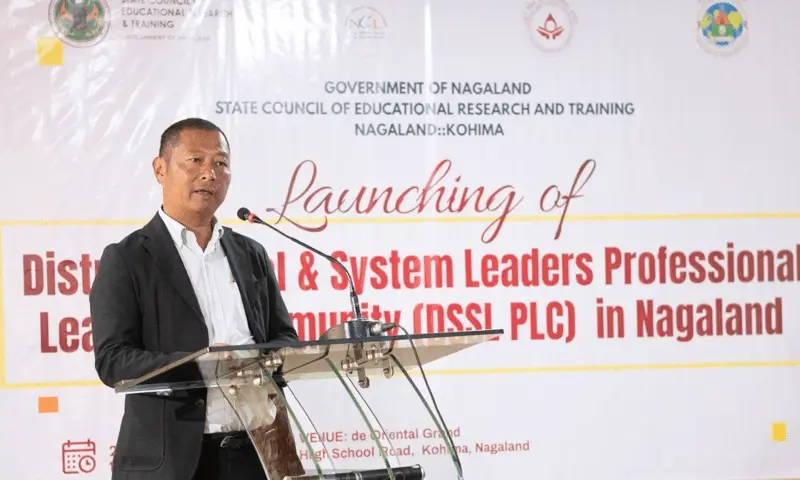

Dimapur: The Nagaland government on Tuesday launched a District School and System Leaders' Professional Learning Community (DSSL PLC) in Kohima, aimed at strengthening the state's education system through collaborative leadership and institutional reform.
Adviser for School Education and SCERT Kekhrielhoulie Yhome, addressing the programme, said a robust education system rests on three key pillars - school leadership, curriculum and administration, and emphasised the need to reinforce these foundations.
He highlighted persistent challenges, including infrastructure gaps, connectivity issues, shortage of human resources, and logistical and systemic constraints that continue to affect implementation on the ground.
Stressing the importance of rebuilding public confidence, Yhome said revitalising government schools remains a priority. He expressed optimism that initiatives such as the professional learning community would help restore trust and create a more accountable and responsive education framework.
He said a baseline survey covering 249 schools across the state has been undertaken, alongside a pilot of the School Quality Assessment and Accreditation Framework (SQAAF), to assess existing conditions and guide future interventions.
Aligning reforms with the National Education Policy, efforts are under way to develop a curriculum tailored to the State's needs, he added.
Yhome also underscored the importance of continuous teacher training and capacity building, noting that school leadership and systems must operate with greater personalisation and close coordination with administrative mechanisms. He called for strengthening the governance ecosystem and adopting a renewed approach to presenting the public education system.
Deputy Director, SCERT Nagaland, Benjung Yaden said the initiative seeks to build leadership capacity across schools to improve learning outcomes.
She said training components include a one-month certificate course for school heads and senior teachers, along with shorter programmes for head teachers. These are supported by locally adapted modules, research activities and documentation of best practices.