
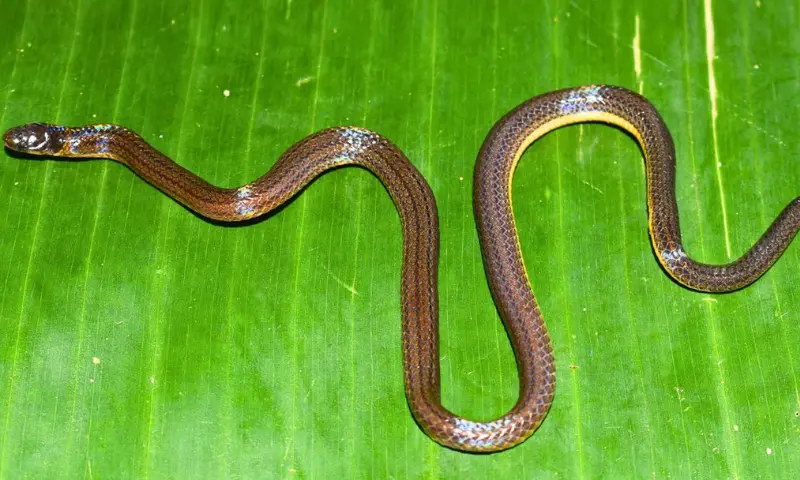

Guwahati: In a discovery that underscores how much of Northeast India's wildlife remains undocumented, researchers have identified a new species of fossorial reed snake from Meghalaya's Garo Hills.
The species, Calamaria garoensis, or the Garo Hills reed snake, has been formally described in the international peer-reviewed journal Taprobanica.
The finding is the result of a multi-institutional collaboration involving Help Earth, Cotton University, Assam Don Bosco University, Mizoram University, the Zoological Survey of India, and Indonesia's National Research and Innovation Agency (BRIN).
The new species was recorded during field surveys in West Garo Hills, with the holotype collected from Oragitok in Rongram Block, an ecologically rich forested landscape. So far, the snake is known only from this locality, suggesting a highly restricted distribution and raising important conservation concerns.
Reed snakes of the genus Calamaria are small, burrowing, and notoriously difficult to study due to their secretive habits. Their striking similarity in appearance has historically led to widespread misidentification, often masking true species diversity.
To confirm the species' distinct identity, the research team used an integrative taxonomic approach, combining detailed morphological analysis with mitochondrial DNA-based phylogenetic studies. The results revealed that Calamaria garoensis represents a separate evolutionary lineage, closely related to Calamaria mizoramensis but genetically distinct, with a divergence of about 6.3%.
The species can be identified by a unique set of features, including smooth dorsal scales arranged in 13 rows, a short, non-tapering tail with a blunt tip, and a prominent black stripe along the underside of the tail. Its body shows longitudinal striping and a faint nuchal ring, setting it apart from related species.
Beyond the discovery itself, the study also addresses a long-standing taxonomic issue. Reed snakes across Northeast India were for decades broadly classified under Calamaria pavimentata. The new findings indicate that what was once considered a single widespread species is actually a complex of multiple, previously unrecognized lineages.
Chesime M. Sangma, a student researcher from Assam Don Bosco University and a native of the Garo Hills, said the discovery holds special significance for the region. "The Garo Hills are a treasure trove of biodiversity that remains largely unexplored. This finding highlights the ecological importance of our landscape and the urgent need for more research and conservation efforts," she said.
Manmath Bharali of Cotton University noted that fossorial snakes are often overlooked despite their ecological importance. "Documenting such hidden diversity is critical. It not only expands our understanding of these understudied groups but also forms the foundation for their conservation," he said.
Scientists say the discovery highlights a broader reality: despite being part of a global biodiversity hotspot, Northeast India remains underexplored, particularly for lesser-known groups like reptiles, amphibians, and invertebrates. Many species, especially those that are cryptic or live underground, are yet to be documented.
The Garo Hills, in particular, are emerging as a key landscape for future biodiversity research, with the potential to yield many more such discoveries.
Researchers stress that increased scientific exploration, backed by conservation-focused planning, is essential to protect these fragile ecosystems. The study also serves as a reminder that lesser-known organisms, though often ignored, play vital roles in maintaining ecological balance, and documenting them is the first step toward ensuring their survival.