
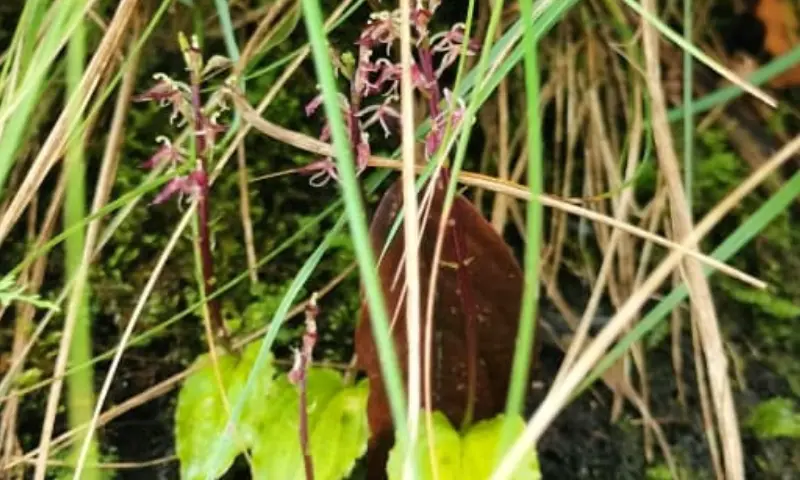

Guwahati: A rare orchid species previously believed to exist only in China has now been recorded in India for the first time, in a significant botanical find from Arunachal Pradesh.
The discovery extends the known range of Liparis mengziensis westward from Yunnan to the eastern Himalayas and adds a new species to India's orchid flora.
The finding was reported in a 2025 research paper by Krishna Chowlu, Abbareddy Nageswara Rao, Chandramohan Kolagani and Simanta Taid, who identified the species during a field survey in Lower Dibang Valley district. The orchid was found growing on moss and soil covered wet rocky surfaces near Mayodia Pass at an altitude of about 2,309 metres.
Until now, Liparis mengziensis was known only from its type locality in Mengzi County of Yunnan province in China, where it was first documented in 2021. Its presence in Arunachal Pradesh is being seen as an important distributional record, underlining the rich but still underexplored plant diversity of Northeast India.
The researchers said the species was identified after detailed examination and comparison with existing orchid literature. They noted that although it resembles Liparis gamblei in having a solitary leaf, it can be distinguished by its broadly ovate leaf with crenate margins, purple flowers and an ovate lip with an acuminate tip.
The paper describes the plant as a small terrestrial, rhizomatous herb about 10 cm tall, with a single leaf and yellowish-green flowers tinged with purple. It flowers and fruits during June and July. A photographic plate in the paper shows the orchid's habitat, inflorescence, flower structure and capsule.
The discovery is also significant because Arunachal Pradesh is already recognised as one of India's richest orchid habitats. The paper notes that India has 42 species and one variety under the genus Liparis, of which 32 taxa are documented from Northeast India and 24 from Arunachal Pradesh alone. The addition of Liparis mengziensis further strengthens the state's position as a biodiversity hotspot.
Botanists say such findings show that parts of the eastern Himalayas continue to hold undocumented floral diversity, especially in remote mountain habitats that remain poorly surveyed.