





Written by: Meher Malhotra, Moitrayee Das
In the journey of young adulthood, Indians commonly face a question from those around them: "settle kab ho rahe ho?" ("When are you settling down?").
This question follows them no matter where they are in their professional life. The idea of a settled-down individual has little to do with their careers and, more so, with their personal life, especially their marital status.
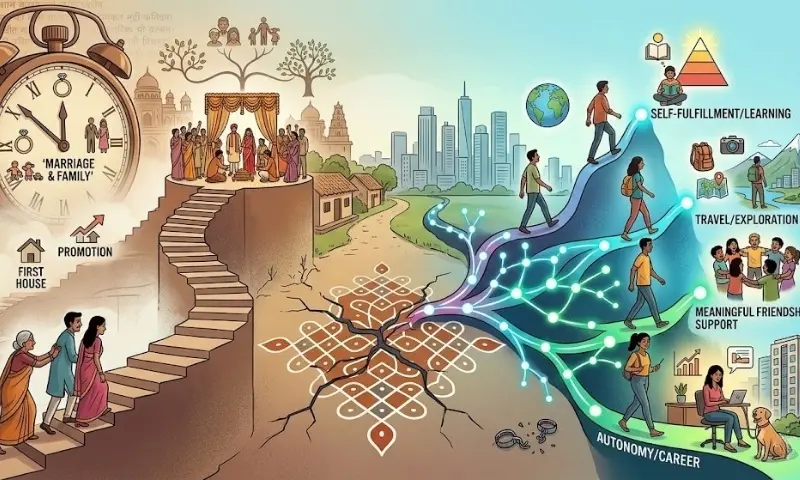
A person may be on the rise on the career ladder, have bought their first house, have well-established friendships, be taking care of their health, or just be in tune with their own self. Yet they would still be far from being "settled" according to social norms in the Indian context as we know it. Marriage and building one's own family are the ultimate goals in the society-mandated list of milestones.
Lately, there has been a change in tide, wherein more and more people are preferring to stay single, let alone get married. According to reports, there are over 100 million more singles than couples in 2017 (The Economist, 2025). Especially in urban settings, people are moving towards rejecting the society-approved idea of settling down. This article explores this new understanding and acceptance of singlehood, wherein the very idea of being settled is being inclusively redefined.
The Age-Old Script of "Settled-down" Adulthood
Adulting has come to be associated with various milestones in life, and they are very often defined or understood in relation to marriage and family. As an overall experience, this is a shared one between all genders. However, it manifests in different ways, especially for men and women. Traditionally, the role of the 'bread-winner' lies on the shoulders of men. They are expected to earn not only for themselves but for their families, including their parents, partner, and children. This idealised notion pushes them to choose careers or jobs that are more financially lucrative. Any form of promotion or benefits in their professional life is sought after to match their timeline for marriage.
For women, it works in the opposite direction. As 'caregivers', they are meant to be solely responsible for running the household, taking care of their family, and raising their children. This pushes them to stray away from jobs altogether. Many who even consider it may look at professions that are not highly demanding, in the sense that their career remains a secondary or even a tertiary priority after their familial roles and responsibilities.
Frameworks and theories based on the evolutionary psychology approach argue that these defined gender roles originated as adaptive strategies for survival. These roles were not just built through cultural understandings but were aimed at promoting reproductive and survival success. Females, because of their ability to bear children, developed traits that were considered favourable for caregiving skills.
Males, in an attempt to appear as suitable mates who would be able to provide, developed traits around physical strength, assertiveness, etc. Sexual selection forms the basis of evolutionary psychologists' understanding of traditional gender roles and their manifestations (Defant, 2025). Gender roles have evolved to be centred around reproductive purposes rather than mere survival.
For both men and women, no matter where the individual is in their professional lives, they are believed to have "settled down" only after they are married and start their own families. These ideals and principles form a standardised linear trajectory for people to follow, all eventually leading up to marriage and building a family. Once they begin working towards building their own families, it is considered a greater marker of societal responsibility than even a stable career.
The Plot Twist of Popularity of Singlehood
The traditional definition of gender roles has been on the current of change for a while now. The division of labour, as understood at home and at work, is slowly and steadily changing to be more inclusive of women. Along with this, there has been a rise in the preference for singlehood over relationships and marriage. In the list of milestones, marriage and romantic relationships have taken a backseat for many people.
According to a study in 2023 by the dating app Bumble, 81% of Indian women feel comfortable staying single and unmarried (Katira, 2023). With more and more people consciously leaning towards single life, the very correlation between "settling down", marriage, and accomplishment in life has changed. A settled-down individual is no longer instantly assumed to be married. There has been a rise in various kinds of milestones which seem to embrace solitude through singlehood rather than shared sentiments of committed relationships.
These milestones work towards a renewed understanding of self-sufficiency and satisfaction in life through exploration and learning, such as travelling or living by oneself, pursuing various hobbies and interests, and building meaningful friendships (TOI Lifestyle Desk, 2024).
This new phenomenon of conscious singlehood connects well with Abraham Maslow's Hierarchy of Needs theory. It is a theory of motivation based on a five-tier pyramid of human needs. The first two levels are physiological and safety needs, which include basic survival needs such as air, water, food, personal security, resources, and employment. The third level touches upon love and belonging, discussing the importance of relationships, friendships, and family.
The next two levels are centred around the person's self and how they perceive themselves. This theory connects with the popularity of singlehood, as more and more single people view the importance of the top-most levels and find themselves fulfilling the third level through meaningful friendships and not romantic relationships. Marriage as an institution is built with the intention to protect and provide for individuals, hence solely fulfilling primary survival needs (McLeod, 2025).
The popularity of singlehood revolutionises the concept of "settling down" into an idea beyond the confines of heterosexual marriage as defined by the patriarchal system. Marriage is no longer considered necessary to reach the optimum level of satisfaction in life. People have moved to prioritise autonomy and personal fulfilment. By 2022, there were nearly 72 million single women in India, which is more than the combined populations of the United Kingdom and Switzerland (Chopra, 2022).
Moving from Autonomy to Conformity
This move away from the traditional understanding of settling down prioritises a newfound sense of stability. The new settled lifestyle is centred around choices of discipline, autonomy, and self. People are still driven by the idea of settling down, but it is no longer defined in marital terms. It is more grounded in self-reliance and emotional stability (Gupta et al., 2025). People are looking to explore the world more by themselves; they are buying houses, travelling, dining, watching movies, and simply being by themselves. The void of companionship is filled with meaningful friendships and connections.
More and more people are also looking to adopt pets as companions at home, from 26 million in 2019 to 32 million in 2024 (Yadav, 2025). The traditional gender roles which used to restrain people from exploring and pursuing their dream careers are no longer governing their lives. People are more open to investing their time, effort, and energy into building careers that align with their true interests and not just safeguard their future.
What now?
There still exists a structural gap between this sociocultural reality and institutional expectations. The systems built for basic living amenities are still functioning through the principles of marriage as an institution. Housing societies still prefer a married couple or a family as residents. Healthcare and medical institutions assume a marital partner to be the default caregiver. Even in corporate spaces, a married individual is often preferred under the belief that they are already settled down (Gupta et al., 2025). However, these structural systems need to adapt to the rise of singlehood. Marriage is no longer equated with stability.
References
Chopra, S. (2022, January 15). India's Single Women. the Globalist. https://theglobalist.com/indias-single-women/#:~:text=A%20tsunami%20of%20singles%20in,a%20force%20to%20reckon%20with.
Defant, M. (2025, March 27). Evolutionary Basis of Gender Dynamics: Understanding Patriarchy, the Pay Gap, and the Glass Ceiling. Journal of Libertarian Studies, 29(1), 10-27. Journal of Libertarian Studies. https://doi.org/10.35297/001c.132320
The Economist. (2025, November 6). The rise of singlehood is reshaping the world. The Economist. https://www.economist.com/leaders/2025/11/06/the-rise-of-singlehood-is-reshaping-the-world
Gupta, K., Singh, A., & Choudhary, T. (2025). Singlehood in Indian context: A mixed-method investigation of psychological impact and perspectives on reasons, advantages and disadvantages of remaining single. Journal of Social and Personal Relationships, 42(12), 3432-3463. Sage Journals. https://doi.org/10.1177/02654075251374760
Katira, K. (2023, January 7). 81% women in India feel more at ease being unmarried, living alone: Study. WION. https://www.wionews.com/entertainment/lifestyle/news-_1-women-in-india-feel-more-at-ease-being-unmarried-living-alone-study-550444
McLeod, S. (2025, October 23). Maslow's Hierarchy of Needs. Simply Psychology. Retrieved December 4, 2025, from https://www.simplypsychology.org/maslow.html
TOI Lifestyle Desk. (2024, September 9). Morgan Stanley study: 45% of women to be single, childless by 2030 | - Times of India. The Times of India. Retrieved December 4, 2025, from https://timesofindia.indiatimes.com/life-style/health-fitness/health-news/45-of-women-to-be-single-childless-by-2030-morgan-stanley-study/articleshow/113192867.cms
Yadav, N. (2025, March 27). Affluent India's pet obsession is fuelling a boom in care industry. BBC. https://www.bbc.com/news/articles/cqjdvzyppyno
Meher Malhotra is a student at FLAME University, Pune, and Moitrayee Das is an Assistant Professor of Psychology at FLAME University, Pune.