
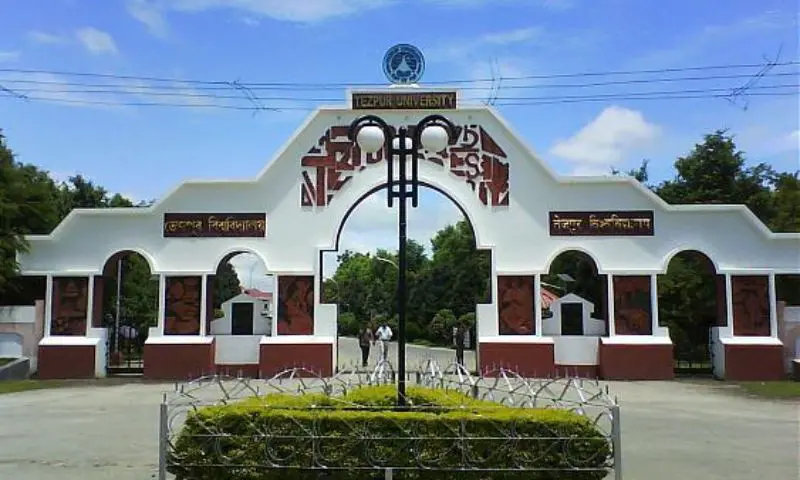

Guwahati: A new study by researchers at Tezpur University has provided fresh insights into how gravity behaves inside the Sun, opening up new possibilities for testing alternative theories of gravity using solar observations.
The research, conducted by the Department of Physics at Tezpur University (TU), has been accepted for publication in Physical Review E, a leading journal of the American Physical Society (APS), known internationally for its rigorous peer-review standards.
Titled "Stability and Wave Dynamics in Polytropic Eddington-inspired Born-Infeld (EiBI) Gravitating Solar Plasmas", the study was carried out by Prof. Pralay Kumar Karmakar and Souvik Das, a Senior Research Fellow under the DST-INSPIRE programme. The work examines how a modified theory of gravity-known as Eddington-inspired Born-Infeld (EiBI) gravity-influences the behaviour of waves inside the Sun.
The Sun's interior is dominated by plasma waves that transport energy and help maintain its structural stability. Until now, these waves have largely been analysed using Newtonian gravity. However, the TU study explores how wave dynamics change when gravity is described using the EiBI framework, particularly under the Sun's extreme internal temperatures and densities.
By combining advanced mathematical modelling with four years of helioseismic data from the Helioseismic and Magnetic Imager aboard NASA's Solar Dynamics Observatory, the researchers found that even small deviations from conventional gravity can produce measurable effects. Under EiBI gravity, wave speeds and energy transport inside the Sun were found to increase by up to 55 percent, leading to more stable solar oscillations.
The study also reveals that certain gravity-driven oscillation modes, previously considered negligible can carry significant amounts of energy in the modified gravity scenario. Notably, the theoretical predictions closely match actual solar observations, making this the first observational test of EiBI gravity within a stellar interior.
"Our results show that even small corrections to gravity can have measurable effects on how the Sun's interior oscillates and transports energy," said lead author Souvik Das. "The close agreement between theory and observation makes this study particularly exciting."
Prof. Pralay Kumar Karmakar, who supervised the research, said the findings highlight the Sun's potential as a testing ground for fundamental physics. "This work clearly demonstrates that the Sun itself can be used as a natural laboratory to test modified theories of gravity beyond Einstein," he said. "Helioseismology offers a powerful new window into understanding gravity at extreme conditions."
The findings add to growing global efforts to probe alternatives to classical gravity and could have broader implications for astrophysics and cosmology, particularly in understanding stellar interiors and extreme gravitational environments.