
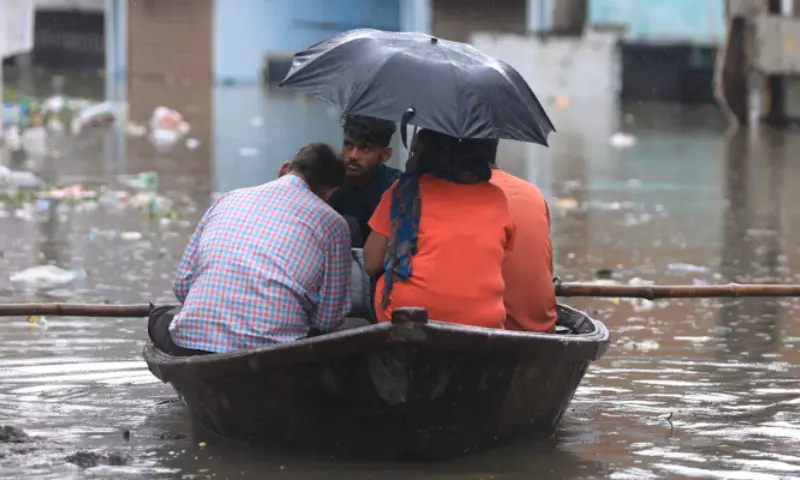

Guwahati: A new study by researchers at the National Institute of Technology (NIT) Rourkela suggests that global warming could significantly alter the Indian Summer Monsoon , potentially increasing rainfall across the country.
Published in the International Journal of Climatology, the research draws parallels between future climate projections and the mid-Pliocene period-around three million years ago, when Earth experienced warmer conditions similar to those expected by the end of this century.
The Indian Summer Monsoon accounts for nearly 80% of India's annual rainfall and is crucial for agriculture, water resources, and the livelihoods of millions. However, scientists have long debated how rising global temperatures will affect monsoon patterns, with studies offering conflicting conclusions.
To better understand this, the research team, led by Nagaraju Chilukoti and Karishma Dahiya of NIT Rourkela, in collaboration with Raju Attada of IISER Mohali, analysed monsoon behaviour during two warm periods- the mid-Pliocene and a projected late 21st-century climate scenario (2071-2100) under high emissions.
Their findings indicate that monsoon rainfall was stronger during the mid-Pliocene, and could increase again in a warmer future. However, the driving mechanisms differ. In the mid-Pliocene, intensified atmospheric circulation and stronger winds boosted rainfall. In contrast, future increases are likely to be driven by a warmer atmosphere holding more moisture.
The study also points to a possible shift in peak monsoon rainfall from July to August, which could have significant implications for agriculture and water planning.
"The past is the key to the future," said Chilukoti. "By studying the mid-Pliocene, we can better understand how a warmer world may influence monsoon dynamics. Our findings suggest increased atmospheric moisture over the Indian Ocean and landmass, which could strengthen moisture transport and rainfall over India."
The researchers say these insights are critical for improving climate preparedness. Better understanding of rainfall patterns can help authorities strengthen early warning systems for floods and droughts, while enabling farmers to plan crop cycles and irrigation more effectively.
The study could also aid policymakers in managing major river systems such as the Ganges and Brahmaputra, and in improving urban planning in flood-prone regions.
As a next step, the team plans to examine how large weather systems forming far north of India influence regional rainfall patterns.
Overall, the research underscores the importance of using Earth's climatic past to anticipate future changes-offering valuable guidance for decision-making in agriculture, water management, and disaster preparedness.