
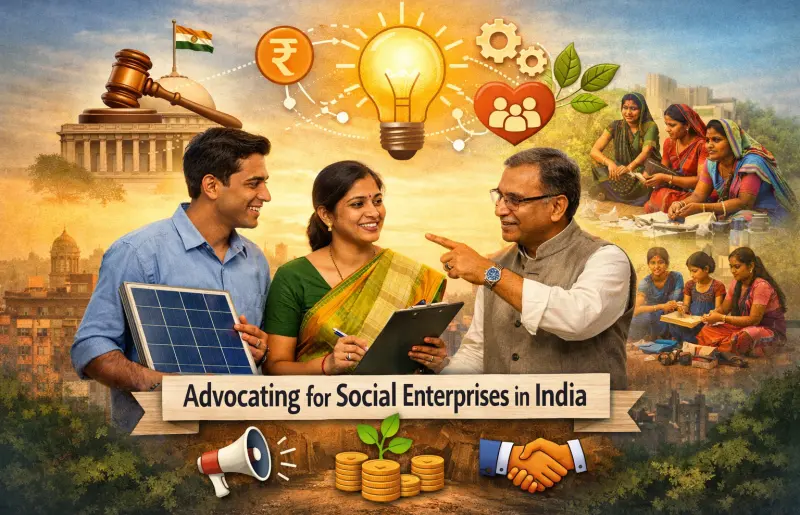

India's development challenges are vast and complex. From rural poverty and energy poverty to gaps in education and healthcare, many communities continue to fall through the cracks of traditional government and market systems.
In this space between public policy and private enterprise, social enterprises have emerged as important agents of change.
Social enterprises are organizations that combine business strategies with a social mission. Unlike conventional businesses that prioritize profit or non-profits that rely primarily on grants, social enterprises attempt to balance financial sustainability with social impact. Across India, they are working in sectors such as education, agriculture, healthcare, renewable energy and financial inclusion.
Yet despite their growing importance, social enterprises in India continue to operate in a difficult ecosystem. Many struggle to access capital, navigate regulatory complexities and gain visibility among policymakers and investors. One of the most powerful tools available to overcome these barriers is advocacy.
Advocacy, in the context of social enterprises, refers to efforts to influence public policy, public opinion and investment decisions in ways that support social impact initiatives. It includes activities such as engaging with government officials, building coalitions with other organizations, raising awareness through media campaigns and generating research to shape policy debates.
In a country as diverse and complex as India, advocacy is not merely an optional activity for social enterprises-it is essential for their survival and growth.
The policy gap
One of the biggest challenges facing social enterprises in India is the absence of a clear legal and policy framework. Unlike some countries that have specific legal structures for social enterprises, India does not yet recognize them as a distinct category.
As a result, social enterprises operate under a variety of legal forms. Some register as non-profit organizations under Section 8 of the Companies Act or as trusts and societies. Others operate as for-profit companies or limited liability partnerships. While these structures allow flexibility, they also create confusion around taxation, compliance requirements and funding eligibility.
For example, non-profit organizations often rely on grants and donations but may struggle to access investment capital. On the other hand, for-profit social enterprises can attract investment but are usually excluded from philanthropic funding. This structural mismatch leaves many organizations in a difficult position.
Although the Government of India has taken some steps to support social innovation through programs such as Startup India and Stand-Up India, these initiatives do not fully address the hybrid nature of social enterprises. A comprehensive national policy for the sector is still under discussion.
Advocacy can play a crucial role in pushing this conversation forward. By collectively engaging with policymakers, social enterprises can advocate for clearer legal recognition, access to blended finance and inclusion in government procurement systems.
Changing the development narrative
Advocacy is not limited to influencing government policy. It also plays an important role in shaping public perception.
A powerful example of this comes from Goonj, a Delhi-based organization founded by social entrepreneur Anshu Gupta. Goonj works with urban surplus materials-particularly clothing-and channels them into rural development programs.
What makes Goonj's work unique is its effort to challenge the traditional charity mindset. Instead of distributing clothes as donations, the organization launched the "Cloth for Work" initiative, where communities participate in local development activities and receive materials in return.
Through campaigns, storytelling and media engagement, Goonj has helped shift the development discourse in India. Clothing is increasingly recognized as a basic need in disaster relief and rehabilitation efforts. The model has inspired similar initiatives in several countries across Asia and Africa.
This illustrates how advocacy can reshape the narrative around development and dignity.
Driving policy and financial innovation
Another example of advocacy-driven impact is SELCO India, a social enterprise that provides solar energy solutions to underserved communities.
Founded in 1995, SELCO has worked extensively with rural households and small entrepreneurs who lack reliable electricity access. But the organization quickly realized that technology alone was not enough. Without financing options and supportive policies, solar solutions would remain inaccessible to the people who needed them most.
SELCO therefore engaged with regional rural banks and other financial institutions to create customized financing models for solar products. It also worked with state governments to promote decentralized energy policies.
Through its research and advocacy initiatives, the SELCO Foundation has helped shape discussions around energy access and sustainable development. Its work demonstrates how social enterprises can influence both financial systems and public policy.
Building advocacy capacity
Despite these success stories, many social enterprises in India still lack the resources and expertise needed for sustained advocacy.
Most organizations operate with small teams focused on program delivery and community engagement. Advocacy requires additional skills such as policy analysis, communication strategies and coalition-building. Without these capacities, many social enterprises find it difficult to make their voices heard.
This is where ecosystem organizations can play a critical role.
Mumbai-based Atma, for example, works as an accelerator supporting education-focused social enterprises. Along with strategic consulting and capacity building, Atma helps its partner organizations engage with policymakers and participate in education reform discussions.
By strengthening advocacy capacity across multiple organizations, such initiatives contribute to systemic change rather than isolated success stories.
The power of collective action
One of the biggest barriers to effective advocacy in the social enterprise sector is fragmentation. Social enterprises operate across diverse sectors-from agriculture and healthcare to climate solutions and education. Their legal structures also vary widely.
This diversity often prevents the sector from presenting a unified voice when engaging with policymakers.
Building coalitions and networks can help address this challenge. Alliances such as Social Enterprise Network India aim to bring together organizations working on social innovation to advocate for common policy goals.
At the same time, partnerships with universities, think tanks and media organizations can strengthen research, amplify narratives and bring credibility to advocacy efforts.
Digital platforms also offer new opportunities. Social media campaigns, online petitions and digital storytelling initiatives can mobilize public support and attract attention to key issues affecting the sector.
A path forward
India's social enterprises are already making a significant contribution to the country's development landscape. They are creating jobs, expanding access to essential services and developing innovative solutions for some of the country's most persistent problems.
However, their ability to scale and sustain impact depends on a supportive ecosystem.
Advocacy is the bridge that connects grassroots innovation with policy reform, financial support and public legitimacy. By investing in advocacy capacity, building stronger coalitions and engaging more effectively with government and investors, social enterprises can strengthen their role in India's development journey.
In a country striving for inclusive and sustainable growth, the voices of social enterprises must not remain on the margins. Through strategic advocacy, they can move from being isolated innovators to central actors in shaping India's future.
The views expressed in this article are solely those of the author and do not necessarily reflect the views or positions of Azim Premji University, where the author works.