
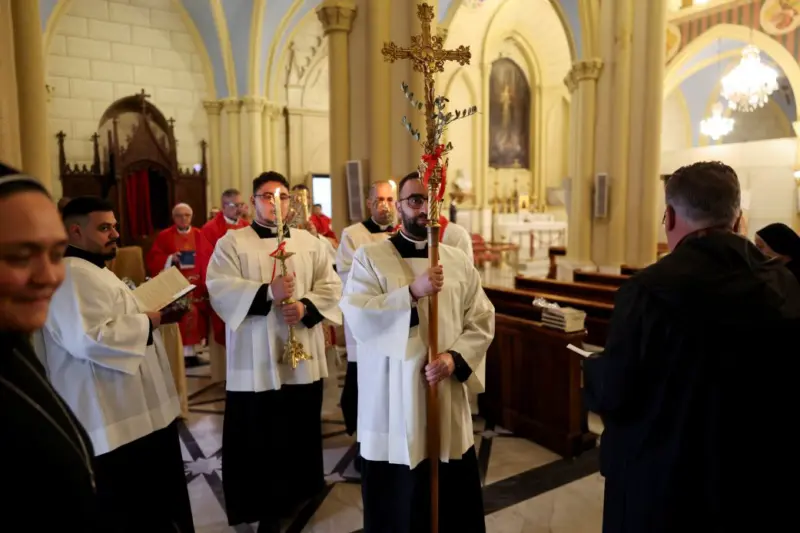

JERUSALEM - Following a wave of international backlash, the Israeli government announced late Sunday that it is developing a plan to allow Christian leaders to worship at the Church of the Holy Sepulchre during Holy Week.
The move comes after Israeli police sparked global outrage by preventing the Latin Patriarch of Jerusalem, Cardinal Pierbattista Pizzaballa, from entering the site to celebrate Palm Sunday Mass.
1. A “Grave Precedent” in the Old City
For the first time in centuries, the heads of the Catholic Church in the Holy Land were blocked from one of Christianity's most sacred sites on Palm Sunday.
- The Incident: Cardinal Pizzaballa and Fr. Francesco Ielpo, the Custos of the Holy Land, were traveling privately without a procession when police stopped them and compelled them to turn back.
- Church Reaction: The Latin Patriarchate described the action as a "manifestly unreasonable and grossly disproportionate measure," noting that the Church had already canceled public processions and complied with wartime restrictions.
- The Site’s Significance: The Church of the Holy Sepulchre is traditionally revered as the location of Jesus' crucifixion, burial, and resurrection.
2. Security Concerns vs. Religious Freedom
Israeli authorities defended the decision by citing the ongoing war with Iran, which began on February 28, 2026.
- Home Front Command Directives: Most holy sites in the Old City, including the Western Wall and Al-Aqsa Mosque, have been closed to worshippers because they lack standard bomb shelters.
- Missile Threats: Prime Minister Benjamin Netanyahu's office stated that Iranian ballistic missiles have repeatedly targeted Jerusalem, with shrapnel recently landing just meters from the Church of the Holy Sepulchre.
- The Response: “There was no malicious intent whatsoever, only concern for his safety,” the PMO stated, adding that a new plan is being devised to accommodate church leaders for the remainder of Holy Week.
3. Global Condemnation
The incident drew swift criticism from top diplomats and world leaders who called for the protection of Jerusalem's “multi-religious character.”
- United States: Ambassador Mike Huckabee called the denial an "unfortunate overreach," noting that the small group of clergy was well within the 50-person limit allowed for other gatherings.
- European Union: EU foreign policy chief Kaja Kallas labeled the event a "violation of religious freedom," stating that access to holy sites must be guaranteed for all faiths without exception.
- Italy: The Italian government summoned the Israeli ambassador in Rome, with Prime Minister Giorgia Meloni calling the incident “an offense to every community that recognizes religious freedom.”
4. Subdued Holy Week in a War Zone
The 2026 Easter season in Jerusalem is expected to be one of the quietest on record. The traditional Palm Sunday procession from the Mount of Olives was canceled last week, and shops throughout the Old City remain shuttered. As the conflict enters its second month, religious leaders of all faiths are struggling to balance the spiritual needs of their communities with the physical dangers of the war.
Wartime Status of Jerusalem Holy Sites (March 30, 2026)
| Site | Current Status | Restrictions |
| Church of the Holy Sepulchre | Closed to Public | Limited access for clergy under negotiation |
| Western Wall Plaza | Closed to Public | Maximum 50 worshippers for priestly blessings |
| Al-Aqsa Mosque | Closed to Public | Prayers canceled for most of Ramadan/Eid |
| Old City Shops | Mostly Closed | Only essential food stores operating |