
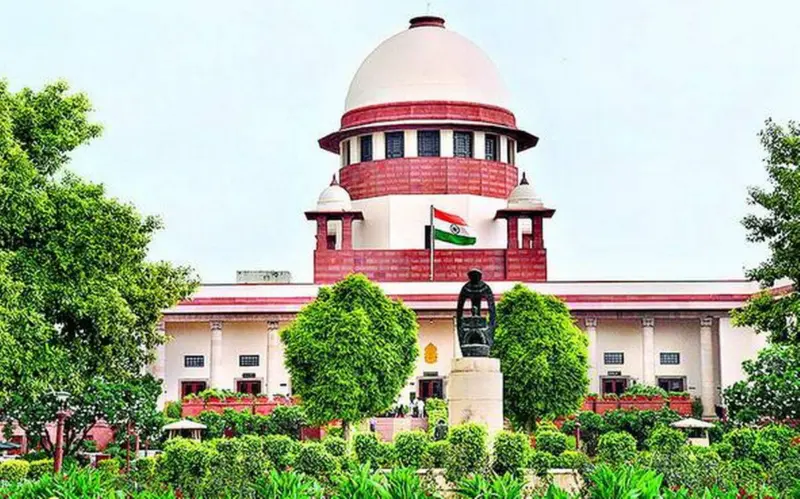

NEW DELHI - A rare nine-judge Constitution Bench of the Supreme Court, led by Chief Justice of India (CJI) Surya Kant, reserved its judgment on Thursday, March 19, 2026 , after a three-day marathon hearing.
The verdict will determine whether the expansive definition of "industry" established in the landmark 1978 Bangalore Water Supply case remains valid in the modern era of Liberalisation, Privatisation, and Globalisation (LPG).
At the heart of the dispute is whether social welfare protections under the (now-repealed) Industrial Disputes Act, 1947 should continue to apply to workers in non-commercial sectors like government research bodies, charitable hospitals, and universities.
1. The Core Conflict: Welfare vs. Economic Reality
The 1978 judgment by a seven-judge bench created a "triple test" to define an industry:
- Systematic Activity: Organised cooperation between employer and employee.
- Production/Distribution: Aimed at satisfying human wants and wishes.
- Irrelevance of Profit: Whether the entity is charitable or for-profit does not matter.
The Centre's Argument: Attorney General R. Venkataramani argued that while the government is "not anti-labour," the 1978 ruling was too broad. He cautioned that labeling the forest department, irrigation departments, or research bodies as "industries" creates serious administrative concerns in a globalized economy.
The Labour Unions' Argument: Senior advocates including Indira Jaising and CU Singh contended that the 1978 ruling has protected millions of workers for nearly 50 years. They argued that industrial tribunals are far better equipped to handle "victimisation and unfair labour practices" than slow-moving civil courts.
2. Perspectives from the Amicus Curiae
The court's two appointed experts presented opposing views:
- Advocate JP Cama: Argued that "industry" must involve a profit motive. He claimed that the 1978 judgment went too far by including charitable institutions. "Social welfare must give way to the precise language of the statute," he noted.
- Advocate PS Sengupta: Supported the 1978 ruling, noting that the word "Socialist" was added to India's Preamble in 1976. He argued that from a worker's perspective, the "nature of the labour" is the same whether the employer is a charity or a corporation.
3. Bench Observations
The bench, which includes Justices BV Nagarathna and PS Narasimha, appeared cautious about narrowing the definition too significantly. They remarked:
"If you keep the definition so narrow, the entire private sector will be hived out… Should we not give such an ameliorative law an expansive meaning?"
Evolution of "Industry" Definition in India
| Era | Legal Standing | Key Characteristic |
| Pre-1978 | Narrow Definition | Generally limited to commercial and manufacturing sectors. |
| 1978-Present | Bangalore Water Supply Case | Expansive "Triple Test"; includes universities, hospitals, and NGOs. |
| 2026 Review | 9-Judge Bench | Balancing worker welfare with "LPG" economic constraints. |
Labour Market Context: The Stakes
The decision will impact millions of employees across various sectors. For context, India's labour force is vast and diverse:
- Organized Sector: Roughly 10% of India's total workforce.
- Unorganized Sector: Nearly 90%, many of whom lack the very protections being debated in this case.
- Scheduled Castes (SC) & Tribes (ST): These groups represent a significant portion of the manual labour force in government departments (Irrigation, Railways, Forests) that may be reclassified based on this verdict.