
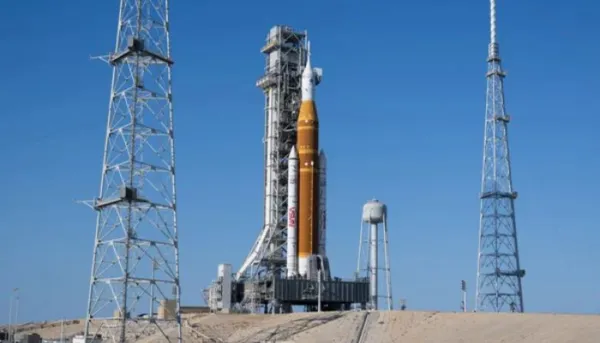

In a remarkable moment for space exploration, NASA's Artemis-II mission successfully launched at 4:04 am IST on Thursday, 2nd April, from the Kennedy Space Centre in Florida.
The powerful rocket lit up the early morning sky as it carried four astronauts on a journey toward the Moon, marking the first time humans had travelled that far into space since 1972.
The 10-day mission includes NASA astronaut Reid Wiseman, Victor Glover, and Christina Koch, as well as Canadian Space Agency astronaut Jeremy Hansen. This mission is special not just because of its destination, but also because of the milestone the crew represents.
Victor Glover becomes the first person of colour to travel beyond low Earth orbit, Christina Koch is the first woman to go this far into space, and Jeremy Hansen is the first non-American astronaut to be part of such a mission.
Test mission, not a landing
Unlike earlier Moon missions, this flight will not land on the lunar surface. Instead, it is designed as a test mission to assess how NASA's new Orion spacecraft and the Space Launch System (SLS) rocket perform with astronauts aboard.
The mission follows the success of Artemis-I in 2022, which was an uncrewed flight that orbited the Moon. Artemis-II now takes things a step further by putting humans inside the spacecraft.
What will happen during the journey
In the first few days, the astronauts will stay in a high orbit around Earth. During this time, they will test life-support systems and practise handling the spacecraft. After that, they will begin their journey toward the Moon.
The spacecraft is expected to fly around the Moon on 6th April at around 9:30 pm IST. It will pass behind the Moon, coming close to its far side. During this time, communication with Earth will be completely lost for about 30-50 minutes.
Breaking records and looking ahead
On the sixth day of the mission, the spacecraft will travel even farther, going about 8,000 km beyond the Moon. This will break previous records and make the crew the most distant humans ever from Earth.
After completing the journey, the spacecraft will return and is expected to land in the Pacific Ocean near San Diego on 11th April.
This mission is an important step toward NASA's plan to send humans back to the Moon, with a landing expected in the coming years.