




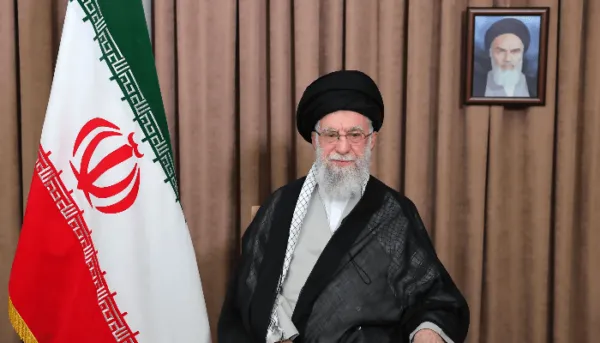

Israel spent years breaking into mobile phone networks and hacking Iran's traffic camera network to track the whereabouts of Supreme Leader Ayatollah Ali Khamenei and his security detail prior to his killing on 28th February (Saturday), reported Financial Times.
The Israelis were observing when bodyguards of key Iranian officials and drivers arrived at work close to Pasteur Street in Tehran, the site of Khamenei’s assassination in an Israeli airstrike.
According to two insiders, almost all of Tehran’s traffic cameras have been compromised for years, their photos encrypted and sent to servers in southern Israel and Tel Aviv. A camera provided specific view into the operations of a routine area of the heavily guarded compound and allowed them to find out where the men liked to park their own automobiles.
The residences of security guards, working hours, commute routes and the people they were routinely tasked with protecting and escorting were all added to their dossiers by sophisticated algorithms, the FT article states.
The capabilities were an element of an intelligence campaign that lasted for years and contributed to the elimination of Khamenei. Israel and the Central Intelligence Agency (CIA) were able to ascertain precisely when the 86-year-old would reach his offices and who would accompany him. Additionally, Israel was able to interfere with individual parts of nearly a dozen cell phone towers close to Pasteur Street, making the devices seem to be busy when calls were placed and preventing Khamenei’s security detail from obtaining potential alerts.
An intelligence officer disclosed, “We knew Tehran like we know Jerusalem. And when you know (a place) as well as you know the street you grew up on, you notice a single thing that’s out of place.”
Israel’s intelligence and technological strength
Israel’s sophisticated signals intelligence Unit 8200, the human resources gathered by its foreign intelligence agency Mossad and the mountains of data processed by military intelligence into daily briefs contributed to the dense intelligence picture of the capital of the arch-enemy. According to a source, the country employed a mathematical technique called social network analysis to sift billions of data points to find improbable centers of decision-making gravity and identify new targets to monitor and neutralise.
“In Israeli intelligence culture, targeting intelligence is the most essential tactical issue, it is designed to enable a strategy. If the decision maker decides that someone has to be assassinated, in Israel the culture is: We will provide the targeting intelligence,” expressed Itai Shapira, an intelligence veteran was quoted in FT.
During the 12-day conflict in June of last year, the nation’s superior intelligence was demonstrated when over a dozen Iranian nuclear experts and senior military personnel were killed in a matter of minutes in an initial attack. Iran’s aerial defences were unprecedentedly disabled by a mix of cyberattacks, low-range drones and accurate munitions shot from outside its borders, which destroyed the radars of the missile launchers.
An official stated, “We took their eyes first.” Israeli pilots utilised a particular type of missile known as the Sparrow far from Iran and beyond the reach of any of its aircraft defence systems, both in the June battle and currently. Sparrow can strike a target as tiny as a dining table from almost 1,000 kilometres away.
Bombing Khamenei was a political move. The opportunity to end his life together with a large portion of Iran’s senior leadership was very favourable when the CIA and Israel learnt that he would be hosting a meeting at his offices. They concluded that it would be far more difficult to track them down once a war had officially started since the Iranians would have swiftly adopted evasive tactics, such as retreating underground to bunkers that were impervious to Israeli bombs.
A conclusive confirmation
American and Israeli intelligence established that Khamenei and his senior officials would be assembling in his compound on the fateful morning, which caused officials to modify their months-long strategy. In recent years, Israel’s extensive algorithm-driven data collection has streamlined the tedious procedure of tracking certain targets which formerly required visual affirmations and filtering false indications.
Data from signals intelligence, including extensively penetrated mobile phone networks and infiltrated traffic cameras was available to Israel. It demonstrated that senior officials were on their way to the meeting with Khamenei. However, the Americans possessed something much more tangible: a human source. Hence, it was made possible for Israeli jets, which had been flying for hours to reach the correct spot on time, to fire off up to 30 precise explosives.
“The decision to strike in the morning rather than at night allowed Israel to achieve tactical surprise for the second time, despite heavy Iranian preparedness,” the Jewish state outlined.
The final outcome of two separate events
According to Sima Shine, a former Mossad official, the strategic achievement was the result of two distinct occurrences that happened more than 20 years apart. The first was a directive to prioritise Iran delivered in 2001 by ex-Prime Minister Ariel Sharon to Meir Dagan, the then-head of Mossad, who was engaged with Syria, Palestinian terrorists, Hizbollah in Lebanon and other similar issues.
Shine quoted Sharon who instructed, “All the things the Mossad is doing is well and fine. What I need is Iran. That’s your target.” Afterwards, she added, “And since then, that is the target.” The second incident was the deadly Hamas attack on 7th October 2023, which Israel believed was supported by Iran.