
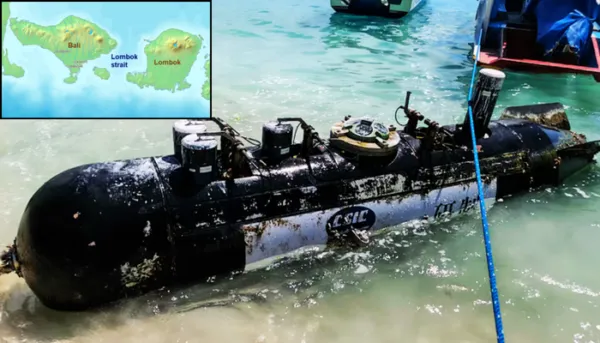

The unmanned underwater vehicle (UUV) found in the waters of the Lombok Strait earlier this month has been identified as a Chinese undersea monitoring system by Indonesian defence analysts.
The torpedo-shaped metallic device was discovered by a fisherman north of Gili Trawangan island in the strategically important strait between Bali and Lombok. China has, however, dismissed the concerns regarding the discovery, saying “there is no need for excessive interpretation or suspicion”.
After the discovery of the suspicious device, the Indonesian Navy took it to the Mataram naval base on Lombok for investigation. Navy spokesperson Rear Admiral Tunggul said that the navy will carry out an in-depth examination to identify the device, including its origin, purpose and stored data.
Maritime defence analyst HI Sutton identified the device as a Deep-Sea Real-Time Transmission Mooring System developed by the Chinese 710 Research Institute. The 710 Research Institute was reportedly a part of the Chinese state-owned China Shipbuilding Industry Corporation (CSIC), which was merged into the China State Shipbuilding Corporation (CSSC).
“The institute focuses on underwater attack and defence,” said Sutton, expressing concern about the presence of the device in the area. “It suggests that China may have a network of these sensors providing real-time information on underwater conditions in the strategic waterways, which would aid their submarine operations,” he added.
According to Sutton, the system is designed to be fastened to an anchor on the sea floor, and it transmits data through communication buoys deployed to the surface. Explaining the features of the device, Sutton said that sensors fitted in it monitor things like temperature, depth, current and sound and target information. The device featured the letters CSIC and the logo of the corporation. The mooring system is reportedly not exclusive to China, and other countries such as the United States, Japan and India also use it.
Speaking to ABC News, a Chinese Ministry of Foreign Affairs spokesperson denied having specific details on the matter. The spokesperson said China had always conducted marine scientific research activities and used related equipment in accordance with international law. “Based on international practice, it is not unusual for marine research equipment to drift into the territorial waters of other countries due to malfunctions or other reasons. There is no need for excessive interpretation or suspicion,” the spokesperson said.
However, no explosives or radioactive materials were found in the vessel during initial inspections. Even before it was sent to Mataram naval base for detailed analysis, it was identified as a surveillance vessel. An Acoustic Doppler Current Profiler (ADCP) was found on the vessel, which is a hydro-acoustic current measuring device similar to sonar, used to measure the speed of water currents at a certain depth.
Markings on the object were linked to the China Shipbuilding Industry Corporation (CSIC), a major Chinese state-owned defence contractor involved in submarine and underwater technology development. The device had some partial Chinese text that can mean either "research and development" or "developed by."
The Lombok Strait between Bali and Lombok is one of Indonesia's most strategically significant waterways, serving as a deep-water passage connecting the Pacific and Indian Oceans. It is capable of accommodating large naval vessels and submarines, making it a closely monitored route by regional powers, including the United States and Australia. The discovery has raised questions about potential underwater mapping or surveillance activities by China in the region's sensitive sea lanes.