

Tomorrow, New Delhi will host one of the most anticipated visits of the year. At Prime Minister Narendra Modi's invitation, Russian President Vladimir Putin will attend the 23rd India-Russia Annual Summit on December 4-5, 2025, resuming the in person annual summit format after four years and a full-scale conflict with Ukraine.
The visit has been formally announced by India's Ministry of External Affairs (MEA), which defines it as an occasion to review the "Special and Privileged Strategic Partnership" and exchange views on regional and global concerns.
Most swift evaluations will reduce this conference to three clichés being S-400 missiles, Su-57 fighter jets, and discounted Russian oil. The amount of crude that has reached Indian ports since 2022 and India's reliance on Russian weapons will be the subject of countless graphics. That's all important. However, this does not fully explain why this visit is of such importance for Moscow, so sensitive for Washington and Brussels, and so beneficial for New Delhi.
In the background, the Modi-Jaishankar doctrine is evident. Multi-alignment, not non-alignment, strategic autonomy without yelling anti-West slogans, and a determined unwillingness to let either Washington or Beijing dictate whom India may cooperate with. This is as much about avoiding overdependence on China as it is about rejecting Western pressure.
What follows is a thorough dive into the "under the radar" agenda for tomorrow's meetings i.e the payments, people and paths that will silently redefine what India-Russia ties mean in the coming decade.
A summit under pressure and a very public show of spine
This is not a usual summit season. The visit comes after US President Donald Trump put high tariffs on a broad basket of Indian goods, with American criticism openly tying that pressure to New Delhi's decision to keep buying Russian oil and retain security ties with Moscow. The tariffs have been portrayed as part of a larger effort to drive India away from Russia by the Trump administration.
European diplomacy has been equally blatant. Just days before Putin's arrival, the ambassadors of the UK, France and Germany co-authored an oped in an Indian newspaper severely criticizing Russia's conduct in Ukraine and urged New Delhi to 'do more.'
The MEA broke its normal silence and openly described the approach as "unusual" and "not acceptable diplomatic practice," emphasizing that India does not enjoy being lectured on the eve of a big bilateral engagement.
On the Russian side, the messaging has been similarly pointed. The Kremlin has confirmed the dates of the visit and constantly stressed that India is a "key strategic partner". Putin told Russian media that Moscow wants to "elevate cooperation with India and China to a qualitatively new level", a rare public pairing of the two Asian giants in his pre-visit statements.
Dmitry Peskov, spokesman for the Kremlin, has gone further, claiming that Western sanctions on Russian shipping and oil are "illegitimate" and emphasizing that Moscow and Delhi are developing ways to maintain trade "without influence of third countries", a diplomatic term for avoiding Western financial levers.
In this tense backdrop, the optics of tomorrow's summit matter. For Western observers, Modi receiving Putin while tariffs, Ukraine and sanctions dominate headlines is uncomfortable. For Beijing, the fact that Russia is not fully locked into a China only embrace is also a difficulty. For Delhi, however, this is exactly the point: India will talk to every major pole the US, the EU, Russia, Japan, the Gulf, ASEAN but it will not allow any one bloc to veto its engagement with another.
Rewiring the money pipes: RuPay-MIR, UPI-SBP and the sanctions proof agenda
The most significant "non-defence" file on the table is arguably payments and financial plumbing. Without resilient payment methods, no amount of political goodwill or energy discounts will matter.
Since 2022, India and Russia have experimented with rupee-rouble settlement, Special Rupee Vostro Accounts (SRVAs), and bank-to-bank agreements that circumvent Western institutions in an effort to maintain trade despite the sanctions. These systems have kept trade alive but remain clumsy and unequal. Indian exporters complain of delayed payments and imprecise FX conversions. Russian businesses are trapped with significant rupee balances in Indian banks that they struggle to spend. A second-generation strategy focused on connecting national payment systems and instant payment platforms is anticipated to be pushed during this summit.
Rupay-MIR Card linkage: According to various publications, including the Economic Times and Russia focused trackers, India and Russia have agreed in principle to link India's RuPay card network with Russia's MIR system. Once operational, a Russian tourist in Goa using a MIR card or an Indian business traveller in Moscow using RuPay should be able to pay directly in local currency, without routing every transaction through Visa/Mastercard and Western banks.
UPI-SBP (fast payments) bridge: UPI, India's real time digital payments backbone, and Russia's SBP (System for Fast Payments) were discussed during External Affairs Minister S. Jaishankar's recent visit to Moscow. According to Russia's Pivot to Asia, this would allow users of national payment systems to execute near-instant cross-border transfers that are paid directly between Indian and Russian banks.
If PM Modi and President Putin can declare even an initial framework or pilot for this payments system, it would signify a tremendous shift. Rather than fighting every new sanctions package on its own, India and Russia would be constructing a parallel banking infrastructure that gradually diminishes reliance on SWIFT and US-centric card networks.
For India, this is not about "de-dollarisation" chants. It is about insurance. In a world where sanctions and bank blacklisting have become normal measures, having a lasting alternative payments network with important partners is element of national security as vital as tanks and missiles, but considerably less visible.
From oil heavy to balanced: Fixing a broken trade relationship
India-Russia trade has expanded in value, but not in balance. As to MEA and commerce ministry data, bilateral trade touched around $68-69 billion in 2024/25, compared to barely $11-13 billion a few years earlier. The main driver has been low cost Russian crude, which Indian refiners have imported in considerable numbers since 2022.
The problem is that Indian exports have hardly changed, locked at roughly $4.9 billion, while imports from Russia (oil, fertilisers, coal, metals) have risen to nearly $64 billion, leaving India with a large trade deficit. That mismatch is unsustainable in the long term, both economically and politically.
Recent weeks have witnessed a marked shift in tone from Moscow. In interviews and briefings, Russian authorities have openly acknowledged the mismatch and stated desire to grow imports from India and improve market access. Reuters and Indian newspapers quote Dmitry Peskov as that Russia wants to "address India's concerns on trade deficit" and make trade more strong and "shielded from third country influence".
Officials in India have been setting the foundation. In November, the 26th meeting of the India-Russia Working Group on Trade and Economic Cooperation met in Moscow to review market access and regulatory impediments for Indian pharma, agricultural products, engineering items and services. Simultaneously, negotiations on a comprehensive free trade agreement have been restarted between India and the Eurasian Economic Union (EAEU), which comprises Russia, Kazakhstan, Belarus, Armenia, and Kyrgyzstan. An 18-month negotiation roadmap and terms of reference have apparently been finalised by the ministry of commerce.
The explanation for India is obvious. Use the oil driven trade surge to create new export possibilities in Russia and throughout the EAEU. Push for mutually recognized standards and speedier customs clearance for Indian pharmaceuticals, textiles, machinery, processed foods, and information technology services. Instead of leaving stranded rupee balances in Russian banks, convert them into orders for Indian goods and services.
Once more, the Modi-Jaishankar strategy is clear. Delhi is attempting to turn a vulnerability (trade imbalance) into leverage by demanding better terms for Indian exports as the price of long-term energy business, rather than apologizing for purchasing discounted oil, which directly benefits Indian consumers.
Energy 2.0: From cheap oil to long-term insurance
Energy is the visible thread that pushed Moscow and Delhi closer after 2022. At one point, highly discounted Urals crude accounted for over one-third of India's imports, surpassing both Saudi Arabia and Iraq as the country's top oil supplier. Recently, however, that proportion has slipped to a three-year low as new rounds of US and EU sanctions, tighter price-cap enforcement and concerns over "shadow fleet" tankers have made some Indian refiners more cautious.
Officials from the Kremlin are eager to stabilise volumes and maintain that this is only temporary. Putin is accompanied by senior executives from major Russian oil companies, according to the Reuters preview of this visit. The topics of discussion will include reviving or renegotiating India's investments in upstream projects like Sakhalin-1, expanding cooperation in civilian nuclear energy, where Russia is still a major partner at Kudankulam in Tamil Nadu, and guaranteeing steady crude flows under sanction safe shipping and insurance arrangements.
The discussions tomorrow will focus on energy security on several fronts for India:
Oil and gas: Give Indian refiners certainty without overexposing them to Western fines by securing long-term supply contracts at conditions acceptable with the G7 price cap and secondary sanctions threats.
Nuclear baseload: Ensure timely construction and fuel delivery for Kudankulam's further units and discuss prospective new nuclear projects so that India's clean-energy transition has a robust, non-intermittent backbone.
Fertilizers and food security: Since 2022, Russian fertilizer exports to India have increased, and new agreements are being finalized to maintain price stability. Fertilizer and related inputs are now an essential component of the bilateral basket, directly impacting Indian farmers and the stability of food prices, according to a new research on trade between Russia and India.
Nothing about this is glamorous. But it is important to the political economy at home. A government that wishes to keep inflation manageable and sustain 7%+ growth cannot disregard the oil and fertiliser lifeline Russia supplies even as it diversifies with the Gulf, the US and others. Whether Delhi can establish long term, sanction resilient agreements instead of surviving shipment to shipment is the true test at this summit.
New routes to old friends: corridors, ports and, map politics
Beyond money and molecules, tomorrow's talks also touch geography. For the past few years, India and Russia have been working quietly on a new connectivity map that lessens their reliance on chokepoints controlled by the West and conventional sea lanes. Two initiatives are essential here. The Eastern Maritime Corridor (EMC) and the International North South Transport Corridor (INSTC).
Since its initial announcement in 2019, the Chennai-Vladivostok Eastern Maritime Corridor has undergone feasibility studies and pilot trips. Recent workshops conducted by Chennai Port and Russia's Far East officials have focused on operationalising regular shipping on this route, which can shorten transit time by up to 16 days compared to existing routes via Europe. The corridor is expected to carry not only coal and oil, but also fertilisers, lumber and potentially containerised cargo, enabling a direct India Far East link outside the crowded Malacca and Suez axis.
Meanwhile, the INSTC, a 7,200-km multi-modal network connecting Indian ports with Iran's Bandar Abbas and Chabahar, the Caspian, Russia and ultimately to Europe, has gained increased prominence. With frequent delays in the Red Sea and concerns over Suez, INSTC offers an alternate route for trade with Russia and beyond.
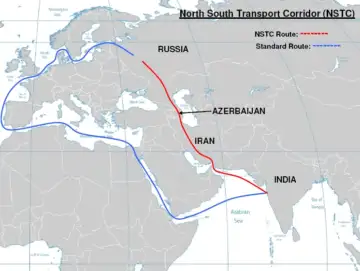 International North-South Transport Corridor. (Source: Wikipedia)
This summit is expected to see new port-to-port cooperation agreements (for example, Chennai-Vladivostok, Mumbai-Astrakhan), progress on customs harmonisation and digital documentation along the INSTC, and possibly pilot "green corridor" schemes for priority cargo such as fertilisers, pharmaceuticals, and machinery.
This is important from a strategic standpoint for two reasons. First, it enables India and Russia design pathways that aren't at the mercy of Western naval might or any crisis in West Asia. Second, it stops China's Belt and Road Initiative from being the only game in town in Eurasia. Delhi does not want a scenario where every overland or maritime route from Asia to Europe flows either through Chinese-financed ports or Western-controlled sea channels. The gathering tomorrow will subtly advance the larger initiative to develop third possibilities, which includes EMC and INSTC.
People as a strategic asset: The Labour Mobility Pact
One of the most interesting items scheduled to be signed during Putin's visit is a Migration and Mobility Agreement between India and Russia. This is about people, not hardware, unlike the major defense agreements, and it may have unexpected effects on Indian migration trends.
The deal has been finalized in recent days and would offer a framework for the legal migration of qualified and semi-skilled Indian workers to Russia, according to MEA briefings and stories in Indian media. All India Radio's coverage and analyses in Chatham House and ABP Live point out that Russia is suffering an acute workforce shortage due to demographic decline, wartime mobilisation and restricted Western immigration, and is actively seeking to India to patch the gap.
The agreement is expected to include simplified work visas, residence permits, and documentation for Indians hired through approved channels, strong language on worker rights, wage protection, social security, and grievance redressal, and a sectoral focus on construction, manufacturing, IT services, healthcare, and possibly agriculture.
Estimates vary, but some publications imply that tens of thousands of Indian workers could relocate to Russia in the coming years under this system, with some speculative pieces mentioning long-term "lakhs" if the model works.
From Russia's perspective, this is about maintaining manufacturing, construction sites, and service sectors operational despite sanctions and mobilisation. From India's standpoint, it fits within a wider picture. India has previously negotiated or expanded labour mobility agreements with European, Gulf, and East Asian partners. The government openly sees abroad employment as a vehicle to transfer skills, generate remittances, and strengthen bilateral connections.
The Russia deal adds a new geography to the globe, one with strategic implications. If Indian workers become essential to Russian business, their welfare and safety will become a regular topic of discussion in bilateral conversations. In the event of a future crisis, that personal bond is still another reason Moscow should take Indian concerns seriously.
NavIC Meets GLONASS: Satellites, space and tech sovereignty
While defence analysts concentrate over S-400s and Su-57s, some of the most important collaboration during this visit will take place well above the ground. India and Russia are planning to interlink their navigation satellite systems, India's NavIC and Russia's GLONASS, in a way that might drastically reduce reliance on US and European positioning services.
A recent story in The Economic Times and follow ups in Russian aviation media suggest that the two sides are working on mutual deployment of ground stations for these systems, with important agreements expected during Putin's visit to Delhi. Plans for a GLONASS ground station in Bengaluru and a NavIC (formerly IRNSS) ground station in Novosibirsk were detailed in a geospatial analysis article at least as early as 2017.
What is new is the urgency for Russia, as Western sanctions and threats to halt technological collaboration make it imperative to improve GLONASS accuracy and coverage with favorable allies. For India, the expanding usage of NavIC in commercial and military uses ranging from shipping and aviation to missiles and drones highlights the need for improved accuracy and redundancy.
By hosting each other's ground infrastructure, NavIC and GLONASS can improve precision over respective priority regions, the Indian Ocean and Eurasia, and provide a reliable backup to GPS and Galileo. This is more than simply smartphone navigation apps; it also supports long-range missile and aircraft guidance, maritime domain awareness, logistics and supply-chain planning, and even clock synchronization for digital finance systems.
Beyond navigation, space cooperation is expected to broaden. A new long-form article on StratNews Global reports that India has publicly invited Russian businesses to engage in its commercial space endeavors, which range from satellite communications and earth observation to AI-driven space logistics and space infrastructure cybersecurity.
Here, the geopolitical logic is subtle but powerful, India collaborates with the United States and Europe on some space projects, Japan on others, and Russia on yet others. This multi-partner approach prohibits any single bloc from using space technology as a leverage point against India. For a government that frequently mentions "Atmanirbhar Bharat" in high technology, deepening space and navigation relations with Russia is another method to diversify dependence while advancing India's own capabilities.
Everyday Security: Pharma, nuclear, fertilisers and food
The summit is anticipated to produce advancements in areas that immediately impact daily life, such as health, electricity, and food prices, in addition to grand strategy and advanced technology.
On pharmaceuticals and healthcare, India is already among the major providers of generic medications to Russia. The trade working group has been concentrating on lowering regulatory obstacles, harmonizing standards, and promoting cooperative production of pharmaceuticals and medical equipment in Russian industrial zones. With Western pharma businesses quitting or reducing back in Russia, Indian enterprises see a significant opportunity and Moscow sees India as a politically reliable, cost effective source.
In civil nuclear energy, Russia is India's most important foreign partner. The Kudankulam Nuclear Power Plant has two functioning units built with Russian assistance and four more under construction. Tomorrow's talks are likely to examine progress there and maybe discuss expanded nuclear cooperation, including fuel delivery agreements and maybe next-generation reactor designs.
On fertilisers and food security, Russia has quickly emerged as one of India's primary suppliers of nitrogen, phosphate and potash fertilisers, especially after 2022. Today's articles on trade between India and Russia and Shafaqna India specifically link the labor mobility agreement to a larger push on fertilizers, implying that tomorrow's Memorandums of Understanding will contain procedures to ensure fertilizer supplies and perhaps local blending or production partnerships.
RT India and the information front
This visit coincides with an uncommon "soft power" development, the official opening of
In a brief statement, RT itself stated that RT India will start broadcasting on December 5th, with an emphasis on "India and Russia's roles in a multipolar world" and a cutting-edge studio close to New Delhi. According to reports from Indian outlets, including regional media, the time was purposefully picked to align with Putin's visit to India and presented as part of an effort to "strengthen the India-Russia bond through media outreach."
For India, the picture is more complex. Officially, India allows a wide range of foreign-owned news and digital media. RT India will join a crowded media landscape that already includes Western broadcasters, Gulf networks, and Chinese state-sponsored programming on social media.
Politically, however, the symbolism is difficult to ignore. The week brings an extraordinary joint oped by three Western ambassadors criticizing Russia, the MEA's forceful reply defending India's diplomatic autonomy, and the debut of a Russian TV channel clearly focused on the "multipolar world" concept, all from Delhi.
Put together, these developments suggest that tomorrow's summit is also about the fight of narratives. Moscow wants a seat on India's airwaves in a world where information is a weapon. Delhi is prepared to put up with that, at least temporarily, as part of its larger plan to engage all key powers without endorsing anyone's propaganda line.
Defence in background
India will raise delays in S-400 delivery, seek clarity on spares for existing Russian systems, and may explore more S-400 batteries and the potential of procuring Su-57 fifth generation jets. Although no one anticipates a final agreement on the S-500 missile defence idea at this time, some press coverage even cites exploratory discussions about it.
Delhi's defence reasoning is simple that decades of Soviet/Russian platforms, such as Su-30MKIs, MiG-29s, T-90 tanks, Kilo submarines, and S-400s, cannot be quickly replaced. Walking away prematurely will create serious capacity gaps, especially when India faces a two-front challenge from Pakistan and China. Demand localization, improved MRO, and diverse supply chains are things you can take to prevent European sanctions or conflicts from severely impairing Indian preparedness.
When viewed from this broader angle, defence is not the entirety of a multi-pillar relationship, but rather one strong pillar. The Modi administration is attempting to transform India-Russian relations from a limited, defense-focused collaboration to a more comprehensive technological, and human partnership. That shift includes the talks on labor, payments, space, and corridors that will take place tomorrow.
The West, China and the Modi-Jaishankar balancing act
The geopolitical triangle of China, India, and the West, as well as Modi and Jaishankar's strategies for navigating it, are interwoven throughout all of this.
That is the core of the Modi-Jaishankar doctrine. Strategic autonomy rather than bandwagoning, multi-alignment rather than non-alignment. In areas where interests coincide, like as the Quad, technology, and maritime security, India works closely with the West. However, it maintains a separate channel with Russia for energy, defence depth, Eurasian access, and now labour and payments.
Another layer is added by China. Russia's reliance on Beijing for trade, technology, and diplomatic cover has significantly increased since the conflict in Ukraine. Many Western commentators feel that this automatically makes Russia part of a quasi-alliance with China. For India, this is a concern since a Russia entirely dependent on China would be less effective as a strategic partner and more likely to side with Beijing on issues in Central Asia, the Arctic, and even the Indian Ocean.
By remaining involved with Moscow, India is effectively ensuring that Russia has at least one big Asian partner other than China. According to Chatham House's recent analysis of the visit, both Delhi and Moscow are looking for ways to "reaffirm relations" at a time when Russia's tilt toward China and Western sanctions complicate the landscape, and India is an important non-Western, non-Chinese pillar in Russia's Asia policy.
In that case, tomorrow's pictures of oil charts and S-400 reports will merely be the visible layer. The real transformation will be in the secret architecture of payments, corridors, human mobility, satellites and narratives that India and Russia are building together not as an act of nostalgia, but as a determined manoeuvre to leave space open between a sanction-heavy West and an increasingly assertive China.
That, in essence, is the Modi-Jaishankar doctrine at work in this visit, optimize alternatives, limit vulnerabilities, and make sure India's partnerships, especially with Russia, put Indian interests first, no matter who is uncomfortable in Washington, Brussels or Beijing.