


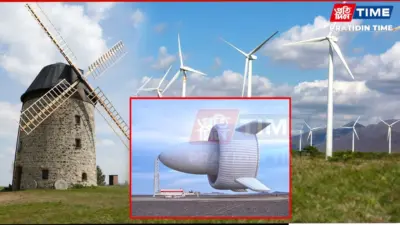

China has reportedly achieved a significant milestone in renewable energy technology after successfully testing a megawatt-class airborne wind power system that can generate electricity while operating at an altitude of around 2,000 metres.
According to the report, the system, known as the S2000 Stratosphere Airborne Wind Energy System (SAWES), completed a test flight in Sichuan Province this week. During the trial, it generated electricity and supplied power to the local grid, marking what is being described as a breakthrough in high-altitude wind energy development.
Developed by Beijing Linyi Yunchuan Energy Technology, the system is designed as a hybrid between an airship and a wind turbine. It aims to capture stronger and more consistent wind currents found at higher altitudes, which are not accessible to conventional ground-based turbines.
During the test, the aircraft-like structure remained airborne for about 30 minutes and produced approximately 385 kilowatt-hours of electricity. The system measures around 60 metres in length and about 40 metres in width and height.
According to the report, the company’s co-founder and chief technology officer, Weng Hanke, the system generates power while suspended in the air, with electricity transmitted to the ground through cables. He said the project required overcoming major engineering challenges, particularly in maintaining a lightweight structure while ensuring stable power transmission.
Officials involved in the project also noted that the airborne platform could potentially be used for communication systems and monitoring equipment, expanding its utility beyond electricity generation.
Shift from Traditional Windmills to Airborne Energy Systems
The development highlights a major evolution in wind energy technology. In earlier times, wind power was harnessed using simple ground-based windmills with large blades, used mainly for grinding grain and pumping water.
These systems later evolved into modern wind turbines, which are now widely used in wind farms to generate large-scale electricity. The latest airborne system represents a further step forward, shifting energy generation from ground-based towers to high-altitude platforms where wind conditions are stronger and more stable.
While still in the experimental stage, experts believe such technologies could play an important role in future renewable energy systems, particularly in meeting rising electricity demand and supporting cleaner urban energy solutions.
Assam CM Meets Mansukh Mandaviya, Focuses on Sports Infra And Workers Welfare