




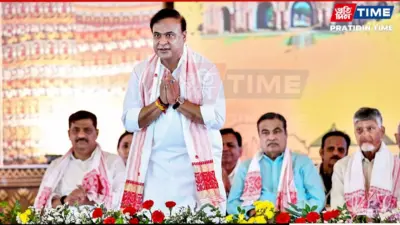

They call him "Mama", though he was once just a boy from Cotton College. Himanta Biswa Sarma arrived at the institution known as the nursery of Assam's chief ministers in 1985, became general secretary of the student union for three terms, met his wife Riniki there, and told her mother he would one day become the Chief Minister of the state.
It was a bold claim for a boy from Gandhibasti, but nearly four decades later, he has fulfilled that prophecy and exceeded it. He has demolished the very party that nurtured him, built a saffron fortress where the BJP once had no presence, and delivered the largest mandate in Assam's history. The boy who dreamed of power became the man who centralised it. The uncle, it turns out, is now also the emperor.
But the man remains an enigma: a former Congress loyalist who became the BJP's Northeast powerhouse; a chief minister whose family wealth has grown fivefold while he courts billionaires to invest in his state; a cultural nationalist who secured Classical Language status for Assamese while using inflammatory rhetoric against minorities; a welfare populist who has lifted thousands from poverty while alienating thousands more.
Himanta Biswa Sarma & Family
Himanta Biswa Sarma was born into Assam's cultural elite on February 1, 1969, at Mission Hospital in Jorhat. His father, Kailash Nath Sarma, was a revered poet and novelist in Assamese literary circles. His mother, Mrinalini Devi, was not merely a homemaker but an active literary personality associated with the Assam Sahitya Sabha, the state's premier literary organisation. The family home in Guwahati's Gandhibasti area was a gathering place for poets, writers, and intellectuals.
This upbringing explains Sarma's later ease with cultural symbolism, his push for Classical Language status, his comfort with Assamese idioms in speeches, and his ability to quote folklore while discussing policy. Unlike many politicians who adopt cultural nationalism as a strategy, Sarma imbibed it at the dinner table.
At Kamrup Academy School, where he passed his senior secondary examination in 1985, Sarma was already showing political promise. It was at Cotton College, the prestigious institution known as the "Nursery of Assam's Chief Ministers", that he found his calling and his life partner. He completed his B.A. in Political Science in 1990 and M.A. in 1994, but it was student politics that consumed him. He served as General Secretary of the Cotton College Union Society (CCUS) for three terms: 1988-89, 1989-90, and 1991-92, before becoming president in 1991. It was here he met Riniki Bhuyan, a fellow student union activist who would become his wife.
Riniki came from a prominent business family. Her father, Jadav Chandra Bhuyan, was one of Assam's leading industrialists of the 1970s-80s. While Sarma was practising law at the Gauhati High Court (after completing his LL.B. from Law College, Guwahati in 1995), Riniki had already founded Pride East Entertainments in 2003, the media company that would become the family's economic foundation.
According to past accounts, Sarma expressed his ambition of becoming Assam's Chief Minister even during his college years, a bold claim Riniki relayed to her mother; nearly three decades later, it came true. They married in 2001, the same year Sarma entered the Assembly, merging political ambition with media power and business acumen, a combination that would prove decisive in his later career.
The couple has two children, son Nandil Biswa Sarma, educated at The Doon School, and daughter Sukanya Sarma, who attended Mayo College Girls School and now helps her mother with the family businesses. Despite his political prominence, the family maintains a relatively private personal life, with Sarma making time for family during festivals even amid his hectic schedule.
The Congress Years and the Great Betrayal
For 14 years, Sarma was the Congress's most visible face in Assam. He won consecutive elections in 2001, 2006, and 2011, becoming a minister in Tarun Gogoi's cabinet and the party's heir apparent. But by 2014, the relationship had soured. The rift began in 2011, when Gogoi's son Gaurav Gogoi entered politics and won the Kaliabor Lok Sabha seat in 2014. Sarma saw his own path to chief ministership blocked by dynastic succession.
The rebellion exploded in July 2014. According to his own later admissions, 58 Congress MLAs had backed him to replace Gogoi. Sonia Gandhi, then Congress president, reportedly backed Sarma as the replacement. But Rahul Gandhi intervened personally, meeting Sarma with central observers present, and rejected the move. Sarma would later describe Rahul's response as "arrogant", telling him that organisational elections mattered more than MLAs' wishes.
On July 21, 2014, Sarma resigned from all ministerial positions, taking 32 MLAs with him. For 13 months, he remained a Congress MLA in name only, negotiating with the BJP while publicly maintaining loyalty.
The BJP's "Saga of Scams" booklet in July 2015, naming him a "prime suspect" in the Louis Berger bribery case, was likely a negotiating tactic to lower his price. A month later, on August 23, 2015, he walked into Amit Shah's residence and joined the very party that had called him corrupt.
The Northeast Chanakya
As convenor of the North East Democratic Alliance (NEDA) from May 24, 2016, Sarma proved his mettle as a political strategist. He delivered state after state to the BJP fold: Arunachal Pradesh with a BJP government, Manipur with a BJP government, Tripura ending 25 years of Left rule, Nagaland with BJP as part of the ruling coalition, and Meghalaya with BJP in the coalition.
His method was a mix of alliances, micro-management, and engineering defections. In Tripura, he dismantled the Left fortress by poaching leaders and mobilising tribal communities. In Manipur, he stitched together fragile coalitions. His reputation rests on booth-level management, maintaining databases of every booth inAssam, knowing caste composition, local grievances, and influential families in each.
A party colleague described his working style to Open Magazine: "Himanta works like a man possessed; his meetings run into the wee hours of the morning... What truly impresses is his connect with ordinary people and voters; he keeps an open house." He begins his day early, tours extensively, and maintains direct access to ordinary workers, a rarity among chief ministers.
People began calling him the "Chanakya of the Northeast", the ancient Indian strategist known for his cunning and statecraft. By 2021, when he became Assam's 15th Chief Minister, Sarma was arguably the BJP's most powerful regional leader.
The Fortunes of Power
Sarma's political climb has coincided with significant growth in his family's wealth. According to his 2026 election affidavit, the combined net worth of Sarma and his wife stands at Rs 35.16 crore, more than double the Rs 17.27 crore they declared in 2021, and a fivefold increase from Rs 6.38 crore in 2016.
The Chief Minister personally owns only movable assets valued at Rs 2.36 crore in 2026, up from Rs 1.72 crore in 2021. He possesses no land and no vehicle in his name. His income stems primarily from his government salary, with ITRs showing annual earnings between Rs 12 lakh and Rs 31 lakh between 2021 and 2025. In 2024-25, he earned Rs 29,62,920.
Riniki Bhuyan Sharma controls the vast majority of the family's assets. Her holdings increased from Rs 16.19 crore in 2021 to Rs 32.79 crore in 2026, over 93% of the couple's combined wealth. Her income from Pride East Entertainment has risen from Rs 2.96 crore in 2021-22 to Rs 4.19 crore in 2024-25. The media company reported revenues of Rs 92.4 crore for FY 2024-25. The media company reported revenues of Rs 92.4 crore for FY 2024-25.
She owns over 22,000 square feet of land in Guwahati through Swarna Valley Developers, a jeep valued at over Rs 21.60 lakh, and has business interests extending into tea estates, luxury hospitality through Vaani Greens resort in Kaziranga, and a school (Vanya International).
Most recently, the Congress had alleged that Riniki holds multiple foreign passports from UAE, Egypt, and Antigua and Barbuda, with undeclared assets abroad including properties in the UAE and a company in Wyoming. She denied these charges and filed an FIR against Congress leader Pawan Khera in April 2026. The charges remain unsubstantiated.
The Welfare Populist
The Orunodoi Scheme, launched in 2020 as Assam's flagship direct benefit transfer programme, has undergone three expansions under Sarma's watch, each timed strategically before elections. Originally providing Rs 830 per month to select beneficiaries, Orunodoi 2.0 increased the amount to Rs 1,000 and expanded coverage to 24 lakh women. In September 2024, Sarma launched Orunodoi 3.0, hiking the monthly transfer to Rs 1,250 and expanding coverage to 37-47 lakh beneficiaries, making it Assam's largest post-independence welfare scheme.
In March 2026, just months before the assembly elections, he disbursed a lump sum of Rs 9,000 each to 40 lakh beneficiary families, injecting nearly Rs 3,600 crore into rural households in a single day.
The results are quite measurable: Assam's multidimensional poverty rate declined from 32.67% in 2015 to 14.47% in 2024. Sarma attributes this largely to DBT schemes like Orunodoi, which he claims have been more effective than previous Congress-era programmes because beneficiaries now have bank accounts and Aadhaar.
The NijutMoina Scheme, launched in 2024 to curb child marriage and boost girls' enrolment in higher education, demonstrates Sarma's targeting of women voters. With an outlay of Rs 1,500 crore over five years, the scheme aims to cover 10 lakh girl students. In 2024-25, over 1.60 lakh girls received Rs 240 crore in stipends: Rs 1,000 monthly for higher secondary students, Rs 1,250 for undergraduates, and Rs 2,500 for post-graduates, translating to Rs 25,000 annually for PG students.
NijutMoina 2.0, launched in 2025, expanded coverage to over 4 lakh girls. The companion NijutBabu Scheme targets 1.20 lakh boys, up from 50,000 in its first year.
Other initiatives include SwanirbharNaari, launched in January 2022, which aims to make Assamese weavers self-reliant. Free electricity up to 30 units for all households has resulted in 17.6% of solar households paying zero bills under the PM Surya Ghar-MuftBijliYojana. The government has also digitised 1.1 lakh new cards for Old Age and Widow Pension.
Sarma's welfare architecture actually serves dual purposes: poverty alleviation and vote bank consolidation. By targeting women, who form the majority of Orunodoi beneficiaries and NijutMoina recipients, he has created a direct financial relationship between the state and female voters that bypasses traditional patriarchal structures. The lump sum disbursals before elections, the expansion of beneficiary lists, and the visible branding of schemes with the Chief Minister's name all suggest a politician who understands that welfare works best as both policy and politics.
The Investment Magnet
The Advantage Assam 2.0 Investment and Infrastructure Summit in February 2025 secured commitments totalling Rs 4.91 lakh crore from India's largest industrial houses, with over 14,500 participants including delegates from 76 countries.
The Tata Group emerged as the largest investor with commitments exceeding Rs 82,000 crore. The flagship project is a Rs 27,000 crore semiconductor assembly and test facility at Jagiroad, India's first indigenous OSAT plant, which will produce 48 million chips daily, generate over 27,000 jobs, and is expected to be operational by mid-2025. The project has secured Rs 14,044 crore in government incentives. Additionally, Tata committed Rs 25,000 crore for electronics and mobile manufacturing and Rs 30,000 crore for renewable energy through Tata Power.
The Adani Group committed Rs 50,000 crore spanning airports, aerocities, city gas distribution, power transmission, cement manufacturing, and road construction. Specific projects include expanding Lokpriya Gopinath Bordoloi International Airport, developing a Guwahati aero-city, establishing city gas grids and EV charging infrastructure, and expanding Ambuja and ACC cement manufacturing. Gautam Adani has already begun honouring these commitments, with Sarma publicly acknowledging the progress in late 2025.
Reliance Industries matched Adani with Rs 50,000 crore in commitments. Vedanta Group, through Cairn Oil and Gas, committed Rs 50,000 crore over three to four years for oil and gas exploration in Assam and Tripura. The company has already drilled six exploration wells in fiscal year 2025, announced its first oil discovery from the Rudra-1 well, adding approximately 6 million barrels of oil equivalent, and is advocating for Assam to be recognised as a "world's mega basin" for hydrocarbons.
The government sector contributed Rs 78,000 crore in infrastructure commitments, including a mega urea fertiliser plant, a rail coach factory, expressways, and an ambitious underwater tunnel beneath the Brahmaputra River. The Kaziranga Elevated Corridor is already under construction.
Sarma projects Assam's economy to reach $143 billion by 2030, up from $69 billion in 2024. In 2024 alone, the state secured $4 billion in private investment, the highest ever recorded. He has personally courted investors in Japan and held multiple meetings with Jeet Adani to fast-track projects, even as he admits the summit's "full potential" will only be realised in 2026-27.
Whatever criticisms may be levelled against Sarma's politics or personal conduct, the scale of investment flowing into Assam under his chief ministership is unprecedented in the state's history. Previous governments talked about development; Sarma has brought India's largest conglomerates to Assam's doorstep with commitments that dwarf anything seen before.
The Cultural Nationalist
In October 2024, Sarma secured Classical Language status for Assamese, a decades-old demand previous governments could not fulfil. The Union Cabinet approved the designation on October 3, 2024, triggering "Bhasha Gourab Saptah" (Language Pride Week) from November 3-9, 2024, with statewide celebrations honouring Assamese scholars.
Sarma has systematically pushed for Assamese dominance in public life. Following February 2025 meetings with AASU, he announced compulsory Assamese education in all schools, including English-medium institutions. Beginning the Bohag month, Assamese became the compulsory official language for all government notifications, orders, and acts, ending English and Bengali dominance in bureaucracy. Proficiency in Assamese is now mandatory for government jobs, effectively barring many Bengali-speaking Muslims from state employment.
He has urged non-Assamese residents to embrace Bihu traditions, wear the gamusa, and participate in Assamese festivals rather than merely donating to functions. "Stop donations, embrace Bihu culture," he told minority communities, framing cultural assimilation as the price of belonging.
His UNESCO initiatives reveal broader ambition. Following the Charaideo Moidams' World Heritage recognition in 2024, his government is pursuing Intangible Cultural Heritage status for Bihu and nominations for the Rangpur-SivasagarAhom capital and Majuli island.
Whether this cultural nationalism preserves Assam's heritage or impoverishes it by closing it off remains the unanswered question. What is certain is that Sarma has made Assamese identity central to state politics in ways no previous chief minister attempted, a legacy that will outlast his tenure even if its consequences remain contested.
The Bulldozer and the Briefcase
Sarma's governance combines welfare largesse with hardline enforcement that critics call discriminatory, and supporters call necessary. The eviction drives have been relentless: over 1.5 lakh bighas of land cleared since 2021, with 5,300 bighas reclaimed specifically in Dibrugarh and Tinsukia districts. The Kamrup Metropolitan administration cleared 1,320.60 bighas, Kamrup Rural 1,788.03 bighas, Hailakandi 1,960.78 bighas, and Nalbari 863.84 bighas. During the 2026 campaign, Sarma promised to evict encroachers from five lakh bighas (over 1.65 lakh acres) if returned to power, a threat carried out with bulldozers and police battalions that mostly affected Bengali-speaking Muslim settlers.
The "Miya" rhetoric has been systematic, with Sarma asking BJP workers to file mass complaints against Bengali-origin Muslims in voter lists, declaring in January 2025 that four to five lakh "Miya" voters would be removed and stating ", it is my job to make them suffer." He told them to "cast their vote in Bangladesh, not India," and claimed that "no matter how much money is offered, be it Rs 10,000 or Rs 1 lakh, a Muslim voter would never choose me." The Supreme Court declined to intervene against his remarks.
Other inflammatory statements include his August 2024 accusation that the University of Science and Technology Meghalaya engaged in "flood jihad," his earlier suggestion as health minister that "cancer is divine justice" for sins committed in past lives, and his November 2024 speeches in Jharkhand that led the INDIA bloc to file complaints for "inflammatory and divisive" rhetoric. In February 2026, the BJP's Assam unit posted a video edited to suggest Sarma shooting at two visibly Muslim men while slogans like "No mercy" and "Foreigner free Assam" played across the screen.
The cumulative effect of evictions, voter list purges, and sometimes shocking statements is a restructuring of Assam's social contract. Sarma calls this protection of indigenous rights, but his critics call it apartheid by another name. History will judge which description endures.
The Force To Be Reckoned With
Despite, or because of, these contradictions, Sarma delivered the BJP's most decisive victory in May 2026.The campaign revealed Sarma's electoral machinery at full throttle. Targeting women and youth voters specifically, the BJP's digital team flooded social media with memes and Gen Z-focused imagery projecting "Mama" as protector of indigenous culture. The Rs 9,000 Orunodoi lump sum disbursed barely a month before polling ensured higher women voter turnout that broke decisively for the BJP.
Prime Minister NarendraModi addressed four rallies in Assam; Home Minister Amit Shah addressed six. Their presence signaled that Assam mattered nationally, and that Sarma mattered to them. At the oath-taking ceremony on May 12, 2026, both Modi and Shah attended, cementing Sarma's position as the BJP's most indispensable regional leader after Yogi Adityanath. Sarma had already begun expanding his national footprint, campaigning in West Bengal immediately after the Assam victory to consolidate Hindu votes there.
In the election, he gained 1,27,151 votes in Jalukbari, defeating his nearest rival by 89,434 votes, a margin that demonstrated his individual dominance in a constituency he has held since 2001. The BJP won 102 seats, crossing the 100-mark for the first time in Assam's history. Sarma's "hat-trick with a century" speech was aimed as much at Delhi as at Dispur.
Moreover, his national ambitions have been carefully managed. In 2019, PM Modi and Shah dissuaded him from contesting LokSabha polls, asking him to remain in Assam instead. The decision proved wise as Sarma built the Northeast fortress that Shah's "Congress Mukt Bharat" agenda required. Today, party leaders acknowledge that apart from PM Modi and Shah, the most demanded campaigners are Yogi Adityanath and Sarma. He has also forged personal connections with Union Cabinet ministers, Shivraj Singh Chouhan, DharmendraPradhan (now former), JualOram, Annapurna Devi, by campaigning in their constituencies outside the Northeast.
The BJP wanted a Northeast fortress but got a feudal lord instead. HimantaBiswaSarma has personalized power to the point where the machinery runs on his memory, his relationships, his nickname. The party can replace chief ministers but it cannot replace him.
Were he ever to walk away from the ruling BJP, the seven states he delivered might reconsider their allegiance and walk with him too. But that scenario remains theoretical. This is a man who joined the BJP mere months after the party branded him a "prime suspect" in a bribery scandal, who understood that power matters more than pride. Having burned the Congress bridge so completely, having built his empire within saffron walls, he has nowhere else to go. The dependency is mutual, and it seems to be permanent.
However, Sarma is no longer the asset the BJP imported from Congress in 2015. He is a force that may one day test the party's own limits.
For now, he remains Assam's "Mama", the uncle who delivers votes, investment, and welfare in equal measure. But the trajectory points upward.
Assam, for better or for worse, is being remade in his image.
: Assam's Gamosa Featured in Air India Express Cabin Crew Uniforms