
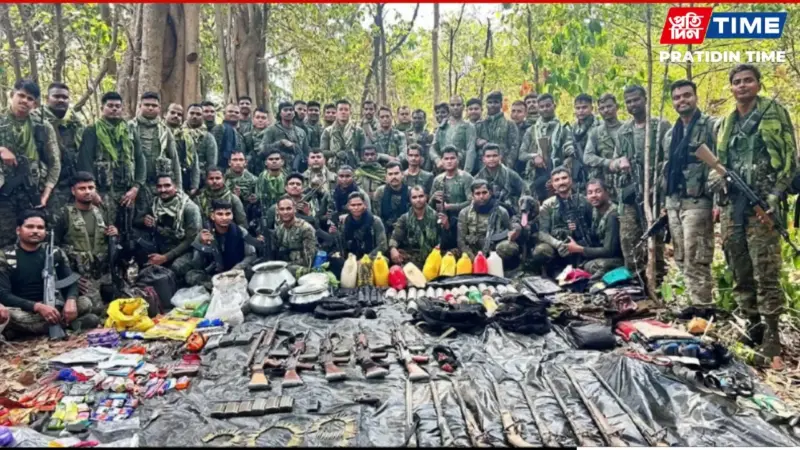

India formally announced on March 31 the end of the Naxal insurgency, closing a violent chapter of Left-Wing Extremism (LWE) that spanned over five decades across the country's tribal belt.
The declaration follows years of coordinated security operations and sustained development efforts that transformed conflict-hit regions like Bastar into zones of governance and connectivity.
What began as an agrarian uprising in Naxalbari in 1967 had evolved into one of Asia’s longest-running insurgencies. Its decline, however, has been driven not only by force but by a calibrated strategy that combined law enforcement with welfare delivery, infrastructure expansion, and administrative outreach in remote forest regions.
The shift began around 2014, when the approach towards LWE changed fundamentally. Instead of treating it purely as a security threat, authorities targeted the socio-economic gaps that had sustained insurgency networks.
This integrated strategy is now reflected in measurable gains across sectors such as healthcare, education, financial inclusion, and democratic participation. The expansion of state presence into previously inaccessible regions significantly weakened insurgent influence on local populations.
Healthcare access in core conflict districts such as Sukma and Bijapur saw a major turnaround with the establishment of a 240-bed super speciality hospital in Jagdalpur and new field hospitals closer to remote habitations. Since 2017, these facilities have treated over 67,500 patients, marking a shift from traditional and inaccessible healthcare options.
Community-level interventions also expanded, with over 70,000 grassroots health workers deployed under the Mitanin Programme. Special health camps and urban women-led initiatives further improved access to sanitation, nutrition, and healthcare awareness.
In parallel, financial inclusion expanded rapidly. Thousands of new post offices and bank branches were opened, alongside over 1,300 ATMs. Crucially, 75,000 banking correspondents were deployed to deliver services directly to villages, reducing dependence on informal lending networks.
Education infrastructure also saw unprecedented growth. Over 9,300 schools were built in LWE-affected regions, while residential schooling under Eklavya Model institutions expanded significantly. Central government schools, including Kendriya Vidyalayas and Navodaya Vidyalayas, were introduced in former insurgency strongholds.
The physical transformation of the so-called “Red Corridor” has been equally significant. More than 17,500 kilometres of roads have been constructed, breaking the geographic isolation that once enabled insurgent operations.
Telecommunication networks expanded with 9,000 mobile towers, including over 2,300 upgraded to 4G connectivity. Rail infrastructure is also advancing, with key lines connecting previously cut-off regions to the national network.
Welfare delivery indicators point to deeper administrative penetration. Housing beneficiaries under PM Awas Yojana saw a sharp rise, while employment under MGNREGA expanded notably in these districts, signalling improved governance reach.
The clearest indicator of change, however, has been voter participation. In Bastar, turnout increased from 66.04% in 2019 to 68.29% in 2024, despite a long history of election boycotts enforced by insurgents. Similar trends were recorded in neighbouring districts, reflecting growing public confidence in democratic processes.
Implementation of laws such as the Forest Rights Act has further strengthened this shift by granting land ownership rights to tribal communities, anchoring them within the formal governance framework.
India’s declaration marks not just the end of an insurgency, but the culmination of a dual-front strategy that combined security with sustained development. The transformation of conflict zones into connected, participatory regions underscores a broader lesson: long-term stability emerges not only from force, but from inclusive growth and state presence on the ground.
Amit Shah Pledges to Wipe Out Naxalism, Honours CRPF on 87th Raising Day in Guwahati