
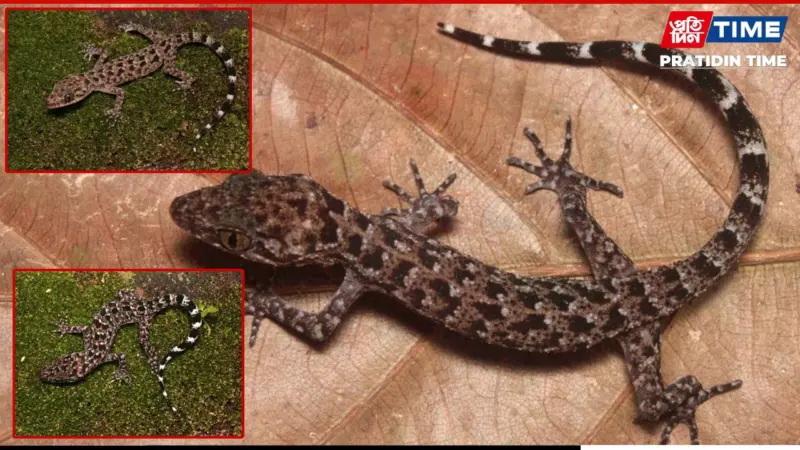

A team of Indian scientists has identified a previously unknown species of bent-toed gecko in the lowland forests of North Tripura, adding a significant chapter to the country's expanding record of reptilian biodiversity.
According to a report, the newly documented species Cyrtodactylus jayadityai was formally described in a study published on April 14 in the European Journal of Taxonomy. The research was carried out by experts from Assam, Meghalaya, Tripura, and Mizoram, highlighting the growing scientific collaboration across Northeast India.
The report said the discovery was confirmed using an integrative scientific method that combined physical examination, statistical comparison, and DNA-based analysis. These approaches established that the species is genetically and morphologically distinct from its closest known relative, Cyrtodactylus tripuraensis. Researchers recorded a mitochondrial genetic variation ranging between 4.7% and 5.2% in the ND2 gene, reinforcing its classification as a separate species.
Reacting to the development, Assam Chief Minister Himanta Biswa Sarma shared his appreciation in a Facebook post, calling it a “proud moment for Assam and the Northeast.” He noted that the discovery underscores the region’s rich biodiversity and the rising capabilities of its scientific community. “It is heartening to see our conservation efforts and scientific talent come together to bring such discoveries to light,” he wrote.
With this addition, the number of known Cyrtodactylus species in Northeast India has risen to 31, underlining the ecological richness of the region, which forms part of the globally recognised Indo-Burma biodiversity hotspot.
The report further stated that the species has been named in honour of noted Indian herpetologist Dr Jayaditya Purkayastha, acknowledging his long-standing contributions to reptile research and conservation efforts in the region.
Members of the research team described the naming as a tribute to a mentor whose work has inspired a generation of young scientists. Co-author Rupankar Bhattacharjee said the recognition reflects both gratitude and respect for Dr Purkayastha’s dedication to the field, particularly his emphasis on conservation.
Lead author Sanath Chandra Bohra noted that the discovery carries wider environmental significance. He stressed that findings like this not only expand scientific understanding but also draw attention to the urgent need to preserve fragile forest ecosystems that are increasingly under threat.
The report added that the newly identified gecko has been provisionally classified as “Data Deficient” under the IUCN Red List, indicating that more field studies are required to assess its population status and distribution.