




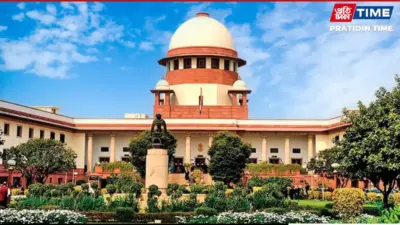

The Supreme Court has ruled that cases involving the trafficking of children for commercial sexual exploitation can be prosecuted under the Protection of Children from Sexual Offences ( POCSO) Act, along with relevant provisions of the Bharatiya Nyaya Sanhita (BNS) and the Immoral Traffic (Prevention) Act (ITPA).
According to the report, Delivering its order on May 29, a Bench comprising Justices J B Pardiwala and R Mahadevan issued a set of detailed directions aimed at strengthening the legal response to human trafficking, ensuring victim protection, and improving rehabilitation mechanisms for survivors.
The court clarified that the concept of consent has no legal validity in cases involving child victims of trafficking. It further observed that even in situations involving adult victims, consent cannot be used as a defence when exploitation is carried out through coercion, threat, deception, fraud, abuse of authority, or exploitation of vulnerability.
Reiterating a key principle, the Bench noted that “lack of consent is not an essential element of the offence of trafficking in persons.” It stressed that investigations must focus primarily on the intent and actions of traffickers rather than claims suggesting voluntary participation by victims.
The judgment also highlighted that individuals who may initially believe they are entering the sex trade can still be considered victims of trafficking if they were misled about the nature or conditions of their work and later subjected to exploitation.
Referring to Article 23 of the Constitution, which prohibits human trafficking and forced labour, the court underlined that the provision applies both to state actors and private individuals involved in exploitative practices.
The Bench further stated that when the victim is a child, and the offence falls within the scope of POCSO, charges must be framed under the special law. It was observed that the Act ensures child-sensitive procedures for reporting offences, recording statements, and conducting medical examinations, reinforcing stronger safeguards for minors.
The ruling came in response to a petition filed by the NGO Prajwala, which sought enhanced legal measures to tackle human trafficking and improve protection for victims of commercial sexual exploitation.
The court also emphasised that trafficking cases must not be examined through a single law in isolation. Instead, investigating agencies must apply all relevant legal provisions after carefully assessing factors such as the victim’s age, the methods used by traffickers, and the circumstances of exploitation.
On rehabilitation, the Bench observed that rescue operations alone are insufficient if survivors are not supported in rebuilding their lives. It stressed that effective rehabilitation is essential to uphold constitutional guarantees of dignity, life, and freedom from exploitation under Articles 21 and 23.
Assam CM Meets Rajnath Singh, Pushes Defence Industry Expansion Plans