




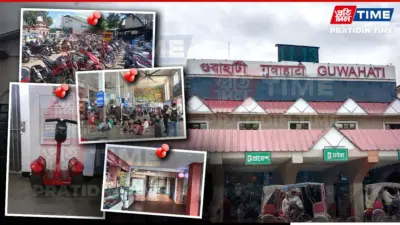

Guwahati: Every day, between 56,000 and 57,000 people pass through Guwahati railway station. That is roughly the population of a small town moving through one building, day after day and year after year.
For most passengers, Guwahati Railway Station is not their final destination. It is simply a point between where they have from and where they have to be. However, the experience inside the station, whether before boarding a train or after getting off one, often becomes an important part of the journey itself.
Guwahati railway station is classified as an A-grade station, a category meant for some of the busiest and better-equipped railway stations in the country. The classification carries expectations of infrastructure and passenger services. However, the experience at the station can vary, with some facilities making travel easier while certain basic requirements continue to draw complaints.
One of the key facilities available at the station is drinking water. The railway department itself operates an RO water system for passengers. In addition to this, a water ATM has been installed at the station, providing access to purified and chilled drinking water. The machine allows passengers to obtain water through a QR code or by inserting a coin. According to the information displayed on the machine, one litre of chilled drinking water is available for Rs 5, while the facility also mentions a Rs 20 option for one litre of chilled water. A toll-free number is displayed on the machine for passengers who face problems while accessing the facility.
While the water ATM offers an additional option for passengers seeking chilled drinking water, the fact that it is a paid facility may raise questions about convenience for passengers when the station also has RO drinking water arrangements. For travellers looking for basic drinking water, having to pay for an additional facility may not always be seen as necessary.
Officials point to such arrangements as part of the station's efforts towards passenger welfare. Parking facilities have also expanded. According to the report, when all sections of the station's parking areas are taken together, they can accommodate more than 100 four-wheelers. The expansion reflects the large number of private vehicles that bring passengers to and pick them up from the station, instead of passengers depending entirely on public transport.
Passenger information is another area where the station has invested. Four large digital displays have been installed at different locations, providing live train information. These displays help passengers keep track of platform numbers, delays, and train arrival details, reducing uncertainty for people waiting for their trains. Cleanliness at the station is managed through a contract system. Private agencies are responsible for maintaining platforms, waiting areas, and washrooms. The station also has 36 stalls located across its inside and outside sections. These stalls provide travellers with snacks and other everyday items they may need before boarding a train.
Accessibility has also been addressed through several facilities. The station's entrances have wheelchair ramps, allowing passengers using wheelchairs to enter and leave without assistance. Lifts are also available for passengers who cannot use stairs.
For visually impaired passengers, tactile pavement and tiles have been laid along important walkways. These raised and textured surfaces are designed to help blind and low-vision passengers move around the station using a cane or by feeling the surface under their feet. Taken together, these arrangements show an effort to make the station accessible to more than just the able-bodied majority and provide support to passengers who require assistance while moving through the station.
Retiring Rooms and Waiting Facilities
Guwahati railway station also provides several accommodation options for passengers who need to stay at the station during long waiting periods or overnight journeys. There are three deluxe air-conditioned retiring rooms. These rooms come with free Wi-Fi, a television, a locker, and a charging point.
Apart from these, the station has two more air-conditioned retiring rooms and two non-air-conditioned retiring rooms with similar facilities, apart from the higher-level comforts associated with the deluxe rooms. Another two non-AC retiring rooms are also available. For passengers looking for a cheaper option, the station has one non-AC dormitory equipped with free Wi-Fi, television and locker facilities. At the top end of the accommodation arrangements is a reserved VIP lounge, which is available to passengers who qualify for access.
On paper, the range of facilities suggests that the station has addressed many of the basic requirements of passengers. For several regular travellers, the experience also appears to match that impression. A passenger from Mizoram, who said he has been travelling to Guwahati for business for more than 30 years, compared the station with railway stations he has used across northern and central India.
According to him, the facilities at Guwahati railway station are better than those at most stations in northern and central India. He also said that he was particularly impressed by the cleanliness maintained at the station over the years. For someone who has travelled to Guwahati regularly for three decades, the observation offers a perspective on how the station has changed and how its facilities have been maintained over time.
Basic Needs Still Draw Complaints
Despite the facilities available, the experience is not the same for every passenger. Some of the complaints are linked not to major infrastructure but to everyday needs that passengers encounter during their journey. One passenger pointed to the availability of affordable staple food inside the station.
He said that he and many other passengers are accustomed to eating rice as a staple meal, or at least roti. However, most of the stalls inside the station primarily offer snacks, sandwiches, or biryani. His concern was that passengers travelling long distances should have easier access to affordable and familiar food. For someone looking for a simple and filling meal, packaged snacks or a single heavy dish may not always be a suitable option.
Toilet facilities have also emerged as a concern, although this observation came from a stall owner rather than a passenger. According to him, there are enough toilets along platform number 1, but the same level of access is not available across the other platforms. He said that because of the shortage on some platforms, passengers often end up using toilets inside trains while the trains are still standing at the station.
Such use can be illegal or may attract a fine depending on the railway network and the type of toilet system installed on the particular train. The practice, however, points to passengers finding their own alternatives when basic facilities are not equally available across the station.
Free Wi-Fi, another modern facility promoted at the station, has also received criticism from passengers. One passenger said the login process itself is difficult and that the connection generally does not work even after completing the login process.
The complaint becomes particularly relevant because free Wi-Fi is also listed among the facilities available in the retiring rooms and dormitory. For passengers waiting for trains, checking updates, or simply trying to remain connected during a long stay at the station, unreliable Wi-Fi reduces the usefulness of the facility.
The different experiences at Guwahati railway station present a mixed picture.
The station has made visible progress in areas such as cleanliness, parking, digital passenger information, accessibility, and accommodation. These are facilities that can be clearly seen and measured. At the same time, some of the smaller and more basic requirements remain uneven. Affordable food that reflects the eating habits of ordinary passengers is one such concern. Toilet access across all platforms is another. The availability of Wi-Fi may be listed as a facility, but passengers say its practical use can be difficult.
Technology-Driven Security System Keeps Guwahati Station Under Watch
Guwahati Railway Station OC Manohar Prasad, while speaking to Pratidin Time, said that the security arrangements at the station have evolved with the changing times and the introduction of modern technology. He said passengers are frisked using modern security systems, including X-ray baggage scanners similar to those used at airports. Suspicious baggage identified during scanning is checked manually, while Handheld Metal Detectors (HMDs) are also used for frisking. The intensity of security checks is increased during occasions such as January 26, August 15, Durga Puja, fairs and other periods when passenger movement is high.
Prasad said the station also has a CCTV-based network surveillance system covering all seven platforms, with a dedicated control room monitoring activities. CCTV footage is backed up for three months, which helps security personnel trace incidents reported by passengers, identify suspects and pursue them for recovery of stolen belongings. He said drones have also been provided for surveillance of the large railway yard, which has 29 tracks and numerous parked coaches. The drones can be used for aerial surveys, photography and video recording, particularly in areas that are difficult to access or are identified as blind or doubtful spots. The surveillance system is complemented by night vision devices, which help personnel monitor suspicious activity in dark or poorly lit areas.
The OC further told Pratidin Time that passenger awareness is an important part of the security system, particularly because Guwahati Railway Station receives passengers from across the Northeast, including Assam, Manipur, Nagaland, Mizoram, Tripura and Arunachal Pradesh. To overcome language barriers, awareness posters have been prepared in six languages: Assamese, Bengali, Manipuri, Mizo, English and Hindi. The posters advise passengers to keep their belongings secure, avoid accepting food or other items from strangers, and remain careful with their bags, laptops and other valuables. Six audio clips in different languages are also played through a public-address system, while awareness videos featuring RPF personnel have been produced in-house. Standees and regular PA-system announcements are also used to spread safety messages among passengers.
Prasad also highlighted the use of Segways for patrolling and public awareness, saying the battery-powered vehicles allow security personnel to move across platforms efficiently while also attracting passengers' attention. During periods of heavy rush, such as Durga Puja, Ambubachi Mela, Chhath and Diwali, the station follows planned access-control, crowd-management and evacuation arrangements. Holding areas are used when necessary to regulate passenger movement and release crowds gradually. For crime prevention and detection, the station has a Crime Prevention Detection Squad (CPDS), which has been involved in apprehending criminals and recovering items including mobile phones, laptops, gold and cash. The station also has a dog squad comprising sniffer and tracker dogs, as well as a maintained criminal database and dossiers that can assist in identifying suspects. According to Prasad, the overall security system combines traditional policing with modern technology to strengthen surveillance, crime prevention, passenger safety, and emergency crowd management at Guwahati Railway Station.
Menstrual Hygiene Vending Machine
The station has also made provisions aimed at improving menstrual hygiene for women passengers. A menstrual hygiene vending machine has been installed at Guwahati railway station, allowing women to access sanitary products when required. Such a facility can be particularly useful for passengers travelling long distances or those who may unexpectedly need menstrual hygiene products while waiting for or changing trains. The availability of the vending machine adds another aspect to the station's passenger-oriented facilities, particularly in addressing a basic need that can often be overlooked in busy public spaces.
For a station through which 56,000 to 57,000 people pass every day, these details matter.
The experience of a railway station is not determined only by trains, platforms, or large infrastructure. Cleanliness, toilets, parking, accessibility, waiting spaces, signage, and passenger safety are the everyday factors that shape how people experience their journey. Guwahati railway station appears to have invested significantly in several of these areas. Its digital displays provide information, its parking facilities have expanded, cleanliness is managed through private agencies, accessibility has been improved, and passengers have several options for resting during long waits.
But the experience also shows that infrastructure does not always answer every everyday need.
A passenger may have access to a digital display and a VIP lounge, yet still struggle to find an affordable, familiar meal. Another may find a toilet on one platform but have difficulty accessing one on another. A passenger may also see free Wi-Fi advertised as a facility but find the service difficult to use. For the tens of thousands of people who pass through Guwahati railway station every day, these may appear to be small issues. Yet they are often the very things that determine whether a journey through the station feels comfortable or frustrating.
: After Japan PM Visit Cancelled, What Happened to Guwahati's Beautification Drive?