




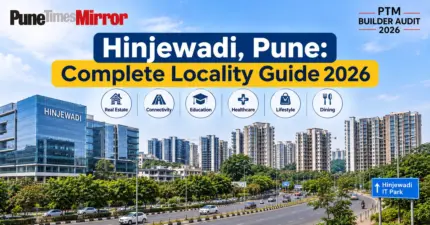

Property prices, IT employment, Phase 1, Phase 2 and Phase 3, connectivity, Metro Line 3, schools, healthcare, rentals and what different budgets can buy
Hinjewadi is unlike most residential localities in Pune.
It is not simply a suburb where people live.
It is one of the city's most important employment destinations.
The development of the Rajiv Gandhi Infotech Park transformed what was once a predominantly rural area into one of Pune's largest IT and business corridors. STPI Pune describes the Rajiv Gandhi Infotech Park at Hinjawadi as a major IT cluster and says the wider STPI-Pune jurisdiction contributed ₹1.83 lakh crore in IT/ITeS/ESDM exports in FY 2023-24.
That employment base has, in turn, created a huge residential ecosystem around Hinjewadi.
Today, the Hinjewadi market includes apartments, gated communities, rental housing, hotels, restaurants, schools, hospitals, retail and commercial developments.
But there is an important distinction.
Hinjewadi is not one locality in practical terms.
Phase 1, Phase 2 and Phase 3 can offer very different living experiences.
For a homebuyer, therefore, the important question is not simply:
"Should I buy in Hinjewadi?"
It is:
"Which phase, which pocket, which project and which commute works for me?"
Housing.com currently reports an average Hinjewadi property price of approximately ₹9,139/sq ft, with a displayed range of ₹4,403-₹14,018/sq ft. Magicbricks' October 2026 dataset reports an average multistorey apartment price of approximately ₹8,601/sq ft, with its locality range running from approximately ₹6,782 to ₹10,420/sq ft. These are portal datasets and should not be treated as registered transaction values.
Hinjewadi lies on the western side of the Pune metropolitan region and is closely connected with the Wakad-Balewadi-Baner corridor.
Its residential catchment extends into:
The Mumbai-Bengaluru Highway provides the major regional connection towards Pimpri-Chinchwad and Mumbai.
The internal Hinjewadi roads connect the residential areas with the IT park.
This creates one of the defining characteristics of Hinjewadi:
The distance between home and office can be extremely short, but the travel time can still be unpredictable.
The transformation of Hinjewadi is closely associated with the development of the Rajiv Gandhi Infotech Park.
STPI Pune is located within the park and describes it as a major IT cluster in Pune. The organisation says the cluster has played a significant role in Pune's emergence as a major IT centre.
The employment ecosystem attracted:
The result has been a classic employment-led urban expansion.
Jobs came first.
Housing followed.
Then came the wider urban ecosystem.
For property research, PTM recommends treating the three phases separately.
Phase 1 is the most established of the three employment zones.
It contains a large concentration of offices and supporting commercial development.
Residential development around Phase 1 includes both older and newer apartment projects.
Housing.com currently reports approximately ₹9,154/sq ft for its Phase 1 dataset, with a displayed range of approximately ₹4,403-₹13,333/sq ft.
For an employee whose office is in Phase 1, living close to the workplace can be a major practical advantage.
But buyers should check the exact distance between the apartment gate and office gate.
The difference between "2 km away" and "10 minutes away" is not always the same thing in Hinjewadi.
Phase 2 contains another major concentration of employment activity and has developed a substantial residential market around it.
Housing.com currently reports an average of approximately ₹8,025/sq ft for its Hinjewadi Phase 2 dataset, with a displayed range of approximately ₹3,777-₹14,736/sq ft.
Another Housing.com dataset specifically covering apartments in Hinjewadi Phase II shows approximately ₹8,380/sq ft.
The variation between datasets itself is a useful lesson for buyers:
There is no single "Hinjewadi price."
The number changes depending on:
Phase 3 is another major employment and development zone.
It has a different character from the older Phase 1 market, with newer residential developments and substantial surrounding land still undergoing transformation.
Housing.com currently reports an average Hinjewadi Phase 3 price of approximately ₹9,090/sq ft, while its apartment-specific sub-area figure is around ₹8,331/sq ft. The portal also displays a wide range, extending up to more than ₹17,000/sq ft for individual listings.
The important point for a buyer is not which phase has the highest or lowest headline number.
It is:
Which phase gives you the best relationship between home, office, road access, amenities and future development?
Current data shows that Hinjewadi has a wide range of housing.
Housing.com currently records an average of approximately ₹9,139/sq ft across the locality.
Magicbricks reports approximately ₹8,601/sq ft for multistorey apartments in its Q3 2026 dataset.
Magicbricks' BHK data gives approximately:
| Configuration | Indicative rate range |
|---|---|
| 1 BHK | ₹5,600-₹9,000/sq ft |
| 2 BHK | ₹6,800-₹10,400/sq ft |
| 3 BHK | ₹7,000-₹11,000/sq ft |
These are market datasets, not official transaction prices.
A buyer should therefore avoid calculating a property's value simply by multiplying the advertised rate by the apartment's super built-up area.
Carpet area is the more useful comparison.
A budget-based approach is more useful for readers than a single locality average.
| Approx. budget | What buyers may encounter |
|---|---|
| ₹40-60 lakh | Smaller 1 BHKs, compact homes and selected resale/newer inventory depending on phase |
| ₹60-80 lakh | Wider selection of 1 BHK and entry-level 2 BHK properties |
| ₹80 lakh-₹1 crore | Larger 2 BHK options and selected newer projects |
| ₹1-1.5 crore | Larger/newer 2 BHKs and 3 BHK options |
| ₹1.5-2 crore | Larger 3 BHKs and premium developments |
| ₹2-3 crore | Premium/larger apartments and selected luxury inventory |
| ₹3 crore+ | Larger premium homes where available |
These are search bands rather than guarantees.
A ₹90 lakh budget can produce very different choices depending on:
The strongest reason is employment.
Someone working in the Rajiv Gandhi Infotech Park may be able to live considerably closer to work than someone living elsewhere in Pune.
That can matter enormously over a five-day working week.
A second reason is housing choice.
Hinjewadi has a large number of apartment developments, ranging from relatively compact homes to large gated communities.
A third factor is the surrounding western Pune ecosystem.
Wakad, Balewadi, Baner and Tathawade are all within the broader residential and commercial catchment.
If Hinjewadi has one issue that a buyer should investigate before everything else, it is road congestion.
The employment concentration creates intense peak-hour traffic.
This is not simply a residential-locality issue. It is a regional employment-transport problem.
The Maharashtra government has recently approved a ₹426 crore initiative for traffic management and last-mile connectivity around Hinjewadi, with measures including improvements associated with the IT corridor.
For a buyer, however, proposed infrastructure should not be treated as an immediate benefit.
The correct question is:
What is my commute today, and what infrastructure is actually operational?
Metro Line 3 is arguably the most important transport project affecting Hinjewadi.
PMRDA's official project information describes the line as a 23.203-km elevated corridor with 23 stations, connecting Hinjewadi with Shivajinagar. PMRDA says the project is specifically intended to address traffic problems around Rajiv Gandhi IT Park and nearby areas.
The line is being developed through the Pune IT City Metro Rail project.
The corridor is designed to connect the employment hub with the city-side transport network.
As of the latest 2026 developments, the first section towards Baner/R.K. Laxman Museum has received safety authorization, while the entire corridor has not yet become a fully operational metro service. Current reporting says the full corridor has faced delays, with the latest target extending into 2026-27.
This distinction is important.
Property advertisements may describe Metro Line 3 as if it is already a fully functioning corridor.
A PTM buyer should verify the actual operational status of the station relevant to the property before making a purchase decision.
If fully commissioned, the metro could provide an alternative to road-based commuting between Hinjewadi and the city.
For residents, that could mean:
But PTM would avoid making a simplistic claim such as "Metro will increase property prices by X%."
Property prices are affected by many variables.
Metro connectivity is one of them.
Hinjewadi's residential market is inseparable from its employment ecosystem.
The Rajiv Gandhi Infotech Park houses a major concentration of IT and technology-related businesses.
The official STPI Pune site describes the park as a major IT cluster and notes its role in Pune's software and technology ecosystem.
For residential buyers, this creates an important structural advantage:
The people buying or renting homes are often living close to their place of employment.
That supports both end-user demand and rental demand.
However, the employment market can also evolve.
Companies can change office footprints, hybrid-work policies and commuting patterns.
Therefore, property decisions should not depend entirely on the assumption that today's office geography will remain unchanged for decades.
The wider Hinjewadi catchment has a growing education ecosystem.
Examples include:
VIBGYOR High School, Hinjewadi, which is located near the Bhumkar Das Gugre Road/New MIDC Road area. VIBGYOR High School, Hinjewadi
Mahindra International School, located in Rajiv Gandhi Infotech Park Phase 1. Mahindra International School
Blue Ridge Public School, located in the Phase 1/Hinjewadi area. Blue Ridge Public School
There are also schools in the surrounding Balewadi, Wakad, Tathawade, Mahalunge and Nande catchments.
For families, school selection should be based on curriculum, fees, admissions, transport and actual morning travel time rather than distance measured in kilometres.
Healthcare infrastructure has expanded alongside the residential population.
Facilities in the wider Hinjewadi area include:
Ruby Hall Clinic - Hinjawadi
Hinjawadi Superspeciality Hospital - Advanced ICU & Multispeciality Care, Pune
Sanjeevani Multispeciality Hospital
There are also several smaller speciality and general-care facilities.
For a family buying a long-term home, healthcare should be considered at two levels:
Everyday healthcare: clinics, pharmacies and general practitioners close to home.
Emergency and tertiary care: larger hospitals accessible by road.
The second category is especially important because traffic can affect actual emergency travel time.
Hinjewadi's original identity was commercial and employment-oriented.
Its lifestyle ecosystem has now expanded significantly.
Restaurants, cafes, hotels, supermarkets, gyms and entertainment businesses have developed around the IT park and residential areas.
The area has a strong weekday population and a significant young professional demographic.
Examples include restaurants and hospitality establishments around Phase 1 and the Hinjewadi-Wakad corridor.
For residents, this means many daily requirements can be met locally.
But Hinjewadi's lifestyle ecosystem is still different from established central Pune neighbourhoods.
Someone seeking an old-city cultural environment, traditional markets or mature urban streetscapes may have a different experience from someone whose priority is proximity to the IT park.
Hinjewadi has a significant rental market because of its employment base.
The typical tenant profile includes:
The rental market also varies by phase.
A property closer to a major employment cluster may attract a different tenant profile from a large family-oriented gated community farther away.
For investors, rental analysis should include:
Annual rent - maintenance - property tax - vacancy - repairs - brokerage/turnover
rather than simply looking at monthly rent.
The locality offers both.
Potential advantages:
But buyers should examine:
Potential advantages:
But buyers should check:
Hinjewadi has a large number of residential projects.
That makes project-level verification essential.
Before booking a property, check:
Do not rely exclusively on a brochure or sales presentation.
The registered project documents are the more important reference point.
Hinjewadi demonstrates a common pattern in fast-growing Indian urban areas.
Employment and housing can expand faster than supporting infrastructure.
The buyer should therefore inspect:
The exact approach road to the apartment can sometimes matter more than the distance from the property to a landmark.
This is not a ranking.
It is a way of showing why a buyer should not treat the three phases as interchangeable.
Again, the purpose is not to declare a winner.
The purpose is to help a buyer understand the trade-offs between living inside the employment hub and living in the neighbouring residential markets.
This is the most obvious group because the employment ecosystem is located here.
Families can find substantial residential communities, schools and healthcare facilities within the wider catchment.
The large supply of apartments creates multiple entry points across different budgets.
The employment base supports a large tenant population.
Hinjewadi's rental ecosystem and employment concentration make it relevant for investment analysis, but project-level rental yield and acquisition cost should be calculated individually.
Someone working in central Pune may want to compare Hinjewadi with Baner, Balewadi or Aundh.
Someone working in Phase 1 may compare an apartment within Hinjewadi with Wakad.
Someone working in Phase 3 may compare properties in Marunji, Maan, Tathawade or nearby western Pune locations.
A family prioritising established schools may want to compare the actual school commute from several localities.
The correct comparison is therefore not:
Hinjewadi vs another locality.
It is:
Home + workplace + school + budget + commute + infrastructure.
Before buying, PTM recommends a simple checklist.
1. Identify the phase.
Phase 1, Phase 2 and Phase 3 should be treated separately.
2. Identify the exact pocket.
"Near Hinjewadi" is not enough.
3. Test the office commute.
Drive at your actual working hours.
4. Check the approach road.
The last kilometre can be the most frustrating kilometre.
5. Check water supply.
Speak to existing residents.
6. Check power backup.
Especially for high-rise developments.
7. Check the project documents.
Use MahaRERA rather than relying solely on marketing material.
8. Check carpet area.
Compare like with like.
9. Check future construction.
Look beyond the current view.
10. Check school travel time.
Morning traffic can transform a short distance into a long commute.
11. Check maintenance.
Large gated communities can have substantial recurring costs.
12. Calculate total ownership cost.
Purchase price is only the beginning.
Locality: Hinjewadi / Hinjawadi, Pune
Primary character: IT employment hub + large residential market
Major employment centre: Rajiv Gandhi Infotech Park
Major divisions: Phase 1, Phase 2, Phase 3
Major surrounding residential markets: Wakad, Tathawade, Punawale, Marunji, Maan, Mahalunge, Balewadi
Current indicative average property price: Approximately ₹9,139/sq ft on Housing.com.
Magicbricks multistorey apartment average: Approximately ₹8,601/sq ft.
Phase 1 indicative rate: Approximately ₹9,154/sq ft on Housing.com's current dataset.
Phase 2 indicative rate: Approximately ₹8,025/sq ft on Housing.com's current dataset.
Phase 3 indicative rate: Approximately ₹9,090/sq ft on Housing.com's current dataset.
Metro: Pune Metro Line 3, Hinjewadi-Shivajinagar corridor.
Metro length: 23.203 km.
Metro stations: 23.
Primary infrastructure concern: Road congestion and last-mile connectivity.
Major future mobility factor: Metro Line 3.
Primary buyer due-diligence issue: Exact phase, project documentation and actual commute.
Hinjewadi is one of the clearest examples of how employment can reshape a city's residential geography.
The IT park created jobs.
The jobs created housing demand.
Housing created schools, hospitals, restaurants, retail and services.
And the resulting population created a new demand for better transport infrastructure.
That cycle is still playing out.
But Hinjewadi also teaches an important lesson for property buyers:
Proximity does not automatically mean convenience.
A home may be only a few kilometres from an office and still involve a difficult daily commute.
A project may have excellent amenities but poor access to the main road.
A cheaper apartment may have a longer daily travel cost.
A more expensive apartment may offer a shorter commute but higher maintenance.
And a property marketed as "Metro-connected" may still depend on a station that is not yet operational.
For this reason, PTM's approach to Hinjewadi should be more granular than a standard locality guide.
First identify the phase. Then identify the micro-market. Then identify the project. Then calculate the actual cost of living there.
That is the difference between simply searching for a flat in Hinjewadi and actually making an informed property decision.
This article uses current 2026 property-market datasets, official infrastructure information, government sources, current reporting and local-market research.
Property-price figures are primarily based on Housing.com and Magicbricks datasets and represent indicative market/listing data rather than a definitive measure of registered transaction prices.
Metro Line 3 information has been checked against PMRDA's official project information and current 2026 reporting on safety clearance, commissioning and project timelines.
Employment information has been cross-checked against STPI Pune, which identifies Rajiv Gandhi Infotech Park as a major IT cluster.
Buyers should independently verify MahaRERA records, title documents, sanctioned plans, possession status, taxes, maintenance charges and all other legal and financial information before purchasing.
Last reviewed: October 2026