
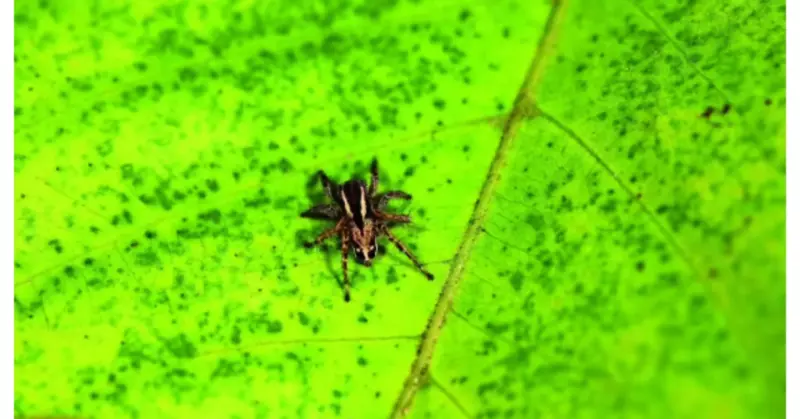

Mogrus Pune jumping spider has quietly emerged from a thorny tree in an industrial suburb of Pune and straight into the scientific record, offering a rare spark of hope for urban biodiversity.
The species was discovered on 31 May 2024 by 24-year-old environmental scientist Atharva Kulkarni during a biodiversity survey at the 20-acre Alfa Laval Biodiversity Park in Pimpri-Chinchwad, a heavily industrialised area on Pune's outskirts.
He spotted the Mogrus Pune jumping spider resting on the branches of thorny Acacia and native Apta trees, an unusual microhabitat where birds and reptiles struggle to hunt because of dense thorns.
Kulkarni collected specimens and spent six months examining their form and behaviour before concluding that the animal did not match any known species in the Mogrus genus.
"The literature on Mogrus is very poor," he explained, adding that he realised quickly this was either a very poorly known species or "an absolutely new description".
The Mogrus Pune jumping spider has now been formally described as Mogrus pune Tripathi, Kulkarni & Kadam sp. nov. in the European Journal of Taxonomy, an international peer-reviewed journal.
The holotype is housed at the National Centre for Biological Sciences in Bengaluru, placing the species in the global World Spider Catalog with India as its known range.
Taxonomists Rishikesh Tripathi and Gautam Kadam led the description process, comparing the spider's morphology with related species and confirming it as new to science.
The Mogrus Pune jumping spider shows distinct brown stripes on its head and abdomen and a vibrant overall pattern that makes it relatively easy to recognise in the field.
Back home, Kulkarni kept the Mogrus Pune jumping spider in a terrarium to study its predatory behaviour.
He fed it Drosophila flies and other small insects and found, as expected, that Mogrus Pune targets herbivorous insects commonly found on thorny trees, acting as a natural biological pest controller without harming plants.
According to Tripathi, members of the Mogrus genus typically occur in arid and semi-arid grassland landscapes, and this species is also associated with grassland patches on trees.
The discovery suggests that even fragmented city grasslands and small urban refuges can support specialised predators higher up the food chain.
This is not Kulkarni's first arachnid breakthrough.
Three years earlier he co-described another jumping spider, Okinawicius tekdi, from Baner hill in Pune, a species later highlighted by researchers as evidence of the city's rich but fragile biodiversity.
Kulkarni calls the chance of discovering any new species "like 1 per cent" and says finding Mogrus Pune jumping spider in a small, urban biodiversity park inside a heavily industrial area shows how vital such refuges are.
"For all those creatures that cannot be displaced from an urbanised environment, this proves Pune is still alive when it comes to biodiversity," he says, hoping the discovery nudges citizens and planners to protect the ecosystems that still quietly thrive on the city's edges.