




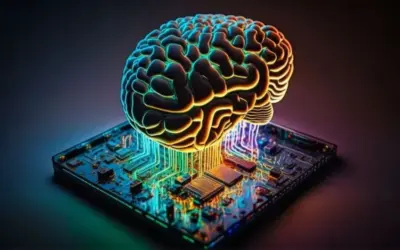

Neuromorphic chips imitate the structure of human brain
Every time we ask an AI assistant a question, a data centre burns up electricity and a precious commodity - water.
Do this a billion times a day - as we all do - and the total cost of electricity and water becomes a civilisational problem.
The silicon architectures powering today's AI were not designed for today's era. Enter neuromorphic computing, based on the idea that the best blueprint for a thinking machine is the human brain. Neuromorphic computing refers to engineering computer hardware and software that mimics the structural and functional design of the human brain. Derived from "neuro" (nerves) and "morphic" (shape), it is often called brain-inspired computing, designed to act as a "brain-like" processor
The case for silicon neurons
The human brain operates on around 20 watts of power, roughly equivalent to the energy used by a dim lightbulb. A comparable AI workload on conventional hardware can lead to usage of tens of thousands of times that energy.
Neuromorphic chips attempt to mimic the brain: spiking neural networks that fire only when there is something worth firing about, parallelism instead of sequential processing, and memory woven directly into the computation rather than shuttled back and forth to AI data centres.
Two research chips
Intel's Loihi 2 is a second-generation neuromorphic research chip designed to mimic the brain's neural structure for AI, offering up to 10x faster processing and 12x higher neuron density than its predecessor. Loihi 2 handles certain edge-computing tasks at a fraction of conventional chip energy.
IBM's NorthPole is a brain-inspired "neuromorphic" chip designed to eliminate the "memory wall" by merging processing and memory on a single piece of silicon. Announced in late 2023 and recently demonstrated in expanded large-scale systems, NorthPole is specialised for AI inference-the phase where a trained model makes predictions-rather than training.
These are early prototypes, but they are compelling enough to draw investment from semiconductor houses.
The real prize is not faster AI. It is AI that can think - on a satellite, inside a hearing aid, aboard an autonomous drone - without the need for a power cable connecting to an AI centre.
Strategic value
The race for neuromorphic supremacy is quieter than the GPU race, but more important. A chip that enables fully autonomous AI inference without cloud connectivity removes dependencies on data infrastructure - and by extension, on the nations that host it. This ensures sovereign AI capability.
The challenges ahead
* Programming a neuromorphic chip requires specialist knowledge.
* The training of spiking neural networks is under research.
* Benchmarks are inconsistent and contested.
* It may take a decade of engineering to bridge the gap between the research chip and a product that can be shipped in billions.
Solving the energy crisis of AI is the incentive that makes developing a neuromorphic chip irresistible.
Inevitable course
Neuromorphic chips will not replace conventional AI hardware next year or perhaps the year after.
But the trajectory is hard to dismiss. When the alternative is building ever more gargantuan data centres on a planet of finite resources, learning from the way the human brain has solved the efficiency problem is inevitable.
Back to the original?
Will neuromorphic chips succeed? The human brain has been running adaptive intelligence for 300,000 years without a fan or a cooling tower. Silicon has just begun trying to imitate the brain.
If neuromorphic chips come into vogue, the need for huge AI data centres will diminish. But AI will continue to suffer from defects like hallucinations and workslop. Ultimately, no AI can beat the original masterpiece - the human brain. This could well be the conclusion of scientists after some more decades of research and development of AI.